|
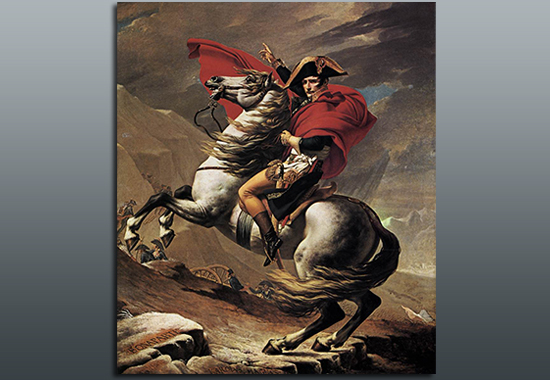
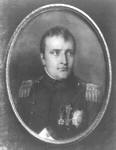
Napoleon I Bonaparte 1769-1821
Napoleon I, or in French
Napoléon Bonaparte, was a highly ambitious
career soldier with remarkable intellectual capacity and charisma.
|
|
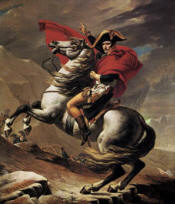
Image
Above
Napoleon I
Bonaparte
Painting by
Jacques-Louis David |
He became one of the greatest military leaders in history, Emperor
of France, and eventually a legend.
Inspired by his successful expansion of French territory and
influence, Napoleon grew increasingly megalomaniacal.
Go here for the
 Napoleonic Wars.
Napoleon's Roots
Corsica was annexed by France just three months before Napoleon’s
birth on the island. Although educated on the continent, Napoleon
later made several trips back to Corsica and became involved in
local politics.
Napoleon — Early Military Years
Napoleon achieved his early military victories at Toulon, France, and
later in Paris against revolting royalists.
Go here for more on the
French Revolution.
After launching a
brilliant military campaign against Sardinia, Italy, and Austria,
Napoleon
went on to undertake the less successful Egyptian Campaign.
A coup
installed Napoleon officially as First Consul of France or, in
effect, dictator.
NAPOLEON I
Click image to enlarge
Napoleon's Family, Siblings, and Wives
Napoleon's parents were
Charles and Letizia Bonaparte.
His
parents were from
Corsica; their original names were Carlo Maria and
Maria Letizia Buonaparte.
They had eight
surviving children:
1.
Joseph, born in 1768
2. Napoleon, born in 1769
3. Lucien, born in 1775
4. Élisa, born in 1777
5.
Louis, born in 1778
6. Pauline, born in 1780
7.
Caroline, born in 1782
8. Jérôme, born in 1784
Napoleon broke his engagement to
Désirée Clary in favor of
the widowed
Joséphine de Beauharnais. Joséphine
and Napoleon married in 1796.

Joséphine de Beauharnais
Joséphine broke his heart and he divorced her in 1810 to marry
Marie-Louise, daughter of the Austrian emperor
Francis I. It was Austrian
mastermind
Klemens
von Metternich who arranged the match.
Napoleon had one legitimate child,
Napoleon II, by Marie-Louise.
In-between, Napoleon got himself
involved with Polish countess
Maria
Walweska, which is understandable if the girl
resembled anything like Greta Garbo, who portrayed her in the 1937 movie
Conquest.
Napoleon and Maria Walewska had one
illegitimate child, Alexandre-Florian-Joseph Colonna, Comte Walewski,
born in 1810.
Napoleon — The Emperor Years
An assassination attempt
on his life prompted Napoleon to proclaim himself
Emperor of the French. He insisted on a coronation by the Pope and,
at the ceremony, took the crown out of the pope’s hands and put it
on his head himself.
Napoleon suffered defeat at the naval battle off Cape Trafalgar (see
Battle of Trafalgar), which
established Britain as dominating sea power for a century to come
and crushed Napoleon's dream of invading Britain.
In order to dismantle the
Holy Roman
Empire and give Prussia and Austria something to think
about, Napoleon created the
Confederation of the Rhine. And it worked.
Napoleon won his
greatest victory at the
Battle of Austerlitz against Austrian and
Russian forces.
He set up his relatives as rulers
over conquered European nations and made treaties with the rest.
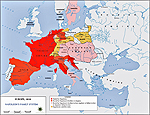
1810 Europe: Napoleon's Family System
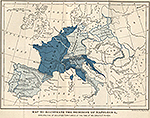
Europe 1810: Napoleon at the Height of His
Power
Against the British, Napoleon declared a
Continental Blockade to
exclude Britain from commerce with the entire continent.
Portugal did not comply, thus starting the
Peninsular War. Neither
did Russia, which lead to Napoleon's disastrous
Russian Campaign.
Napoleon’s enemies, heartened by the French defeat at the
Battle of
the Nations at Leipzig, eventually closed in on Paris and forced
Napoleon to abdicate. Napoleon had to pack his bags and leave for
Elba.
Louis XVIII, brother of the executed
Louis XVI, was declared king.
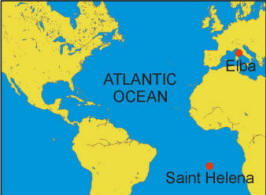
Elba and Saint Helena on a Map
Napoleon's Army
That was the grande armée, or Grand Army, so called because
it was huge. Napoleon managed to move this large body of soldiers
swiftly across Europe.
Alexander the Great comes to mind.
In 1804, Napoleon restored the
military honor of marshal and decorated 18 men with the title
maréchal
d'Empire:
Augereau,
Bernadotte,
Berthier,
Bessières,
Brune,
Davout,
Jourdan,
Kellermann,
Lannes,
Lefebvre,
Masséna,
Moncey,
Mortier,
Murat,
Ney,
Pérignon,
Sérurier,
and Soult.
Exile and the Hundred Days
On April 6, 1814, Napoleon signed his abdication.
On April 20, 1814,
Napoleon gave his
Farewell to the Old Guard speech, took his knapsack, and was exiled to Elba,
where he arrived on May 4, 1814.
Here is the
Farewell
speech in French.
Napoleon escaped while his enemies at the
Congress of Vienna were still discussing how to balance power in
Europe. He was back on the mainland (at Cannes) on March 1, 1815.
Using his charisma, he won over the
soldiers dispatched to arrest him.
Louis XVIII couldn't
believe it and had to escape to Ghent on March 13, 1815.
Napoleon reassumed power over France for a short period of
time, known as The Hundred Days.
To be exact, Napoleon's Hundred Days
refer to the time period from March 20 until July 8 of 1815.
On March 20, 1815, Napoleon arrived in
Paris.
On July 8, 1815, Louis XVIII returned to
Paris.
By the way, in history, the Hundred Days can also refer to
Franklin D. Roosevelt's first three months in office. Go here for more about
FDR's 100 days.
Back to 1815.
After losing the
Battle
of Waterloo on June 18, 1815, Napoleon was finally exiled to Saint
Helena where he died at 51 years of age, probably of stomach cancer.
Either that or because he was bored out of his skull.
Napoleon I Bonaparte — Brief Timeline
1769 August 15 - Birth at Ajaccio,
Corsica
1779 Collège d’Autun, later Military School Brienne
1784 Royal Military School in Paris
1785 Graduation; Napoleon finishes 42nd out of the 58 graduates;
Joins army
1793 Leaves Corsica with his family for good
1793 Brigadier General
1795 Commander of the Army of the Interior
1796, March - Commander of the Army of Italy.
Italian Campaign
begins. See also
War of the First
Coalition.
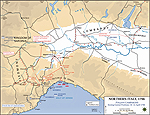
Northern Italy - April 1796
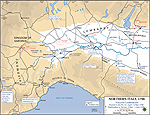
Northern Italy - April-June 1796
1798
Egyptian Campaign
1799, November 9 - Napoleon's coup d’état
(18 Brumaire year VIII) makes him
First Consul of the Republic.
1801, February 9 -
Treaty of Lunéville.
Peace with Austria.
1801, July 15
- Napoleon finally comes to an agreement
with the Roman Catholic Church by means of
the
Concordat of 1801.
And here is Pope Pius VII
quoted:
We are
prepared to go to the gates of Hell — but no
further.
Attempting to
reach an agreement with Napoleon, c.
1800-1801
1802, March 25
-
Treaty of Amiens.
Peace with England, and then some.
1802, August 2 - Napoleon is Consul for Life
1803 Britain declares war on France
1804, May 18 - Napoleon is Emperor of the French
1804, December 2 - Napoleon's coronation
1805, March 17 - King of Italy
1805, Sept 21 - Oct 20 -
Battle of
Ulm
1805, October 21 - Defeated in the
Battle of Trafalgar
1805, December 2 - Brilliant victory at the
Battle of Austerlitz
over Austria and Russia
1806, July 12 -
The
Confederation of the
Rhine is established with
Napoleon as "protector."
1806, October
14 - Victory in the
Battle of Jena-Auerstaedt.
Napoleon submits Prussia.
1806, November
21 - Continental blockade against England.
1807, June 7 -
Treaty of Tilsit
after a victory over Russia at the
Battle of Friedland.
1808, May 2 -
Beginning of the
Peninsular War (until 1814)
against Spain and then some.
1809, May 21-22 - First defeat at the
Battle of Aspern-Essling
1812
- Napoleon's
Russian Campaign
1812, October 25 - Beginning of the
withdrawal from Russia.
1813
Battle of the Nations at Leipzig, Germany
1814, January-March - Campaign against
France launched by Austria, Prussia, and
Russia
1814, April 6
- Abdication, and exile on the isle of Elba
1815, March 20
- Napoleon is back at Tuileries. Beginning
of the
Hundred
Days.
1815, June 15 - Beginning of the
Belgian Campaign.
1815, June 18
- Defeat at the Battle of
Waterloo (Belgium)
1815, June 22
- Napoleon's second abdication, end of the
First Empire, exile on St. Helena
1821, May 5 - Death on St. Helena Island
Go here for a
Napoleon I Bonaparte timeline,
Napoleon in the stream of time.
How Tall Was the Man, Really?
One of Napoleon's nicknames was
Le Petit Caporal, or
The Little Corporal.
Napoleon's exact height was five foot two in French units which is
five foot six and a half or 169 centimeters in today's measurement.
And here is a 2009
interview with some of the good people from
Porticcio.
Porticcio is located 2 miles
from Ajaccio, Corsica, Napoleon's birthplace.
All interviewees were born on Corsica
and were employed at the local library. See what you think, and let's keep in
mind that this is their opinion, it must not necessarily be yours.
Thanks for agreeing
to this interview. Last Saturday, August 15, 2009, Corsica celebrated
Napoleon's birthday with fireworks and other festivities. Did you
guys attend the event?
No, we didn't go this year,
but we've been attending it many times in
previous years.
It might also be of interest to
non-Corsicans that the 15th of August is as well the Assumption Day
of Sainte Marie, who is the patron saint of Corsica. Approx. 60% of
the Corsicans, male and female, are named Marie.
Hence, the celebrations weren't
exclusively dedicated to Napoleon's birthday.
Good to know, thanks. So in general, what do Corsicans today think
of Napoleon?
Only good things. (everybody smiles)
What do you
think of him?
He was a great strategist.
Yes, a great man in many respects.
I've spoken with some other Corsicans, and
some don't seem to like him at all. One even compared him with
Adolf Hitler.
What do you think about that?
Maybe there are some parallels regarding the desire to
extend their power. But unlike Hitler, Napoleon did a lot of good.
Under the kings, the poor didn't have anything to eat, for example.
Under Napoleon, they did.
If you could educate the world about Napoleon's accomplishments,
what would you emphasize?
Probably the Code Civil, which is also called the Napoleonic Code,
and maybe the Legion d'honneur, the Legion of Honor.
During Napoleon's lifetime, were any
Corsicans not happy with Napoleon?
Yes, there were rivalries between the partisans of
Pascal Paoli and
the friends of Napoleon.
Paoli was pro-British (the English LOVE
Paoli), he was for
Corsica's independence and in 1755, he had created the République
Corse, the Corsican Republic.
Then everything happened at once, the French came on the
island, Corsica became French, Paoli fled to England, and Napoleon
was born - all this happened in the year 1769.
Napoleon was pro-French, obviously, the
future Emperor of the French people.
When you think of Napoleon, can you think
of anything negative?
Sure, a lot of people lost their lives because of him.
But that's the case with all great men, if you think of
Alexander the Great for
example, it was the same. Lives were cheap then.
Thanks for
sharing your opinions. Now, who are the three most important people
in Corsican history, and in what order?
That would
probably be
1.
Pasquale Paoli
2.
Sampiero
Corso, and
3.
Napoleon Bonaparte.
Thank you for your time!
More History
|