John's nickname was
John Lackland,
or as the French called him Jean Sans Terre.
John's Famous Family
John's father was
 Henry II.
His mother was the beautiful and smart
Eleanor of Aquitaine, who by the way was brilliantly
depicted by the great Katherine Hepburn in the movie
The Lion in
Winter.
Henry II.
His mother was the beautiful and smart
Eleanor of Aquitaine, who by the way was brilliantly
depicted by the great Katherine Hepburn in the movie
The Lion in
Winter.
Back to John.
Henry and Eleanor had five sons and three daughters.
The oldest son was William who died at age three.
Henry
Jr.
was son number two. Son number three was
John's very famous brother
Richard the Lionheart.
Number four was
Geoffrey. John
was his parents' youngest son and his father's favorite.
John's sisters were Matilda,
Eleanor Jr., and
Joan.
John's mother Eleanor was married once before — to
Louis VII.
The marriage was annulled in the year 1152. Eleanor and Louis had
two daughters.
1167 - 1188
It was the year 1173. John was 16 years old.
John's father had it all figured out. His favorite son would marry
the daughter of Humbert III, count of Maurienne (Savoy),
which would mean lots of lands for John. Unfortunately for
John, the marriage proposal didn't sit right with John's elder
brothers, a greedy bunch. The brothers started a rebellion during
the years 1173 - 1174.
See also
the Anglo-Norman Rebellion of 1173
This marriage was off and father Henry arranged another marriage
via which John would become the Earl
of Gloucester.
In 1177, John was given the lordship of Ireland. John went and visited Ireland
in April 1185 and stayed until late
1185. While in Ireland, John partied the house down, which didn't
help
his reputation.
Father Henry kept preferring son
John. John's brother Richard was finally fed up with it and raised
serious stink. John, son of a smart mother, figured that father Henry would
probably kick the bucket fairly soon. So John made friends with Richard and turned against his
father.
1189 - 1199
Richard became king
after the death of his father in 1189. Richard was very generous towards his brother John.
He made him Count of Mortain, France, and gave him lands and revenues in England.
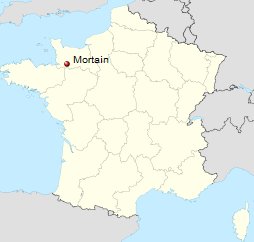
MAP LOCATION OF MORTAIN, FRANCE
As it had already been arranged by his father, John now married
Isabella, heiress to the earldom of Gloucester.
Richard was no fool. When
he was fixing to go on
crusade,
he made his brother John promise not to enter England while he was
away. John promised and kept his word. That is, until October 1190,
when Richard announced that their
nephew
Arthur I, son of their late brother
Geoffrey, would be
successor to the throne.
This ticked John off and he returned
to England in order to kick butt and take names.
During Richard's absence (1190 -
1191),
William Longchamp and
Hugh de Puiset were entrusted with
the running of the country. William soon managed to get
rid of Hugh. William was loyal to Richard, but he was a
Frenchman.
John thought this was an opportune time to convince the
English citizens that he, John, should
become king. Now.
Thus, in 1191, John declared himself ruler.
Many people, however, kept their loyalty to Richard and disliked John's
presumptuous actions. In addition, clever and powerful mother Eleanor
wished to see her son Richard on the
throne, rather than her son John.
In January 1193, John received
news that Richard, on his way back from the crusade, had been
imprisoned in Germany by Holy German Emperor
Henry VI. John thought that was
excellent news and teamed up with French King
Philip II to
get some backup to take over the throne for good.
But easier planned than done.
Richard's loyal supporters forced John to accept a truce in April 1193.
John continued scheming with Philip. On
paper, they divided Richard's belongings
amongst each other, just in case something
actually should happen to Richard, God forbid. To make sure
it would, they were also planning a rebellion in England.
When Richard came
back to England in early 1194, he issued John a one-way ticked into
exile and all
his lands were confiscated. John apologized to Richard and, amazingly enough,
Richard forgave him. By May
1194, the brothers were best friends again. Richard gave John back some
of his estates including Mortain and Ireland.
But there was still the
nephew Arthur issue
that John wanted to be taken care of. And solved it got. In
1196, the Brits handed Arthur over to Philip II of France. Dungeon
storage optional. Richard
announced that John would be his successor, Arthur who?
King of England 1199 - 1216
Richard died in April 1199 and John became king of England. Finally.
But not
undisputed. The people weren't blind and some thought that Arthur
had been dealt a foul hand.
Greedy Philip II of France decided there was potentially some money to
be made with his prisoner, Arthur. Philip switched game plans and
loyalties, turned against John, voted for Arthur
as English ruler,
and organized a propaganda campaign accordingly. In Anjou and Maine everybody was
convinced that Arthur was the rightful king of England. Death to John.
A year down the road:
The Treaty of Le Goulet
between the supporters of Arthur and the supporters of John established that John
could be Richard's successor and rightful
owner of all of Richard's lands in France if John would pay money and
give several estates to Philip.
John complied and things calmed down for
the moment.
No,
not really.
War With the French 1201 - 1206
John equally
alienated the English and the French. How does one accomplish this?
Let's learn from John. He got rid of his first wife (1199), a girl
from England, in favor of his second wife (1200), a girl from
France.
The English thought that was
as extremely unpatriotic as it was tasteless. But why did it alienate
the French as well? Because the new girl, Isabella, was the heiress to Angoulême
and she had been already promised to Frenchman Hugh IX de Lusignan. Well
done, John.
Now, the Angoulemes and the Lusignans couldn't stand each other.
Both families were living in the county of Poitou,
France, where John was screwing things up even further my meddling in local
politics.
Therefore, the result of John's second marriage
was that the Lusignans revolted. The year? 1201. The people complained to Philip II, who ordered John to come
by and explain himself. John did not pay the ordered visit.
War ensued between England and France.
At Mirebeau in August 1202, John captured Arthur,
and the latter found himself murdered by 1203.
In 1204, John lost Normandy and by 1206 John
had lost Anjoy, Maine, and parts of Poitou as well. Only
Aquitaine and a piece of Poitou were still his.
Why did France win this war? Because
they had all the resources and England and Normandy didn't.
Trouble With the Church
During the war, in the year 1205, things started going downhill at home, as well.
Hubert Walter, chancellor and archbishop
of Canterbury, died. So far not a problem but what followed wasn't
pretty:
Hubert Walter needed a successor. John was ready to pick one but
Pope Innocent III wanted to
pick one himself. The Pope had Stephen Langton in mind and in December 1206
he got
Stephen the job.
John took this personally and didn't accept Langton. In turn, the Pope took John's
disobedience personally and
in November 1209 John was fired from Church, excommunicated.
That did
the trick. John gave in and in November
1212 John accepted Langton and the Pope's terms.
The terms in question
were pretty harsh, by the way. John had to surrender his kingdom to
the Pope, which he did on May 15, 1213, at Ewell, near Dover. The Pope, a smart businessman, let John
continue to rule as a vassal for 1,000 marks per year.
John paid
up and his excommunication was undone by, of all
people, Mr. Langton in July 1213. Keeps one nice and humble.
Why
would John go through all of this? Because the papacy was an important
ally. The political situation of the day was this: John wanted his lands in France
back, the French were toying with the idea of invading England, and John's barons
had become pretty ruthless lately.
John couldn't afford to alienate the powerful Church as well. So he played along.
Another French Campaign
With the Church problems
under control and the Pope appeased, John was ready to show the French. He allied with
Otto IV,
who was Holy Roman emperor and son of John's sister Matilda. John
landed at La Rochelle in February 1214. But he couldn't pull it off.
Nephew Otto was defeated by French Philip at Bouvines in 1214.
John had to accept a truce and returned to England in October 1214,
where a lot of his barons were discontented and complaining about John's
unreliable style
of ruling. The barons demanded some
concessions. John and his barons negotiated all they could and each side appealed to the Pope.
It didn't help. No agreement could be reached.
Magna Carta 1215
In May 1215 civil war broke
out and in June an agreement,
Magna Carta,
was sealed by the king. Right after sealing the document, John appealed to the
Pope against it. Pope Innocent took John's side and, once again,
civil war ensued.
John captured Rochester castle and
showed who was boss in the country. Meanwhile, the
barons asked
Prince Louis of France
to come over for a raid. What would be in it for Louis? The English throne
was promised to him.
But all of a sudden John died
and, surprisingly, all the contempt for his rule with him. Now the
barons preferred for a fellow Brit to rule.
Henry III, John's son, was good and ready to go. French Louis was paid some cash under
the table. Thanks for the support and goodwill was mumbled, and
Louis moved on.
Controversy
Historians comment that John didn't
have quite as many enemies during
his lifetime as some future historians, for example
Roger of Wendover
and
Matthew of Paris,
wanted people to believe. They say that many prominent barons
actually fought on John's side.
Trivia
John could be one cruel puppy. There was a
certain baron whose guts John hated with a vengeance. A la mafia,
John arranged for that baron's wife, Matilda de
Braose, also called Maud de Braose, and their son to be imprisoned and starved to death.
... and here is the kicker
Historians say that
John was a brilliant executive. Moreover, they say that fair
treatment of his subjects was extremely important to him. He ruled
with absolute powers over rich and poor, which wasn't much
appreciated by the rich who were used to preferred handling. Remember that the barons
were the ones who made
John sign the Magna Carta, not the peasants.
John was the good guy all along.
Ohmygosh.
See also the chart
Governments
of Britain.