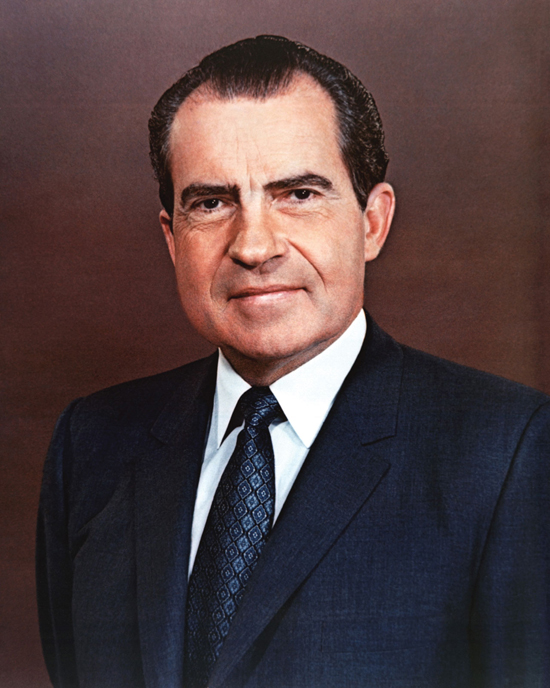
Richard Milhous Nixon
became a public figure in 1948. Back then he was
a congressman and a member of the House
Un-American Activities Committee (HUAC).
The occasion?
The investigation
of former State Department official
Alger Hiss.
Hiss was accused
of spying for the Soviet Union before and during
World
War II.
What made Nixon
famous was his hardcore stance on the matter.
Hiss was eventually found guilty.
In 1950, Nixon
became senator for California.
Checkers and the Slush Fund
Nixon's daughter Tricia had a dog named
Checkers. Why should we care? On September 18,
1952, the New York Post told the world of
Richard Nixon's alleged secret slush fund, filled with
money from Californian businessmen.
On September 23,
1952, and in defense, Nixon delivered his nationwide televised
Checkers speech,
which saved his neck for the time being.
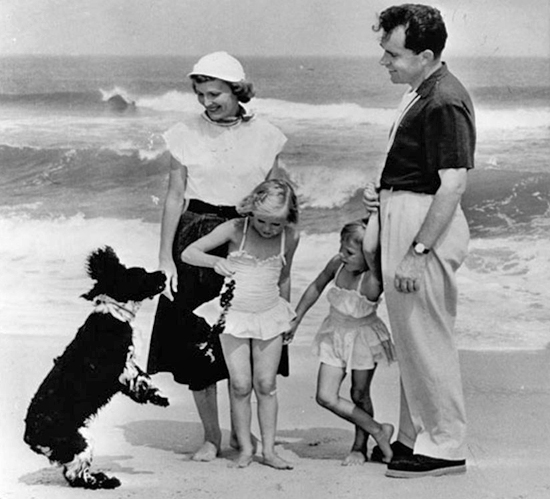
And here is a photo of the Nixons with the darn
dog.
checkers SHOWING OFF ON A WEEKEND TRIP TO NEW
JERSEY - AUGUST 1953
Richard Nixon Library
The slush fund affair happened
in the middle of Eisenhower's presidential campaign, during which
Nixon was his running mate. Eisenhower was never really enthused by Nixon's
nomination. The history buffs at the U.S. Senate remember that,
"While Nixon
campaigned as an experienced leader, the
press asked Eisenhower what policy
suggestions Nixon had made that had been
implemented. Eisenhower replied, "If you
give me a week, I might think of one."
Shortly before Nixon's Checkers speech, Tom
Dewey called Nixon and told him that Eisenhower's top
advisers thought it would be probably best that he, Nixon, would end his
speech with offering his resignation.
When Nixon managed to turn the public
around with his Checkers speech, the Eisenhower-Nixon relationship
became that of a truce, openly endorsing each other, secretly hoping
the other would slip on vomit.
Vice President
From 1953 until 1961,
Richard M. Nixon was vice
president under
Dwight D. Eisenhower.
Ike made sure that none of the important
things landed on Dick's desk.
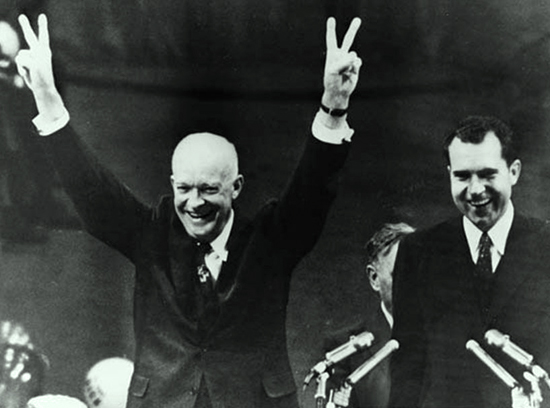
Dwight D. Eisenhower and Richard M. Nixon
Republican National Convention in San Francisco
1956
Dwight D. Eisenhower Library / U.S. Army
In 1960, the Republicans let Nixon run for
president against Democrat
John
F. Kennedy. The American public had
to stomach four TV debates.
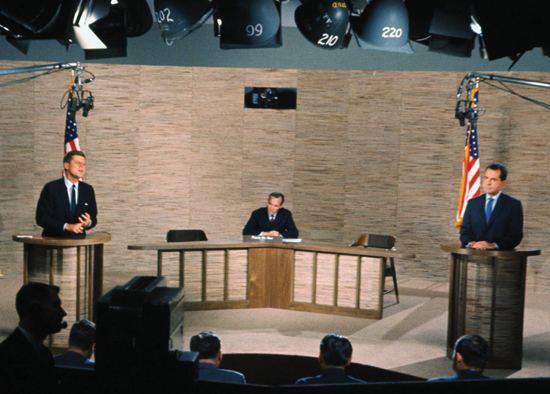
TV DEBATE JOHN F. KENNEDY / RICHARD m. NIXON
US Presidential Campaign 1960
U.S. Senate.gov
JFK won the
election because he was generally conceived a
bit spunkier than Nixon. But it was a very close race.
Too close, some
thought and claimed that Illinois and Texas
votes had possibly been monkeyed with. Nixon was
encouraged to challenge the election results but
he decided to let it slide.
The Nixon Presidency
In 1968, Richard
M. Nixon ran again and this time he won. Nixon defeated Democrat
Hubert H. Humphrey and on January 20, 1969, Nixon
delivered his
First Inaugural Address
as the 37th president of the United States.
President Nixon's vice president was
Spiro T. Agnew,
former governor from Maryland.
President Nixon's predecessor was
Lyndon B. Johnson.
Johnson had been JFK's vice president. After
JFK's assassination in 1963, he became the 36th
president of the U.S.
Nixon and the Vietnam War
The
Vietnam War
had started back in 1954. As President of the
United States, it was now Nixon's job
to end the war and bring about a "peace with honor," as he
had promised during his campaign. The task
turned out a bit trickier than anticipated.
At least that was
what Americans believed to be true.
The truth had a
much uglier face.
In his campaign,
Nixon's big rhetoric was that the Democrats were
unable to end the war. He argued that the only
way to end the Vietnam War was to elect him,
Richard Nixon, because he knew how to end the
war and would be doing so once in office.
However, on
Thursday, October 31, 1968, LBJ aired a
televised address to the Nation and announced
that peace in Vietnam was at hand.
This was excellent
news for the world, but devastating news for
Nixon, whose foundation upon which he had built
his campaign was falling to pieces.
What to do?
Nixon meddled in
diplomatic affairs and ensured that no peace
deal would be reached. How did he do it? He
instructed fellow Republican Party member
Mrs. Chennault
(Anna Chen Chennault, née Chen Hsiengmei) to
contact the South Vietnamese and convince them
that the current deal would not be the best deal
they could get. After his election, he would
give them a much better deal.
And it worked.
On Saturday,
November 2, 1968, the deal was off because the
South Vietnamese pulled out of the peace talks.
LBJ knew about
Nixons trickery, called it treason, but said
nothing because he himself had acquired this
intel via illegal wire tapping of the South
Vietnamese ambassador by the FBI.
Here is LBJ on the
phone with Senator Richard Russell on Saturday,
November 2, 1968:
We have found that our friend, the
Republican nominee, our California friend,
has been playing on the outskirts with our
enemies and our friends both, he has been
doing it through rather subterranean sources
here. And he has been saying to the allies
that you're gonna get sold out. You better
not give away your liberty just a few hours
before I can preserve it for you.
Mrs. Chennault is contacting their
ambassador. Now this is not guess work. Mrs.
Chennault, she's young and attractive, she's
a pretty good looking girl. And she's around
town and she is warning them [the South
Vietnamese] to not get pulled in on this
Johnson move.
This is LBJ on the phone with Senator Dirksen,
also on November 2, 1968:
... And they oughtn't to be doing this. This
is treason.
I think it would shock America if a
principal candidate was playing with a
source like this on a matter this important.
Nixon had
prolonged the war for his own purposes. So,
having committed what LBJ called a hanging
offence, Nixon entered the 1968 election on
Tuesday, November 5th.
He won by less
than 1% (43.4%) vs. Hubert Humphrey with 32.7%
and George Wallace with 13.5%.
Untrue to his
campaign promises, Nixon did not know how to end
the war. Instead he expanded the combat zone
into Cambodia and Laos. The Vietnam War
continued another 5 years, cost another 22,000
American lives and countless Vietnamese,
Laotian, and Cambodian lives.
On October 15,
1969, antiwar protesters united in the
October Moratorium.
They demanded the end of the war, but with the
quickness.
On November 3,
1969, Nixon televised his
The Silent
Majority speech, which gave everybody a
heads-up on his Vietnam war policy.
On April 30, 1970, Richard
Nixon gave his
Cambodia address to bring
everybody up to speed with the fact that the Vietnam war was now
also fought in Cambodia and Laos.
On May 4, 1970,
four people were killed in a anti-war
demonstration at Kent State University, Ohio,
when the Ohio National Guard opened fire on the
protesters. This event became known as the
Kent State Shootings or the Kent State
Massacre. Here is the clip:
On January 23,
1973, Nixon announced the end of the Vietnam
War. All U.S. troops were withdrawn from Vietnam
by March 29, 1973. Actually, the war continued
to drag on
until North Vietnam won this bloody struggle in
1975.
Richard Nixon and SALT
In 1972, Nixon signed
SALT I, an agreement with the
Soviet Union to limit construction of strategic missiles.
Richard Nixon and Watergate
— A Timeline
The break-in at the Democratic National Committee
headquarters, the Watergate complex, took place on June
17, 1972, by former employees of the Nixon reelection campaign.
In detail, and incorporated are notes
from the FBI Watergate Summary, file number 139-4089:
On June 17, 1972, at approx. 2:30 am,
James McCord and four of the Cuban-Americans, Barker, Sturgis,
Gonzalez and Martinez, are captured inside the Democratic National
Committee Headquarters office by the Washington Metropolitan Police
Department.
Found in the possession of these
subjects was photographic equipment, burglary tools, electronic
equipment and what appeared to the police at that time to be an
explosive device. Later, the agents were advised that it was in fact
an electronic listening device.
All of the subjects were using aliases
at this time and refused to be interviewed and to state for whom
they were working and for what purpose they were in the building.
Continuing investigation by WFO agents and the Metropolitan Police
Department resulted on June 18, 1972, in the identification of the
five arrested subjects and determination that McCord and Barker had
CIA ties.
On June 19, 1972, information was received that a room in the Howard
Johnson Motel immediately across the street from the Watergate
Office complex had been utilized by James McCord and others.
Investigation determined that James McCord had rented a room in this
motel in the name of McCord Associates. Telephone toll calls made
from this room led Bureau agents to the identification of
Alfred C. Baldwin III and a
determination that he is a former Special Agent of the Federal
Bureau of Investigation. Baldwin was identified by personnel of the
motel as a person they had seen frequently in the room rented by
McCord.
On July 10, 1972, Alfred C. Baldwin III made a statement to Bureau
agents and Assistant U.S. Attorneys implicating himself in the
monitoring of electronically intercepted telephone conversations on
the telephone of Spencer Oliver in the Democratic National
Headquarters at the Watergate Building.
Baldwin indicated he was working
directly for James McCord and had also had direct contact with
E. Howard Hunt and
G. Gordon Liddy during the
course of the electronic interception and break-in at Democratic
National Committee Headquarters.
Baldwin indicated that both Hunt and
Liddy were on the scene in the immediate vicinity of the break-in on
June 17, 1972, but both had escaped detection at that point.
Baldwin's statement provided the first direct proof of the
involvement of Hunt and Liddy in the Watergate break-in and
wiretapping.
On September 15, 1972, a Federal Grand Jury in Washington, D.C.,
returns a multi-count indictment against the five subjects found
inside the Democratic National Committee Headquarters at Watergate
and additionally charges E. Howard Hunt and G. Gordon Liddy with
Conspiracy, Interception of Communications and Burglary.
On December 7, 1972, White House secretary Kathleen Chenow confirms
the existence of
the Plumbers.
On January 8, 1973, in U.S. District Court, Washington DC, before
Chief Judge John Sirica, the trial of the seven indicted Watergate
break-in subjects begin.
On January 11, 1973, Senator Sam J. Ervin (D-NC) is picked to head a
Senate investigation of Watergate related matters in the
Presidential election campaign of 1972.
Also on January 11, 1973, E. Howard
Hunt plead guilty to all counts of the indictment charging him with
complicity in the Watergate break-in wiretapping matters.
On January 15, 1973, four of the
Watergate break-in defendants, Barker, Gonzalez, Martinez and
Sturgis, enter guilty pleas to all seven counts of the Watergate
break-in indictment.
On January 17, 1973, during the trial
of the seven defendants in the Watergate break-in case, the court
goes into closed session where Alfred Baldwin testified that he
monitored approx. 200 conversations on this wiretap and gave daily
logs to James McCord.
On January 30, 1973, in the Federal trial of the remaining Watergate
break-in defendants, James McCord and G. Gordon Liddy, the jury
returns a guilty verdict on all counts.
On February 7, 1973, the United States Senate votes to establish a
select committee for the investigation of the Presidential election
campaign of 1972. The committee is to be composed of four Democrats
and three Republicans.
On April 27, 1973, L. Patrick Gray resigns as Acting Director of the
FBI. There have been previous newspaper accounts indication that Mr.
Gray had received certain documents from the White House safe of E.
Howard Hunt directly from John Dean and that he had withheld these
files and later destroyed them.
Also, on April 27, 1973, William D.
Ruckelshaus is appointed by President Nixon as Acting Director of
the FBI to replace Mr. Gray. Mr. Ruckelshaus states that he does not
expect to be in this position longer than two months.
On April 30, 1973, Nixon fired his
adviser John W. Dean, who had
previously sung like a canary on the laps of federal investigators.
It turned out that Dean could sing even better after losing his job.
Also on April 30, 1973, Nixon accepted
the resignations of his chief of staff,
H.R. Haldeman, his assistant for domestic affairs,
John D. Ehrlichman, and his
attorney general Richard G. Kleindienst.
Still on April 30, 1973, at 9 pm, Nixon gave his
First Watergate Address, which became also known as the
No Whitewash at the White House speech.
It was broadcast nationwide via TV and radio.
Nixon used his dramatic voice, especially during the final minutes of this speech.
This speech could make you feel guilty about having bothered the president with the Watergate affair
at all, when he has so much more important things to do.
"Since March, when I first learned that the
Watergate affair might in fact be far more
serious than I had been led to believe, it
has claimed far too much of my time and my
attention."
On June 25, 1973, John
Dean, former White House Counsel,
testified concerning his role in the cover up of
the Watergate investigation and the role of
several other administration officials.
Dean indicated
that the President was aware of the cover up as
early as September 1972.
July 16, 1973, Alexander P. Butterfield,
Administrator of the Federal Aviation
Administration and a former White House Aide,
advised the Senate Watergate Committee that all
of President Nixon's conversations in the White
House and Executive Office Building were
recorded beginning in the Spring of 1971 by
concealed microphones and telephone bugs.
Butterfield stated
that the listening devices were installed under
President Nixon's authority for "posterity's
sake".
"I had no prior
knowledge of the Watergate break-in. I neither
took part in nor knew about any of the
subsequent cover-up activities. I neither
authorized nor encouraged subordinates to engage
in illegal or improper campaign tactics. That
was and that is the simple truth."
And one more:
"I reject the
cynical view that politics is inevitably or even
usually a dirty business."
The air got thinner by the minute, and it became
increasingly difficult to breathe, especially in
high places.
Vice President Agnew resigned
on October 10, 1973. Nixon's new vice was
Gerald R. Ford.
On October 20, 1973, the White House announced
that President Nixon had ordered Attorney
General Elliott L.
Richardson to dismiss Special
Prosecutor Archibald
Cox; that Richardson had resigned
rather than comply with that order and that
Deputy Attorney General
William D. Ruckelshaus, who had
also refused the Presidents order, had been
fired.
The White House
stated that Solicitor General Robert H. Bork had
become the Acting Attorney General and had
dismissed Special Prosecutor Cox and dissolved
the Office of the Special Prosecutor.
On November 17, 1973, Nixon pointed out that,
"I welcome this kind of examination because people have got
to know whether or not their president is a crook. Well, I'm not a
crook."
Fittingly, this event took place at Disney World,
Orlando, Florida.
Go here for the entire
I'm Not a Crook speech, which
is not really a speech but rather a Q & A session with 400
Associated Press managing editors.
On November 21, 1973, White House Special Counsel J. Fred Buzhardt
advised U.S. District Judge John Sirica that an eighteen and
one-half minute section of a White House tape recorded on June 20,
1972, of conversations between President Nixon and his former Chief
of Staff, H.R. Haldeman, was blank and contained no audible tones.
Judge Sirica ordered the White House
to turn the remaining portion of that tape and others that had been
subpoenaed over the court by November 26, 1973.
On December 20, 1973, House Judiciary Committee Chairman Peter W.
Rodino (D-NJ), announced the selection of John M. Dear, former
Assistant Attorney General in the Administration of President
Kennedy as Special Counsel to the House Judiciary Committee for the
purpose of conducting an inquiry into possible impeachment grounds
against President Nixon.
On February 6, 1974, the House of Representatives, U.S. Congress,
votes approval for the House Judiciary Committee to conduct an
impeachment investigation and grant powers of subpoena and funds for
this inquiry.
On March 1, 1974, a Federal Grand Jury in Washington, D.C., indicted
seven former officials of the White House or the President's
Re-Election Committee for conspiring to impede the investigations of
the Watergate break-in at the Democratic National Headquarters.
The seven indicted include former
Attorney General John Mitchell,
former Presidential Chief of Staff H.R.
Haldeman, former Assistant to the President for Domestic
Affairs John D. Ehrlichman,
former Special Counsel to the President
Charles W. Colson, former Assistant Attorney General
Robert C. Mardian, former
attorney for the Committee to Re-Elect the President
Kenneth W. Parkinson, and former
Assistant to H.R. Haldeman at the White House
Gordon Strachan.
According to
Herblock's History, on April 3,
1974, the White House announced that Nixon would pay $432,787.13 in
back taxes plus interest after an investigation by the Internal
Revenue Service and a congressional committee.
Among Nixon's benefits to himself were
improvements in his properties, supposedly necessary for his
protection. These included a security ice maker, a security swimming
pool heater, security club chairs and table lamps, security sofa and
security pillows.
On April 30, 1974, President Nixon transmits to the House Judiciary
Committee and releases to the public 1,308 pages of edited
transcripts from recordings taken in the White House relating to
Watergate matters.
The President states that these
transcripts will answer all inquiries regarding his activities in
relation to the Watergate matter and will provide the public and the
House Judiciary Committee with the answer to the basic question at
issue, "Whether the President personally acted improperly in the
Watergate matter?"
Richard Nixon made history by becoming
the first US president who quit his job.
On August 8, 1974, Nixon broadcasted
his
Resignation Speech,
also known as the I Have Never Been a Quitter Speech,
to the American Nation. His resignation would be in effect the next
day at noon.
On August 9, 1974, Nixon assembled his
staff in the East Room of the White House and gave his Farewell
Speech, after which he packed his bundle, boarded a helicopter, and
was gone by noon as promised.
Assassination Attempts on Richard Nixon
February 22, 1974, Baltimore, Maryland - An excerpt from the
must-read book for bodyguards Just 2 Seconds by Gavin de Becker,
Samuel Byck
shot his way onto a Delta jet at the
Baltimore-Washington Airport. He intended to
hijack the plane, force the pilots to take
off, and then crash the plane into the White
House to kill Nixon.
He killed a
security guard and the crew, before police
shot and wounded him. He then killed
himself. He was armed with a .22 revolver
and a gasoline bomb in a briefcase.
Richard Nixon's Family
Richard's father
was Francis Anthony Nixon. Richard's mother was
Hannah
Milhous Nixon. The couple had five children.
Richard was child number two.
Richard's brothers
were Harold Samuel
Nixon,
Francis Donald Nixon,
Arthur Burdg Nixon,
and Edward Calvert
Nixon.
In 1940, Richard
married Thelma Catherine
Ryan. They called her Pat because she
was born on St Patrick's Day. Pat
taught business classes at Whittier High School.
The two met at the local amateur theater group.
Pat Nixon died on June 22, 1993, of lung cancer.
Pat and Richard
had two daughters. Tricia
Nixon was born in 1946 and
Julie Nixon in 1948.
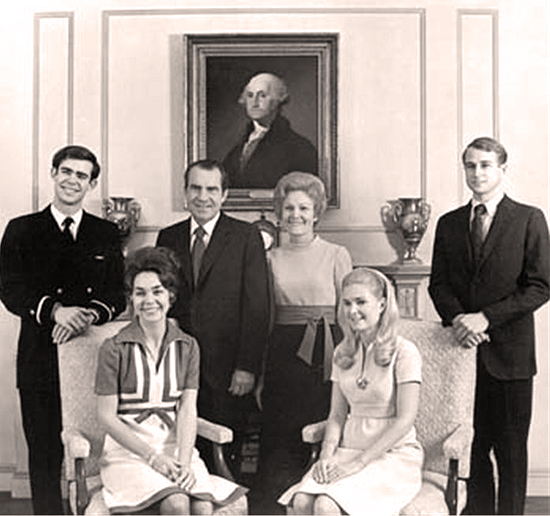
Julie later married Dwight D. Eisenhower's
grandson. And here is the group photo:
THE NIXONS:
David & Julie
Eisenhower,
President & Mrs. Nixon, Tricia & Ed Cox
If you look closely, you can see Washington shedding a tear.
Nixon Presidential Library and Museum
What's New About Nixon?
March 23, 2007
Nixon ordered to bomb
targets that officially were off-limits. Read
the
article in The New
Yorker...
May 31, 2007
The National Archives and Records Administration
has announced the impending release of an
additional 11 hours and 30 minutes of Nixon
White House tape recordings. The tapes in
question were recorded in 1972.
September 13, 2008
Nixon interview published where he comments on
the execution of the Rosenbergs in 1953.
Read the NY Times article.
Resigns presidency, Vice President
Gerald R. Fordbecomes the new
president, Nixon and his wife return
to their home in San Clemente,
California
September 8, 1974
Ford
pardons Nixon for "all offenses
against the United States" which
Nixon "has committed or may have
committed or taken part in" during
his presidency.
1980
The
Nixons move to New York City
1981
The
Nixons move to northern Bergen
County, New Jersey
Richard Nixon's Writings
Richard Nixon wrote quite a few
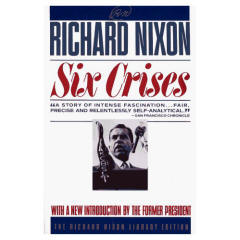
books, among them the bestseller, Six Crises (1961), and
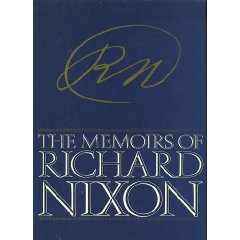
RN: The Memoirs of Richard Nixon
(1978).
What Else?
Let Nixon
have the final note. For old time's sake and for the
Dick that we will miss.
Greco-Persian Wars
Also called the
Persian Wars, the Greco-Persian Wars were
fought for almost half a century from 492 to
449 BC. Greece won against enormous odds. Here
is more: