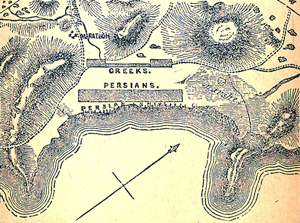
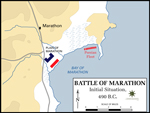
The Plain of Marathon lies along the crescent-shaped bay of the same
name. The plain is about six miles in length and two miles broad in
the center where the space between the mountains and the sea is
greatest.
The Greeks came from Athens and waited on the slopes. The
Persians landed on the shore beneath.
Who Fought Against Whom in the Battle of Marathon?
The Athenians vs.
the Persians.
For Athens fought approx. 10,000
Athenians and 1,000 Plataeans.
View Plataea on a map.
Athens had no cavalry, no archers, and no military engines. But the
guys did have spears.
For Persia fought approx. 15,000 men. These soldiers had horses and
archery. The horses weren't of much advantage because the marches
were usually flooded in the fall.
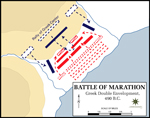
About the battle formation. Athens' right wing was led by
Callimachus. Athens' left wing was covered by the Plataeans. Athens'
center was led by Themistocles and Aristides.
The Greek idea was to attack first and
to cross the distance from the slopes to the Persians as fast as
possible in order to beat the Persian cavalry and archers to it.
Greek battle trumpet blows, Athenians
sweep down the hills, Persians drive Athens' center back over the
plain and up the valley, Athens' wings come down and sandwich the
Persian center, Persian army flees to their ships, Greeks pursue and
try to set fire to as many galleys as they can get their torches on.
In Childe Harold's Pilgrimage,
Canto the Second, XC, Lord Byron describes the scene as
follows:
The flying Mede, his shaftless
broken bow; The fiery Greek, his red pursuing spear; Mountains above, Earth's, Ocean's plain below; Death in the front, Destruction in the rear! Such was the scene
Actually, it was here at the Persian ships where a
lot of Greeks were killed, including the generals Callimachus
and Stesilaus, and Aeschylus' brother Cynaegeirus.
However, Athens managed to capture 7
ships. The Persians pushed off the coast and Persian satrap Datis
sailed as fast as he could direction Athens, hoping to find the city
unprotected.
Greek general Miltiades knew
exactly what
Datis had in mind and ordered a speedy night march back to the city
of Athens. The next morning, the Persian ships arrived at the harbor of
Athens and for them waiting were the soldiers the Persians had been
fleeing from the previous night.
Datis decided to retreat and the Persian
fleet sailed back home.
For the Greeks, who fought a battle
and then ran a marathon, it was nap time.
The entire
encounter was
over after only one afternoon / early evening.
Soldiers Who Fought in the Battle of Marathon
Athens
Persia
The Greek land forces
were headed by 10 generals. One of them was General
Miltiades,
also called Miltiades the Younger.
Athens' General Callimachus was a noble and the elected War-Ruler of the year 490 BC, which
meant he was the leader of the 10 generals, the polemarchos,
or the supreme military commander.
When the Greeks were trying to decide
whether or not to strike first, the assembled generals voted 50/50.
It was Callimachus' vote that tipped the scales, thus Athens
attacked first and brought home a victory. Unfortunately for
Callimachus, he fell in this battle. (The Persians didn't attack
first because there was a chance of a bloodless conquest. Athens
being scared shitless was one of the reasons. See "Background of the
battle of Marathon," if you scroll down a bit.)
On their way towards Athens, also in
the year 490 BC, they had already sacked Eretria, a town on
the island of Euboea, which was a former ally of Athens. Up
to the Battle of Marathon, the Medes and the Persians rolled with
the reputation of being
invincible.
Also travelling with the Persians was
Hippias, an exiled tyrant of Athens who
had ruled the city from 528
to 510 BC. Before Hippias, it was Hippias' father Pisistratus
who ran the outfit. Hippias, no doubt toying with the thought of settling unfinished
business, was the one who came up with the idea of landing
at Marathon.
When the Persians landed at Marathon,
desperate Athens asked Sparta for help. The Spartans replied
"Not Now. Maybe Later." as they were busy observing important religious ceremonies
at the time. Athens had a good swear, prepared for battle, and tried to
look as fearless as possible.
The only military support for Athens
came from Plataea.
View Plataea on a map, Athens's loyal friend. Plataea hosted
their own home game against the Persians a year later. See
Battle of Plataea.
Did the Spartans Ever Arrive?
Yes, they did!
After having properly finished their religious celebrations, 2,000
spearmen from Sparta arrived AFTER the battle had been fought. They
had marched for 3 days from Sparta to Marathon, took some pictures
of the dead bodies on the battlefield, and went back home.
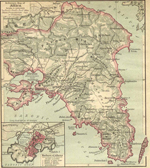
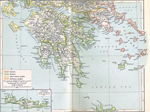
Check out their route on the map. Look
for Lacedaemonia, which is the ancient name for Sparta,
pretty much center of the map (b - B/C). Athens is up there further
to the right in Attica, across the island of Salamis, (b -
D).
Legend has it that a
messenger was sent from Marathon to Athens to deliver the news of
the victory. Public transportation was a bitch and the poor guy ran the entire 25 miles
which is 40 kilometers.
He arrived in Athens, announced the good news, collapsed, and died of
exhaustion.
For the organizers of the first modern Olympic
Games (held in Athens in 1896), it only made sense to include this insanity
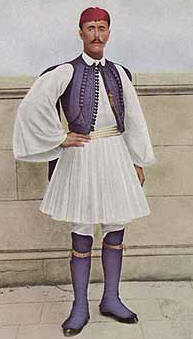
as part of the event. Twenty-four-year-old Spyridon Louis
from Greece fetched the gold medal.
SPYRIDON LOUIS 1896 FIRST MARATHON GOLD MEDAL CHAMPION
By the way, the first recorded
Olympic Games, maybe the first
Olympic Games ever, were held in the year 776
BC.
Back to the Battle of Marathon in 490
BC.
Who in the World Was Pheidippides?
Pheidippides was,
according to
Herodotus,
a professional runner who was sent from Athens to Sparta before
the Battle of Marathon took place in order to request reinforcement
from the Spartan army.
The entire thing got mixed up, as tales
do, and Pheidippides was all of a sudden the name of the guy who ran
from Marathon to Athens after the battle and expired.
Which Historian Tells Us About the Battle of Marathon?
Among others,
Herodotus, who lived
484-425 BC, tells us much about it and
here is his
report.Herodotus also apparently interviewed Epizelus,
or Epizelos, a veteran of Marathon.
Check it
out.
Thucydides, who lived
460-400 BC, tells us about the battle. Thucydides was also a
big fan of Greek general Themistocles. -
See here.
Other reporting historians lived a long
time after the event.
Plutarch, who lived 46-119 AD, wrote on the battle and so
did
Justin, aka Marcus Junianus Justinus,
who lived in the 3rd century AD -
lookie here.
And here is Eddie Izzard's sum up:
The Battle of Marathon — Trivia
The Battle of Marathon
featured the biggest difference in comparative territorial resources
of the opponents involved. As Sparta didn't get their act together,
Athens and Plataea, who represented Attica, fought the delegation
representing the
Persian Empire.
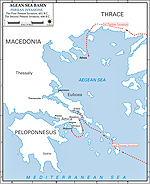
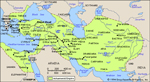
On the map below, you will find Attica
in the upper left corner. It is not labeled though. Look for
the tiny stretch of land around the words "Marathon" and "Athens."