|

 Explorers, Scientists &
Inventors
Explorers, Scientists &
Inventors
Musicians, Painters &
Artists
Poets, Writers &
Philosophers
Native Americans & The Wild
West
First Ladies
Popes
Troublemakers
Historians
Archaeologists
Royal Families
Tribes & Peoples

Assassinations in History
Who
got slain, almost slain, when, how,
why, and by whom?
Go to the
Assassination Archive



Online History Dictionary A - Z
All-Time Records in
History
What was the
bloodiest battle, the battle with the least
casualties, who was the greatest military leader?
Go to
Records in History
The Divine Almanac
Who all roamed the heavens in
olden times? The Who's Who of
ancient gods.
Check out
the Divine Almanac


French Revolution Glossary A-Z
::
Ancien Régime
Ancien régime is French for Old Rule,
also translated as Old Order, and refers
to the government, the political and social
order of France before the Revolution.
:: Calendar
or rather French
Republican Calendar
The French Republican Calendar was the official
timetable of the French from September 22, 1792,
until December 31, 1805.
For the French
revolutionary soul, the Gregorian Calendar, the
one we are using today, reminded too much of
religion.
On October 5,
1793, the
National Convention
decided to use the Republican Calendar instead
of the Gregorian Calendar.
On that day, the
Republican Calendar was put in place
retroactively. The first day of the first year
of this calendar was the date of the
proclamation of the Republic — September 22,
1792.
September 22,
1792, was 1 Vendémiaire, year I.
Weeks were
replaced by décades of ten days. Each of
the twelve months had exactly 30 days, or 3
décades.
At the end of the
360 days, five public holidays were added and a
sixth day every fourth year, to celebrate the
sanculottide.
The 12 months of
the Republican Calendar were poetically named
with reference to agriculture and climate:
Vendémiaire
(vintage)
September 22 to October 21
Brumaire
(mist)
October 22 to November 20
Frimaire
(frost)
November 21 to December 20
Nivôse (snow)
December 21 to January 19
Pluviôse
(rain)
January 20 to February 18
Ventôse (wind)
February 19 to March 20
Germinal
(seedtime)
March 21 to April 19
Floréal
(blossom)
April 20 to May 19
Prairial
(meadow)
May 20 to June 18
Messidor
(harvest)
June 19 to July 18
Thermidor
(heat)
July 19 to August 17
Fructidor
(fruits)
August 18 to September 16
Here is an excellent French Republican
Calendar Converter put up by Stephen P.
Morse:
Go to
Stephen's French
Calendar converter
::
Committee
of Public Safety
The Committee of Public Safety was established
on April 6, 1793. There were 9, and later
12, members of this committee, who were to be re-elected
each month.
The National
Convention thought it would be a good idea to set up
this committee in order to be able to more
effectively coordinate measures against foreign
and domestic threats.
First president of
the Committee was
Georges
Danton, who was a
moderate. Too moderate, people thought, and in
July 1793, he was replaced by
Robespierre and
other men of Robespierre's caliber.
Power thus
centralized in the hands of a few
radicals, the Committee became bigger than
its creator and introduced the Reign of Terror. Georges Danton himself ended up on
the guillotine in April 1794.
The power and
importance of the Committee of Public Safety
faded after Robespierre's execution in July
1794.
However, it still
had power over matters regarding foreign affairs
and war. In March 1796, for example, the
Committee decided to make Napoleon commander of
the army of Italy.
::
Consulate
The Consulate was the French government from
1799 to 1804.
Officially, three consuls (
Napoleon,
Emmanuel-Joseph
Sieyès, and Pierre-Roger Ducos) were in power.
Unofficially, Napoleon was the only one in
charge.
In 1804, Napoleon
decided to drop the pretense and declared
himself emperor.
:: Corvée
The unpaid labor that you owed to your lord
(seigniorial corvée) or to your king
(royal corvée) if you were a vassal.
The word derives
from Latin corrogata opera, which means
requested work.
A French peasant
who lived in the year 800 was obliged to work
180 days per year for free for his lord.
In time, free
labor for a lord was replaced by a tax.
Louis XIV
brought back a royal corvée for road and
highway constructions.
In 1787,
Louis XVI
decided that the royal corvée had to be
paid in form of a tax, which was added to your
regular tax, the taille.
In 1789, the
Constituent Assembly
abolished the corvée.
Today, spoiled
French teenagers still complain about corvée
when told to clean up their rooms. But only the
educated ones.
::
Directory
The Directory (French: Directoire) was
the French government from November 1795 to
November 1799. It had been created by the
National Convention, which prepared its
constitutional foundation.
The Directory had
two chambers: The lower house, also called the
Council of Five Hundred, or
Conseil de Cinq-Cents,
with 500 delegates, and the Council of Elders,
or Conseil des Anciens, with 250
delegates.
The 500 were to
suggest laws, the 250 were to approve them.
Executive authority was in the hands of five
directors, elected by both chambers. These
directors were Barras,
Rewbell,
Lareveillère,
Letourneur,
and
Carnot.
The Directory was
a complete disaster because it was corrupt and
had no teeth, i.e. it could not implement or
enforce its own decisions.
On September 4,
1797, the Directory had royalists and other
undesired individuals not only banned from the
administration but also deported, just to be
sure. This was the
Coup of
18 Fructidor, year V. Executive
in charge was General
Augereau.
Napoleon was
behind the coup that ended the Directory on
November 9-10, 1799, also called the
Coup
of 18-19 Brumaire, year VIII.
The
Consulate became the new government of
France.
The Conseil des
Cinq-Cents existed from October 27, 1795 -
December 26, 1799.
::
Émigrés
French aristocrats who emigrated because of the
French Revolution and who tried to re-establish
their power from abroad. French nobles in exile.
::
Estates-General
Also called the States
General (French: États-Généraux
or simply États), this was an assembly of
deputies from the three estates, also called the
three orders:
the clergy
(First Estate)
the nobility
(Second Estate)
the commons
(Third Estate)
The Estates-General existed under the French
monarchy and met more or less regularly to
discuss matters of public interest. Their powers
were advisory only.
The
Estates-General assembled for the first time on
April 10, 1302, prompted by French
King Philip IV the Fair
who needed support in his struggle with
Pope Boniface VIII.
The
Estates-General assembled for the last time on
May 5, 1789,
at Versailles.
Technically, they
met once more on July 9, 1789, only to confirm
the creation of the
National Assembly
(Assemblée Nationale), that had been proclaimed on
June 17, 1789.
::
Ferme Générale
The Ferme Générale, or General Tax
Farm, was an organization
that collected indirect taxes for the King.
The lease for the
royal permission to collect was awarded every
six years.
The Ferme Générale
employed its tax collectors, the
fermiers-généraux, or farmers-general.
Jean-Baptiste Colbert
created the Ferme Générale in 1681. It
was abolished in 1791.
::
Gabelle
The gabelle, or gabela, was a tax
on salt established back in 1341 under
Philip VI of Valois.
By 1789, the salt
tax had become a ridiculously unequal tax in
France.
Here is a map:
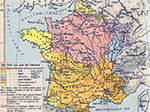
Map Gabelle France 1789
The gabelle
was abolished in 1790.
Here is
more about the
gabelle.
:: Girondists
A Girondist, or Girondin, was a member of the
moderate republican party of France from 1791 to
1793. Their policy was also referred to as
Girondism.
It's leaders were
the deputies from Gironde, a department located
in southwestern France. See map
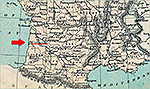
Gironde
Department, France 1790
:: Jacobins
A Jacobin was a member of the radical Jacobin
Club, the most famous political group of the
French Revolution, associated with extreme views
and violence. The Jacobins led the French
Revolutionary government from mid-1793 to
mid-1794. Their goal was absolute equality.
The Jacobins
started out calling themselves the Society of
the Friends of the Constitution (from 1789
to 1792) and then switched to become the
Society of the Jacobins, Friends of Liberty and
Equality (from 1792 to 1794.)
The name Jacobins
derives from their club house, a former convent
of the Dominicans, who built it near the church
of Saint Jacques (Saint Jacobus or Saint James)
in Paris.
One of the Jacobin
leaders was
Maximilien
de Robespierre. Another famous
member of the Jacobins was
Napoleon.
In the National
Convention, the Jacobins were known as the
Montagnards.
:: La Plaine (The Plain)
La Plaine were those deputies in the National
Convention who were seated on the floor and
had the majority. Members of La Plaine were mostly moderate.
At first, La
Plaine voted with the Girondins, but later, when it
came to Louis XVI's execution, with the
Montagnards. In the end, they acted against the
Montagnards and against the Committee of Public
Safety.
::
Lettre de Cachet
Cachet is the French word for stamp
or seal.
By means of a
lettre de cachet, a letter with the royal
seal and co-signed by a secretary of state, the
King could summon anyone anywhere willy-nilly.
Some of these
letters put individuals into prison without
trial or hearing (see
Bastille),
some summoned political bodies of people to
assemble or to appear before His Royal Highness.
The lettres de
cachet appeared in the mid-sixteenth century
and were used, at first, exceptionally. Later,
their usage grew proportionally to the usage of
royal absolutism.
Originally, the
King issued these letters because he felt like
doing so. Later, more and more individuals sent
applications for such a letter.
As a police
officer in Paris you could apply for lettres
de cachet to keep your streets crime free,
the advantage being a, if not necessarily just
but speedy incarceration process. In the 18th
century, lieutenants of the police have been
using these lettres more than 60,000
times.
Families could
seek a lettre de cachet for their
"libertine son", "unfaithful husband",
"promiscuous wife", or simply "insane uncle"
etc.
Under
King Louis XV,
who ruled 1715-1774, the lettre de cachet
was in demand like it had never been before. A
massive amount of ministers was required to go
through these applications and to approve or
deny them.
Criticism grew,
accusing the monarchy of targeting innocent
victims of private vendettas and family feuds.
The arbitrary use of the lettres de cachet
became a symbol of intolerable absolutism.
The
Constituent Assembly
abolished the lettre de cachet in 1790,
carefully seeing to it that a good number of
those imprisoned at the time would stay where
they were.
::
Montagnards
A Montagnard (French for Mountain Man)
was a Jacobin in the National Convention, and so
called because they were seated on the higher
benches at the convention.
::
National Assembly
The National Assembly (Assemblée Nationale)
grew out of the
Estates-General,
a solely advisory council to the King.
The National
Assembly was established by the Third Estate on
June
17, 1789, and became the first French
revolutionary parliament.
It existed from
June 17 to
July 9, 1789,
when its legitimacy was confirmed by the First
and the Second Estate, and it was renamed
National Constituent
Assembly.
The National
Constituent Assembly was active until September
30, 1791. On October 1, 1791, the
Legislative Assembly,
became its successor.
National Assembly — Achievements:
Abolition of
feudal privileges
August 4, 1789
Declaration of the Rights of Man and Citizen
August 26, 1789
Nationalization of Church property
November 2, 1789
Civil Constitution
of the Clergy
July 12, 1790
Prohibition of
strikes and workers' unions
Le Chapelier Law, June 14, 1791
Constitution
of 1791
Accepted by the King on September 14, 1791
Penal Code
September 25, 1791
And here is a list of the
presidents of the National
Assembly 1789-1791.
::
National Convention
The French National Convention (Convention
Nationale) was the government of France from
September 21, 1792 until October 26, 1795.
The National
Convention replaced the Legislative Assembly (Assemblée
Législative,) which had been in session from
October 1, 1791, to September 21, 1792.
This assembly, the
National Convention,
consisted of 749 elected deputies. They met for
the first time on September 21, 1792, and
immediately abolished the monarchy. The very
next day they established the French Republic.
Altogether, the
National Convention issued 15,414 decrees.
National Convention — Timeline & Factions:
- From September 1792 to May 1793, the National
Convention was overshadowed by the power struggle
between the
Montagnards and the
Girondins.
- The Girondins
lost and the Montagnards controlled the National
Convention from June 1793. They set up the
Committee of Public Safety, which dominated the
National Convention until July 1794.
- The
Reign of
Terror ruled from September 5, 1793, to July 27,
1794, during which a suspect had no rights
whatsoever and people were executed by the
bunch.
- The Committee
became too radical for many moderate members of
the National Convention from the center, also
called The Plain (La Plaine) and was
toppled by them. This was the
Revolution
of 9 Thermidor, year II, or July
27, 1794.
After the overthrow of the
Committee, the Girondins were recalled to the
convention.
The National
Convention was replaced by the
Directory in
November 1795.
::
Parlement
A judicative, administrative, and political
institution in France during the Middle Ages and
under the
ancien régime.
Not to be confused with the English
parliament. (nervous chuckle)
The parlements
represented the nation while the
Estates General
was not in session.
Its members
(referred to as legislative representatives,
judges, magistrates, or Nobles of the Robe) were
expected to register royal edicts, thus writing
them into law. But they could refuse to do so,
in which case the king could still overrule
their decision via mail (lettre de jussion)
or in person (lit de justice).
And it would sound
like this,
"Il
n'appartient point à mon parlement de douter
de mon pouvoir, ni de celui que je lui ai
confié."
In other words:
"It does not
belong to my parliament to doubt my power,
nor that in which I have invested it."
The king could also direct someone to stage a
lit de justice in His Majesty's name.
Lit de justice,
by the way, means literally translated bed of
justice, referring to the original seat that
was created with great pomp for the king when he
visited the parlement in the 14th
century. It was a pimped out portable throne, including
platform, seat, drapes, canopy, and
fleur-de-lis
wall coverings.
The parlements did not have the power to
create laws on behalf of the nation.
Other than "law
making," the parlements were judges of
civil and criminal cases, in fact, they were the
highest courts of justice, the supreme courts.
In 1789, the jurisdiction
of the parlement of Paris covered a third
of the kingdom, and France had 13 sovereign
courts plus 4 minor courts (Artois, Alsace,
Roussillon, Corsica).
Here is the map
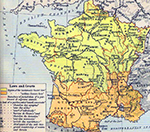
Laws, Courts, Parlements -
France 1789
Depending on the
issue at hand, there were next to the
parlements a few other supreme courts, such
as the
Chambre des Comptes,
the
Cour des Aides,
the Cour des Monnaies,
and the Châtelet.
::
Sansculottes
A Sansculotte, or Sans-Culotte, was a supporter of the French
Revolution from the poorer or lower class.
Culottes
were knee-breeches worn by the upper classes.
The lower class wore pantalons, or long
trousers. Sans is French for without.
The Sansculottes were associated with an extreme
radical and militant view. Hence, it was also
possible to run into people from the upper class who shared
these views and called themselves Sansculottes
while wearing culottes.
Just FYI, today's culottes look like
this:

Victoria's Secret Boxer Culottes
And if someone
today describes you as being culotté
(adjective), you're being sassy, cheeky, or
daring.
|
|
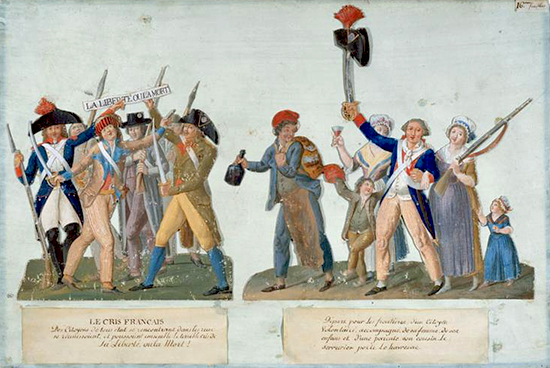
La Liberté ou la Mort ! – Liberty or
Death!
French Revolution 1789–1799
The French Revolution is also called The Revolution of 1789.
|
|
Liberty, Equality and Brotherhood
was one of the mottos in the French Revolution. Such honorable
goals, however, could not prevent the gruesome
Reign of Terror.
The Revolution also introduced the
guillotine, the infamous device for decapitation, in 1792.
Image Above
La Liberté ou la Mort ! – Liberty or Death
Gouache by Jean-Baptiste Lesueur,
who lived 1749-1826, and who created this artwork around 1792.
Formerly attributed to Pierre-Etienne
Lesueur.
Underneath it reads on the left:
"LE CRIS FRANCAIS / Des Citoyens de
tous états se rencontrant dans les rues / se réunissoient, et
poussoient ensemble le terrible cris de / La Liberté ou la Mort."
And on the right it reads:
"Départ pour les frontières d'un
Citoyen / Volontaire, accompagné de sa femme, de ses / enfants et
d'une parente son cousin Le / serrurier porte le Havresac."
In other words:
The French cry / Citizens of all
estates come together in the streets / they gather and shout out
unitedly the terrible cry of / Liberty or Death.
A citizen's departure to the frontiers
/ A volunteer, accompanied by his wife, his / children and a
relative his cousin The / locksmith carries the knapsack.
Musée Carnavalet
|
What Caused the French Revolution?
The immediate cause of the French Revolution was France's financial
crisis after having supported the
American Revolution against
Britain.
France was broke. Which lead to the question, Who should come up
with the money — the clergy, the nobility, or the common people?
Which lead to the question, Shouldn't these three social groups be
treated equally when it comes to paying taxes? Which lead to the
question, If everyone is equal, what's a king doing in France?
People were done with the monarchy and wanted a change. (Ironically,
the monarchy returned to power in 1814 with
Louis XVIII.)
But revolutions are never as simple as that.
In a nutshell, the French Revolution was the result of many economical and social
problems.
France Before the Revolution
The Country
Before the French Revolution, France looked like this on a map:
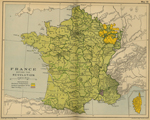
France before the
Revolution
Click to enlarge
His Majesty the King
The King of France had absolute powers. He was
responsible to God alone, which could heighten his sense of
accountability, but effectively meant
nothing if it didn't.
With God or without, it had become common practice in law making to
consult with His Majesty's ministers.
What were their powers? They could refuse to register the king's
edicts. It was frowned upon not to consider the opinion of his
parlement. But in the end, the King could always overrule his
minister's veto with impunity.
France had no written constitution. Royal power was executed
according to tradition.
The Administration
In 1789, France was divided
into 34 généralités, each one taken care of by a royal
intendant. Here is a map of the generalities or intendancies:
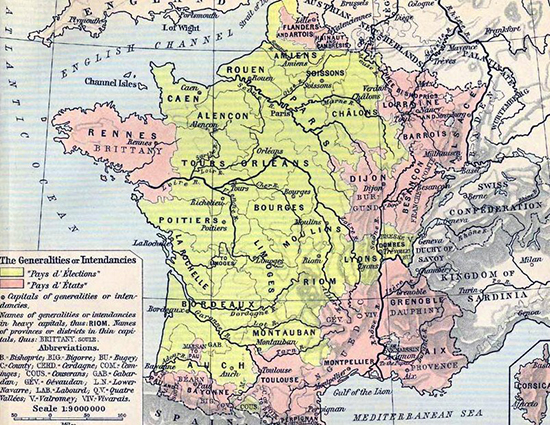
Map of the generalities (généralités) or intendancies
and their capitals.
Click to enlarge.
The French Nation
In 1789, France was the most populated country in Europe.
France represented one sixth of the European population. By 1914, it
was less than one tenth, and in 1950 one fourteenth.
Eighteenth century France had a population of about 26,000,000
people. Around 21,000,000 of them depended on farming.
French society was a social order of privileges.
If you were male and a member of the clergy
(First Estate)
you belonged to a group of about 120,000
people, but you
owned 1/10 of the land. But you had to be a
bishop. There was not much money in being
just a regular priest.
If you were male or female and belonged to the
nobility (Second Estate) you belonged to a group of around
250,000 to 400,000 people,
but you owned 1/5 of the land.
If you were anything else (Third Estate) chances were
50/50 that you couldn't read. Although you
guys owned over 1/4 of the land, it stood in
no proportion to the number of your
population and it was by no means enough to
feed all of you. The Third Estate
represented at least 96% of the French
nation.
Many offices could
be bought or inherited. Attached to these offices came ennoblement
and tax privileges.
And speaking of taxes and tolls, smuggling was rampant to such an
extent that in 1783 a wall was built encircling Paris.
See also
Taxation in
Pre-Revolutionary France.
The Revolution Builds — Brief Summary
After supporting the Colonists in the
American Revolution
(1775-1783,) France
faced serious national debts. Representatives of clergy, nobility,
and the common people (also called the Third Estate) met at Versailles to discuss their options.
Conflict of interests made negotiations impossible. The deputies of
the Commons finally declared they were prepared to proceed alone,
and, on June 17, 1789, formed a
National Assembly.
The king,
Louis XVI, was not pleased and locked them out of their meeting hall.
This prompted the Commons to occupy Louis' indoor tennis court,
taking an oath not to leave until a written constitution had been
agreed upon. This was the Tennis Court Oath
of June 20, 1789.
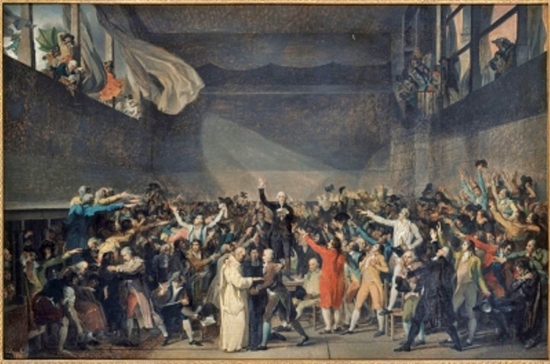
The Tennis Court Oath, June 20, 1789*
Le Serment du Jeu de Paume, le 20 juin 1789
In the center standing on a table is the astronomer
Jean-Sylvain Bailly, who was
appointed president of the Third Estate on May 5, 1789. He reads the
text of the oath.
Oil on canvas by Jacques-Louis David, who lived
1748-1825.
Musée Carnavalet
*
Please note that the official English
title of this painting might be misleading, especially if you are
into sports. Tennis and Jeu de Paume are obviously not
the same thing.
For
more see here. Thanks Marleen for kindly prodding me
to double clarify this.
On July 10, 1789, the National Assembly was renamed
National Constituent Assembly.
On July 11, 1789, the king fired his popular finance minister,
Jacques Necker.
What Started the French Revolution?
The French Revolution officially begun with the
Storming of
the Bastille on July 14, 1789.
A mob stormed the
Bastille
prison in Paris and demanded from the guards to hand over the arms
and ammunition that were stored there.
The guards refused, the mob
wouldn't take a no for an answer and captured the prison, thus proving that power resided with the people.
The days of the
ancien régime were over.
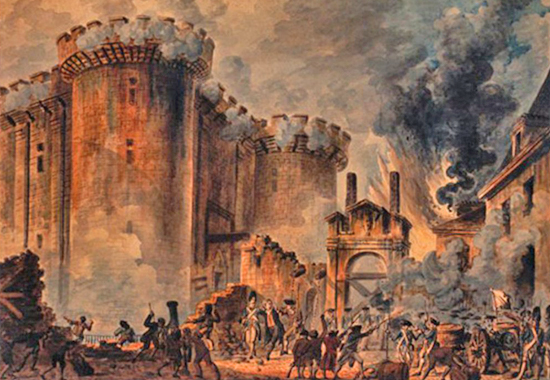
La Prise de la
Bastille (The Storming of the Bastille)
Illustrated in the
center of the painting is the arrest of
Bernard
Rene Jourdan,
the Marquis de Launay. He was the
last governor of the Bastille.
The mob had him lynched later that day.
Painting
by
Jean-Pierre-Louis-Laurent Houel, 1789.
Bibliothèque
Nationale de France
Here is more on the
Bastille, its history, its
prisoners,
and what it stood for.
The Great Fear of July 1789
Rumors of a conspiracy by the king and the aristocracy prompted
peasants to pillage and burn the houses of nobles and to destroy
feudal records.
This became known as the Great Fear of July 1789. These
developments led
to the abolishment of the feudal regime and the adoption of the
Declaration of the Rights of Man and Citizen.
One of the new laws of this declaration seized lands from the Roman
Catholic Church in order to pay the national debt. Additionally, the
church was subjected to severe reorganization.
Pope Pius VI was not amused.
King Louis didn't show himself cooperative and the people of Paris
decided to pay him a visit at his castle at Versailles, forcing the
royal family to relocate to the Tuileries Palace at Paris. These were the
October Days (October 5 and 6, 1789.)
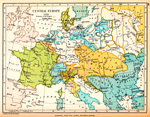
CENTRAL
EUROPE 1789
Click map to enlarge
The French Revolution Runs Its Course
Compared with 1789, the year 1790 seemed all in all more harmonious for the French, especially with a
draft of the constitution in their pocket, and with patriotic events
like the
Festival of the Federation
being held etc.
But in 1791,
Louis XVI made a big
mistake when he tried to flee the country.
This act showed everyone who still had doubts, that Louis secretly
desired that the Austrian and Prussian armies would help him restore
absolutism. He was caught, forced to return, and the little
credibility that he had left was gone for good.
Meanwhile, the monarchies of neighboring nations were alarmed by the French
Revolution.
In France, war was desired by royalists and revolutionists alike
because they believed it would rally the nation to their respective
causes.
France declared war against Austria in 1792 and the
French Revolutionary Wars began.
Originally, France experienced reverses, and these made the
French population susceptible to the ideas of extremists. The revolution
turned radical.
The French Republic was proclaimed. The king was tried for treason
and executed. Countless arrests of royalist and supposed
sympathizers followed.
The news of the advance of the
Coalition added panic to radical.
The killing of more than a thousand political prisoners within six
days in 1792 became known as the
September Massacres and indicated what was
still to come.
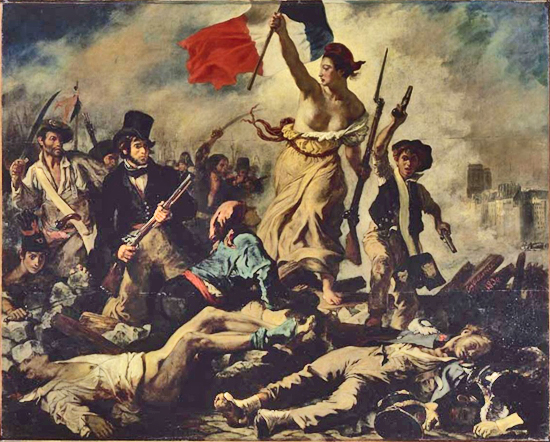
July 28:
Liberty
Leading the People by Eugène Delacroix
Louvre
Image Above
This painting was created by Delacroix
in 1831. "July 28" refers to July 28, 1830, which puts it in the
middle of the
July Revolution.
The July Revolution was fought for three days — from July 27 to July 29,
1830.
How does this painting relate to the
French Revolution?
Let the smart people from the Louvre
explain:
The allegory
of Liberty is personified by a young woman
of the people wearing the Phrygian cap, her
curls escaping onto her neck. Vibrant,
fiery, rebellious, and victorious, she
evokes the Revolution of 1789, the
sans-culotte, and popular sovereignty. In
her raised right hand is the red, white, and
blue flag, a symbol of struggle that unfurls
toward the light like a flame.
...
The towers of
Notre Dame represent liberty and
Romanticism — as they did for
Victor Hugo — and
situate the action in Paris. Their position
on the left bank of the Seine is inexact,
and the houses between the Cathedral and the
river are pure products of the painter's
imagination.
...
This realistic and innovative work, a symbol
of Liberty and the pictorial revolution, was
rejected by the critics, who were used to
more classical representations of reality.
...
It is now
perceived as a universal work — a
representation of romantic and revolutionary
fervor, heir to the historical painting of
the 18th century and forerunner of Picasso's
Guernica in the 20th.
And if you are wondering why Liberty couldn't get her shaving
together, or why the other guy lost sock and pants,
go to the
official site of the Louvre and
read all about it.
Back to the French Revolution of 1789.
The Reign of Terror
Extreme revolutionary actions triggered counterrevolutionary unrest.
This, in turn, was met with even more brutality.
During two years of terror (July 1792 to July 1794) approx. 300,000
suspects were arrested and 16,594 individuals had been condemned to
death by the Revolutionary Tribunal.
Among them was former
Queen Marie Antoinette.
All in all, the victims of the two years of terror were approx.
35,000 to 40,000.
Strictly speaking, the Reign of Terror
refers to the phase from
September 5, 1793, to
July 28, 1794.
Many died in prison or were killed without trial. Meanwhile, the
revolutionary government had launched a mass military recruitment
(August 1793) and
became victorious at war (the
French Revolutionary Wars.)
The Reign of Terror, now spearheaded by
Robespierre, kept
gaining momentum.
Between June 10 and July 21, 1794, also called the
Great Terror, the
terror reached its peak. Within these six weeks, the
Revolutionary Tribunal had 2,554 persons guillotined. Soon,
Robespierre himself was guillotined.
Resistance broke out in form of the White Terror led by the
royalists.
The
Directory, notorious for its corruption, became the new
revolutionary government. This government maintained power for the
remaining four years of the Revolution.
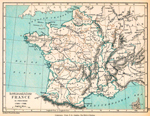
1769 - 1789
France
What Ended the French Revolution?
By a coup, on November 9-10, 1799,
Napoleon
became First Consul of France and proclaimed the
end of the Revolution. This also
ended the
Directory.
And here's a map of Paris during the Revolution:
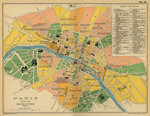
MAP OF PARIS DURING
THE REVOLUTION
Click to enlarge
Key Events of the French Revolution — Brief
Timeline
1789, May 5 - The Estates-General (États
généraux) opens session at Versailles.
1789, June 17 -
Formation of the
National Assembly. Unofficially, the
Revolution has just begun.
1789, June 20 -
Tennis Court Oath.
Declared goal to switch from absolute
monarchy to constitutional monarchy.
Hence, a written constitution was
needed.
1789, June 27 -
Louis XVI
orders the clergy and the nobility to
join with the Third Estate in the
National Assembly.
1789, July 14 - Storm of the
Bastille.
The Revolution officially begins.
1789, August 4 - Abolition of privileges
and the feudal regime.
1789, August 26 and 27 -
Declaration of the Rights of Man and Citizen,
a draft of a constitution.
1789, October 5 and 6 - The royal family has
to move from Versailles to Paris.
1790, July 14 -
Festival of the
Federation (Fête de la Fédération)
1791, June 21 - The king and his family
try to flee
the country. They are caught at Varennes
and brought back to Paris.
1791, July 17 -
Champs-de-Mars Shooting
(Fusillade du Champs-de-Mars)
1791, August 27 - Austria and Prussia
issue their
Declaration of Pillnitz in
which they call on all European monarchs
to aid in the restoration of the French
monarchy.
1791, September 13 - King Louis XVI
accepts the new constitution. The next
day, he signs it in front of the
National Assembly.
1792, April 20 - War declaration against Austria. The
French Revolutionary Wars
begin.
1792, June 13 - Recall of the Girondin ministers
1792, August 10 - Storming of the Tuileries. Overthrow of the monarchy. France is now a
republic. The First Terror
begins.
1792, August 13 - The royal family is thrown into the Temple
prison.
1792, September 2-6 - September Massacres
1792, September 21 - Formal abolition of the monarchy. The
National
Convention is the new
government of France.
1792, September 22 - Proclamation of Republic.
First day of the
French Republican Calendar.
Today is 1 Vendémiaire, year I.
1792, December 25 -
Louis XVI
signs his
Last Will
1793, January 21 - Execution of
Louis XVI
1793, March 11 - The
Wars of the Vendée
begin.
1793, June 2 - Fall of the Brissotins (Girondins)
1793, June 24 -
Constitution of the Year I
1793, July 13 -
Charlotte Corday, a
Girondin, assassinates Montagnard leader
Jean-Paul Marat in his bath.
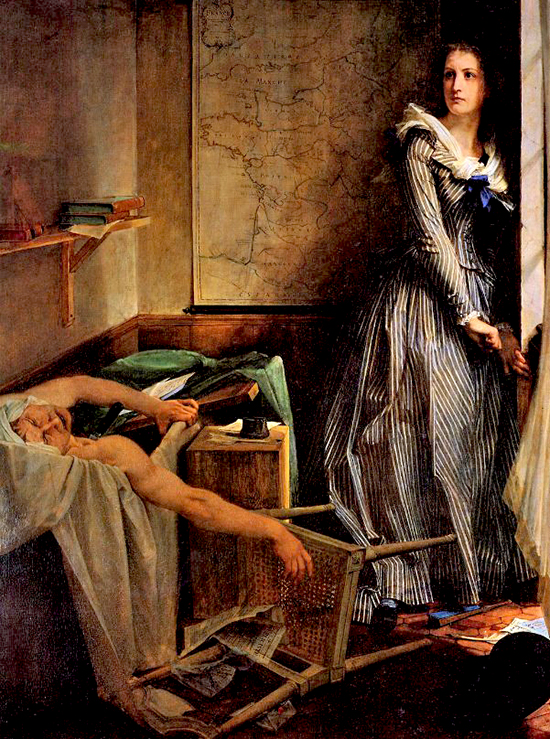
The
Assassination of Marat by Charlotte Corday
Oil on canvas by Paul Baudry, who lived
1828-1886
Musée des Beaux-Arts de Nantes
1793, September 5 - July 27, 1794 - The Reign of
Terror
1793, September 10 - The National
Convention decrees the Revolutionary
Government until peace is restored.
1793, September 17 - The
Law of Suspects
is passed, authorizing the
creation of revolutionary tribunals to
try those suspected of treason against
the Republic and to punish those
convicted with death.
1793, October 5 - The French republican calendar replaces the
Gregorian calendar. It is implemented retroactively and will be used
until January 1, 1806.
1793, October 16 - Execution of
Marie Antoinette.
1793, December 4 - The National Convention confirms the creation of
the Revolutionary Government by passing the
Law of 14 Frimaire, year II.
1794, June 8 -
Festival of the Supreme Being (Fête
de l’Être Suprême)
1794, June 10 - Beginning of the Great
Terror
1794, July 28 - Execution of
Robespierre
1795, May 20 - Insurrection of the
Sansculottes
1795, August 22 - Constitution of the year
III
1795, October 27 - The Conseil des Cinq-Cents replaces the
Convention Nationale
1795, October 31 - Inauguration of the
Directory
1796, April 10 - Beginning of the
Italian Campaign.
1797, September 4 - Coup d'état of 18
Fructidor, year V. Encouraged by Napoleon, the Directory
eliminates the royalists from the government.
1798, May 11 - Coup d'état of 22 Floréal,
year VI. The Directory invalidates half of all elections
to eliminate the Jacobins.
1798, July - Beginning of the
Egypt Campaign.
1799, November 9
Napoleon takes power
(Coup d'Etat du 18 Brumaire).
The Revolution ends. The Directory is
replaced by the
Consulate.
Political Aftershocks, Mini-Revolutions, and
Coups Following July 14, 1789
Filtered from
the list above, the following events
redefined or challenged the government.
December 4,
1793
Law of 14 Frimaire, year II
The
National Convention
establishes the Revolutionary government.
July 27, 1794
Revolution of 9
Thermidor, year II
The
National Convention ends the Reign of
Terror that was created and kept alive by the Committee
of Public Safety.
May 20, 1795
Revolt of
1 Prairial, year III
The uprising of the
Sansculottes.
September 4, 1797
Coup of 18
Fructidor, year V
The
Directory extracts royalists and other
undesired individuals from the
administration.
May 11, 1798
Coup of
22 Floréal,
year VI
The
Directory
monkeys with the election results to get rid
of the Jacobins.
November 9-10, 1799
Coup of 18-19
Brumaire, year VIII
The Directory ends, the
Consulate begins.
May 18, 1804
Proclamation of the Empire
The Consulate declares
Napoleon I Bonaparte
Emperor of France.
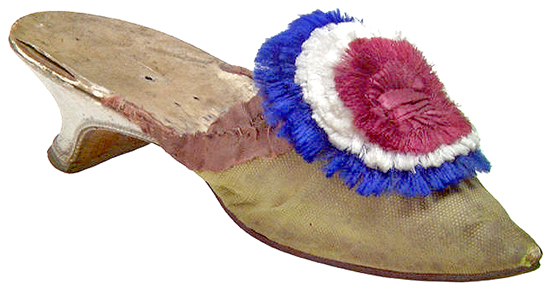
French Revolutionary Slipper
Liberty Heels at the Musées de France
More Timelines
Here is a different
French
Revolution Timeline,
illustrating the revolution in the stream of
time alongside the American Revolution and
the American Civil War.
And here are the detailed timelines:
French Revolution
Timeline: 1789
French Revolution
Timeline: 1790
French Revolution
Timeline: 1791
French Revolution timelines for the years
1792-1799 are combined with the French
Revolutionary Wars timelines:
French Revolutionary
Wars Timeline - 1792
French Revolutionary
Wars Timeline - 1793
French Revolutionary
Wars Timeline - 1794
French Revolutionary
Wars Timeline - 1795
French Revolutionary
Wars Timeline - 1796
French Revolutionary
Wars Timeline - 1797
French Revolutionary
Wars Timeline - 1798
French Revolutionary
Wars Timeline - 1799
See also
Governments
of France
And maybe
Forms of Government
And here is a chart of the
French armies from
1791-1802, their creation, their
commanders, their timeline.
More French Revolution Maps
1789 France
1789 Paris
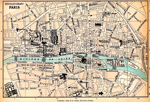
1789
Revolutionary Paris
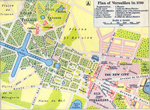
1789
Versailles
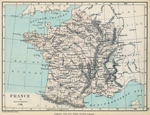
1790 France
More History
|



