Home - History Dictionary - G - Z


History Dictionary

A - F     G - Z


G

Garter, Order of the
British award for knights


MORE ABOUT THE ORDER OF THE GARTER


Glasnost & Perestroika
Gorbachev's openness and restructuring.

MORE ABOUT GLASNOST AND PERESTROIKA


Great Depression
Worst decade for the economy worldwide.


MORE ABOUT THE GREAT DEPRESSION


Granicus
River in today's Turkey.


MORE ABOUT THE RIVER GRANICUS


Guerrilla Warfare
If you are a guerrilla, also spelled guerilla, you are a person who engages in irregular warfare especially as a member of an independent unit carrying out harassment and sabotage. Or so Merriam-Webster defines it.

MORE ABOUT GUERRILLA WARFARE


H

Hanseatic League
Commercial alliance between towns in northern Germany.

MORE ABOUT THE HANSEATIC LEAGUE


Helots
The Helots were conquered Messenians. Messenia was conquered by the Spartans, who started their conquest around 735 BC. The Spartans made the Messenians their slaves.

The world Helots derives from the Greek world Heilotes, which is the plural of Heilos, which in turn is commonly associated with the Laconian town Helos that was reduced to serfdom by Sparta.

The word Helots could also be related to the Greek word halonai, which means be captured.

Here you can find the map location of Messenia. Look for the boxes BC-bc. You will find the town Helos underneath the letter N of Laconia.
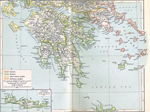
Ancient Greece. Southern Part.
Ancient Greece (south)


The Helots didn't appreciate the treatment and were able to stand strong during some revolts, the Messenian Wars.


Helvetic Republic
The French idea of Switzerland. During the French Revolutionary Wars, France decided to visit / invade the Swiss and set up a new government, the Helvetic Republic, which lasted from 1798 - 1803.

MORE ABOUT THE HELVETIC REPUBLIC


Hindenburg (aircraft)
World's largest rigid airship.


MORE ABOUT THE HINDENBURG


Holocaust
Systematic killing of Nazi opponents during World War II.


MORE ABOUT THE HOLOCAUST


Holy See
The Holy See is the Vatican.


Hudson's Bay Company
Fur trade and much more in Canada.

MORE ABOUT THE HUDSON'S BAY COMPANY


Huguenots
French Protestants.

MORE ABOUT THE HUGUENOTS


I

Ides  
PRONOUNCE IDES

In the Roman calendar the Ides were the middle of a month: the 15th of March or May or July or October or the 13th of any other month. Julius Caesar was assassinated on the Ides of March 44 BC, or on March 15, 44 BC.

More on the calendar in general and the Roman calendar in particular from the Encyclopedia Columbia.


Inquisition
Polite invitation to convert to Catholicism.

MORE ABOUT THE INQUISITION


Issus
Historic spot in Turkey.

MORE ABOUT ISSUS


K

Khmer Rouge
Cambodian native or communist.

MORE ABOUT KHMER ROUGE


L

Languages
The stuff we say and why we say it the way we do.

MORE ABOUT THE ROOTS AND HISTORY OF LANGUAGES


L

Lotharingia
Another word for Lorraine. Named after king Lothair who was king of Lotharingia 855 - 869.


M

Man-of-war
An armed warship. Unless you talk about a Portuguese man-of-war, which is a jellyfish. It gets rather tricky when you try to refer to a Portuguese armed warship.


Manhattan Project
Successful atomic bomb research.

MORE ABOUT THE MANHATTAN PROJECT


Mayflower
Vessel of the year 1620.

MORE ABOUT THE MAYFLOWER


Mediatization 
or Mediatisation. Annexation of smaller states. If you were a sovereign of a smaller German state in the early 1800s, you had a good chance to get legally mediatized, or mediatised.

MORE ABOUT THE GERMAN MEDIATIZATION OF THE 1800'S


Medising
If you were medising in ancient Greece, you were sympathetic to Media and the Medes, or more to the point, you were in favor of the ruling Persians, because in 550 BC, Cyrus II the Great had made Media part of the Persian Empire. The noun is medism.

SEE A MAP OF MEDISING STATES IN ANCIENT GREECE


Microhistory
The study of history on a very small scale. More info from Microhistory.org. Here is an example of microhistory on William Shakespeare.


Mir
The mir is a Russian community council.


Mithra
Mithra was an ancient warrior god of sun and light in Persia and India. In India it was called Mitra. The god was in popular demand from the 5th century B.C. until the 3rd century A.D. In Latin and Greek it was called Mithras.

Interestingly, the Mithraists celebrated the birth of Mithra on December 25. Mithradates VI Eupator was named after this god.


Mummies
Preserved dead bodies.


MORE ABOUT MUMMIES


Nobel Prize
Award initiated by Swedish inventor Alfred Bernhard Nobel.

MORE ABOUT THE NOBEL PRIZE


O

Oglala
A branch of the Sioux tribe. Crazy Horse was an Oglala.


Old Style / New Style Dates
The Old Style Calendar is the Julian calendar. The New Style Calendar is the Gregorian calendar, the one we use today.

The switch from Old to New Style Calendar was somewhat choppy, each country adopted it whenever they were good and ready. France, for instance, adopted it in 1582 but it took Greece until 1923.

If you have no clue what this is about, here is an example: If you look up the October Revolution, you might find the dates given as October 24 - 25, 1917 (November 6 - 7, 1917, New Style.) Why two dates? Because it took the Soviet Union until 1918 to adopt the New Style Calendar. Which is why the October Revolution actually took place in November.

Confused? Probably not as much as the British were when, in order to switch from Old to New Style Calendar, their September 2, 1752, was followed by September 14, 1752.


Okhrana
The secret police of Russia's tsar. Father Gapon was on their payroll.

MORE ABOUT FATHER GAPON


Oprichniki
The goons that were on Ivan the Terrible's payroll.


P

Panticapaeum
Today's Kerch in the Ukraine. Mithradates IV Eupator died here.
More info on Panticapaeum provided by the Encyclopedia Ukraine.


Papal Legate
If you are a papal legate, then you're a direct representative of the Pope to a certain country and authorized to settle any matters regarding the Church. All in all, you are very powerful. William Longchamp was made papal legate for England in 1190.


Perestroika
Reorganization a la Gorbachev.

MORE ABOUT PERESTROIKA


Pilgrims
If you are referring to pilgrims, they can either be a) people who travel in foreign lands or b) people who travel to holy places for religious reasons. If you capitalize the Pilgrims then you are talking about c) the bunch of English colonists who came to Plymouth, Massachusetts in 1620. These guys launched the first stable New England colony.

Here's more about their voyage and their ship, the Mayflower.


Poet Laureate  
PronouncE POET LAUREATe

If you are a poet laureate in England you are officially the top poet of the country and, best of all, you get a salary from the royal household. Alfred Tennyson was one of the lucky bastards. If you are a poet laureate in the US you are also the consultant in poetry for the Library of Congress and have to show up at certain national ceremonies. Here is a list of the all poets laureate.

Why laureate you ask? The laurel was Apollo's favorite tree. Apollo in turn was the god of music, dance, rubber ducks, and poetry.


Politburo
Heart of the Communist Party of the Soviet Union.


MORE ABOUT THE POLITBURO


Pontifex Maximus
Highest priest


Pope
Head of the Roman Catholic Church. The Greek word papas originally means father. Later the term was used in the sense of bishop and patriarch.

LIST OF ALL POPES


Praetor  
PronouncE PRAETOR

Roman high official; judicial officer.


Praetorian Guard
Bodyguards of the Roman Emperors. Constantine the Great suspended the famous guards.


Punic
Language of ancient Carthage. Also all things related to the Carthaginians.

MORE ABOUT WHAT'S PUNIC


Q

Quaestor  
PronouncE QUAESTOR

Lowest ranking Roman magistrate


R

Red Scare
Extreme anticommunism. The fright of Communists.

MORE ABOUT THE RED SCARE


Rhine, Confederation of the
Napoleon's buffer states and allies against Prussia and Austria.

MORE ABOUT THE CONFEDERATION OF THE RHINE


Risorgimento
A movement in the 19th century to unify Italy. Giuseppe Mazzini and Giuseppe Garibaldi were prominent figures in this movement.


S

Sanskrit  
Pronounce Sanskrit

A language of India. No longer spoken. It goes way back to 1100 B.C. Some think Sanskrit is an even more refined language than Greek and Latin.


Satrap
A satrap was a governor back in the days of the Achaemenian dynasty and Alexander the Great.

MORE ABOUT SATRAPS


Scutage
If you owed your lord military service but didn't serve, you had to pay scutage, a military tax. John of England was going to collect scutage from his barons, who should have supported him on his campaign against France in 1214, but didn't.


Second Triumvirate
Mark Antony, Lepidus, and Octavian.


MORE ABOUT THE SECOND TRIUMVIRATE


Secularization 
or, Secularisation, occurred when ecclesiastical belongings were given to secular entities. In other words, church stuff became lay stuff. This kind of transfer took place many times in history. One of the largest incidents of Secularization evolved in 1803.

MORE ABOUT THE SECULARIZATION OF 1803


Serf System
aka Serfdom. The habit of keeping peasants as serfs, who are by definition, but not necessarily in practice, a little bit better off than slaves.

More or less related terms are bondservants, bond slaves, menials.


Seven Wonders of the World 
The top seven of architecture.

MORE ABOUT THE SEVEN WONDERS OF THE WORLD


Ship Money 
Tax in the history of England and Wales.

MORE ABOUT SHIP MONEY


Ship-of-the-Line 
A sailing warship built to fight in the line of battle. A Ship-of-the-Line usually has at least two gun decks.


Soviet  
A Russian group of people who, as a committee, had ruling authority.


MORE ABOUT THE SOVIET


Spanish Armada  
A cheerful group of 130 ships with the mission to make England Spanish.


MORE ABOUT THE SPANISH ARMADA


Spartacus League
Or Spartacus Party, German organization of extreme Socialists 1916 - 1919, named after Roman gladiator Spartacus. Karl Liebknecht and Rosa Luxemburg were leaders of the Spartacus League.


Stars and Stripes
US flag.

MORE ABOUT STARS AND STRIPES


T

Teutonic Order
The Teutonic Knights kicked rear during the Third Crusade and later in the Baltic regions.

MORE ABOUT THE TEUTONIC ORDER


Titanic  
Luxury ocean liner that sank on its maiden voyage in April 1912.

MORE ABOUT THE TITANIC


Totalitarianism 
According to Oxford English Dictionary, totalitarianism is a system of government which tolerates only one political party, to which all other institutions are subordinated, and which usually demands the complete subservience of the individual to the State.

Case in point, the Bolsheviks' all-parties-get-left-behind policy in the Russian Civil War 1918-1920.


Triumvirate 
A board of three in ancient Rome.


MORE ABOUT THE TRIUMVIRATE


V

Valor Ecclesiasticus
Henry's church survey.


MORE ABOUT VALOR ECCLESIASTICUS


W

Watergate Scandal 
President Nixon and his team messing up entirely.


MORE ABOUT THE WATERGATE SCANDAL


Z

Zemstvo
The zemstvo, or plural zemstvos, were public elected local councils in Russia, established in 1864.


Zero, the year  
Sometimes you might have to count back and forth between B.C. and A.D. and find a year missing. Here's the deal about the year zero: It didn't exist.

There was the year 3 B.C., followed by the year 2 B.C., followed by the year 1 B.C. followed by the year 1 A.D., followed by the year 2 A.D., followed by the year 3 A.D.

For all things calendar, check Claus Tondering's fine site.


© Copyright 2005 - 2010 Emerson Kent. All rights reserved.