|

EMILIANO ZAPATA
1879 - 1919
Expert in Guerrilla
Warfare for Mexican Land and Liberty
Emiliano was a
Mexican revolutionary general and just the type of guy
you would think Marlon
Brando would be interested in
portraying. And guess what... So it happened.
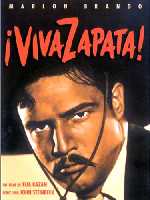
Check out
 Viva
Zapata! from 1952. Viva
Zapata! from 1952.
|
|
Emiliano Zapata led the peasants of southern
Mexico in the
Mexican Revolution.
His slogan was
Tierra y Libertad, or
Land and Liberty.
In a
nutshell, Zapata wanted the land that the huge hacienda
owners had snatched from the peasants restored
to them.
|
Emiliano Zapata's Character,
Talents, and Looks
Historians describe Emiliano Zapata as
a skilled guerrilla warrior, an excellent horseman, and a very
humble person.
Only few could match his ability to ride long distances and few
could equal his skill as a rider.
It is also said that Zapata was shy
and reserved, that he avoided personal glory, and that he could've
become much more powerful, if power would've been what the man was
after. Zapata's quiet assumption of power won him respect.
With a solid mustache, Emiliano Zapata
was a tall man, although not as tall as
Pancho Villa, which you
might find surprising, but Pancho was rather on the beefy
side, so there. Matching Zapata's physique was his voice - thin and high. Zapata
was efficient and honest. The man was no fake and that was one main
reason for his popularity. So what if it sounded funny when he
spoke, soft spoken Zapata was never a friend of many words anyway.
When he did speak, his words were smart and to the point.
A true peasant in the best sense of
the word, Emiliano loved the land and was ready to fight for it.
What was Zapata's principal
personality trait? Some people say it was his pigheaded
stubbornness. Others say caution was a prime characteristic.
Zapata looked always neat as a pin. Some interpret his style and
choice of wardrobe as arrogant and cocky. Others say, he was merely
dressing like any other typical village chief, who would wear his
best clothes.
In any event, Zapata had the reputation of being fair, cautious, yet
forceful and resolute, a man who always kept his word.
Toward reporters Zapata was always polite but rather
uncommunicative. He felt uncomfortable in the presence of
politicians and preferred the company of ordinary villagers.
And it is said that Zapata had a good sense of humor.
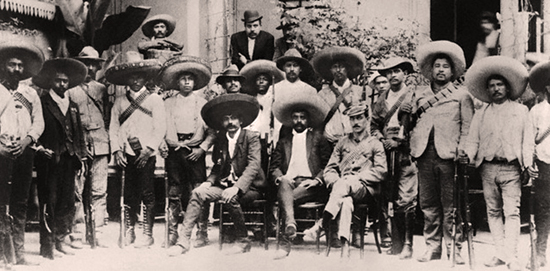
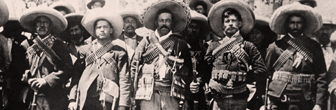
Emiliano Zapata and his Sombreros in 1914
Bettmann Archive
Emiliano Zapata's Background
The issue in Emiliano's days was land
grabbing. The big plantation owners tried to absorb all the land
there was without exception, leaving high and dry the people who
formerly lived off the land.
Thus, haciendas were suffocating
villages. Many people didn't have any other choice than becoming a
resident labor (gente de casa) who permanently moved onto a
hacienda.
By the way, what was produced on the plantations? Mexico's main
products were sugar, rum, and rice. In
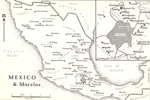
Morelos, Zapata's home state,
the rural leaders reacted against the expansion of the sugar
estates.
Emiliano Zapata's Family
Emiliano Zapata's father was
Gabriel Zapata. He was a horse
trainer and dealer. Of horses, that is. Gabriel Zapata was
considered an expert when it came to horse training and breeding.
Gabriel's brothers were Cristino
and José, who fought against
France in the
War
of the French Intervention.
Emiliano Zapata's mother was
Cleofas Salazar. Cleofas' father
was José Salazar, who fought
against Spain in the
Mexican War of Independence.
Cleofas' brother was León Salazar,
who in turn had a son named
Amador Salazar Jiménez,
who was also a busy revolutionary.
When living off the land became
insufficient, the Zapata Salazar family started to sell and purchase
animals and to specialize in small livestock breeding. This gave
them some independence from the Hacienda del Hospital, which
was the big sugar plantation that dominated the area.
At the age of 16 Emiliano lost his
mother and 11 months later his father as well.
One of Zapata's brothers was
Euphemio Zapata, who was six years
his senior. Euphemio was gunned down in the streets. Check the
timeline entry.
Emiliano was 31 years old when he
married Josefa Espejo, the
daughter of a livestock dealer in Villa de Ayala. By that time
Zapata already had one child by another woman,
Nicolas. Josefa spent much of the time with her
husband, always quiet and keeping in the background.
Emiliano Zapata had approx. 5 more
illegitimate kids.
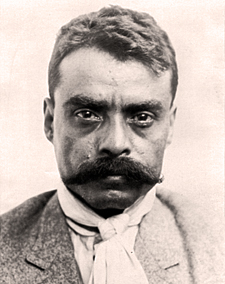
MEXICAN REVOLUTIONARY EMILIANO
ZAPATA
Archivo Cassola
Emiliano Zapata's Life
Zapata lived 39 years. He was born in
the tiny peasant village of Anenecuilco, Morelos, which featured at
the time around 90 houses. A stream of the same name, Anenecuilco,
ran through the village.
Most villagers were employed on the
haciendas. They worked as farm hands, functioned as slaves, and were
officially treated as serfs.
Following in his father's footsteps,
Zapata became a horse trainer.
Aged 26, Emiliano Zapata was one of
the representatives for his village. The occasion? The residents of
Anenecuilco and Villa de Ayala asked for a meeting with the governor
of the state Morelos, Manuel Alarcón,
as well as with the manager of the Hacienda del Hospital in
order to bring the peasant's desperate situation to the attention of
these men. The meeting did not bring any solution.
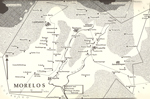
By the way, here is where it all
happened:
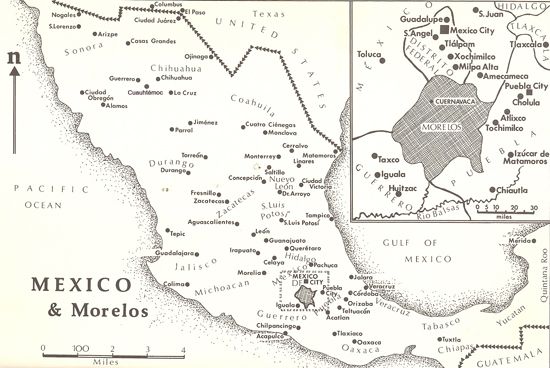
Map of Morelos, Mexico - 1910
Click to enlarge
In the elections for governor of the state of Morelos, Zapata
supported the independent candidate
Patricio Leyva, who ran against
President
Diaz' favorite, the
hacienda owner
Pablo Escandón.
Escandón won the elections. The year?
1909.
The town elders of Anenecuilco elected
Zapata to defend the villagers' right to have their own lands and to
get back what had been stolen. This put Emiliano Zapata officially
on the governmental blacklist and he was force-drafted into the
federal army. Emiliano joined the Ninth Cavalry Regiment with
headquarters at Cuernavaca. His commander was
Colonel Ángel Bouquet.
Ignacio de la
Torre y Mier was the owner of the Tenextepango
Hacienda, as well as the son-in-law of Diaz, which always helps.
Ignacio arranged Zapata's discharge and hired him as his chief groom
and horse specialist at his Mexico City stables. Emiliano did not
last long in this position and decided to return to his town, where
the indifference of the government hadn't change a thing in favor of
the peasants. Quite on the contrary.
Generally, the problem of the hacienda
owners was that they didn't hear well when peasants tried to talk to
them. Thus, Zapata and his men took action. They re-took the lands by
force, and distributed it among themselves. The lands in question
were llano de Huajar, Anenecuilco, Villa de Ayala, Moyotepec. The
date? Mid 1910.
In detail:
Zapata and approx 80 armed men marched to the fields they had
recently been kicked off from by the Hacienda del Hospital
management. When Zapata and his friends appeared, the hacienda
guards and the farm hands cleared out.
The Hacienda del Hospital
administration was gnashing teeth and demanded rent from the
Anencuilco farmers, who refused. Brought before a judge, a ruling
was issued in favor of the farmers. Zapata sent a letter to
President Diaz, who also backed down. Soon, other villages followed
the Anencuilco example.
But Zapata and his men still saw the need for change on a higher
level. When
Francisco Madero
announced his
Plan of San Luis Potosí, Zapata
and his men couldn't agree more and decided to fight on Madero's
side.
It worked. Old dictator Porfirio Díaz
resigned, appointed foreign secretary
Francisco
León de la Barra as interim president and
Zapata's new problem became . . . Madero.
Zapata asked Madero to arrange for the
hacienda owners to restore the lands to the peasants. Madero, now
caught between many chairs, said No. Instead, Madero offered Zapata
money to buy some land. Madero also told Zapata to lay down his
arms.
Madero meant it and Zapata took it to
heart. Emiliano Zapata announced his retirement, went home, and got
married.
Zapata retires - El Pais article June 22, 1911
Click to enlarge
However, things did not improve even
after Madero was officially announced president. Action oriented
Zapata therefore came up with
The Plan of Ayala and declared
the Revolution back in full motion as the main objective hasn't been
met yet.
About the Plan of Ayala
Zapata had high hopes in Madero. But he quickly realized that Madero
would not keep his promises regarding the return of the lands to the
peasants. Zapata therefore thought up a plan that would replace
Madero's
Plan of San Luis Potosí. A plan that would express
the social goals of the Revolution and that would serve as guideline
and principle for all future revolutionary actions.
Although able to read and write,
Zapata appreciated some academic help. This help materialized in the
persons of
Otilio E. Montaño and
José Trinidad
Ruiz.
As a result,
The Plan of Ayala, basically put the
following points on record:
- Contrary to
earlier thinking, Madero is not the man who
can bring about the goals of the Revolution,
i.e. return of the lands.
- Therefore, the Revolution is recommenced
with full force.
- The goal is to set up an interim
government until free elections are
possible.
- Land should be restored to the peasants.
Moreover, all lands formerly belonging to
the big haciendas should be distributed
among the people. The haciendas can keep a
third. Haciendas that don't accept this rule
get nothing.
- The new slogan is Tierra y Libertad,
or Land and Liberty
Here you can read the
English translation of The Plan of Ayala.
Why was it called The Plan of Ayala?
Because Zapata had his headquarters close to Villa de Ayala. Check
the map below, Villa de Ayala is located in the state of
Morelos
and you can find it just underneath / left of
Cuautla, pretty much center of
the map.
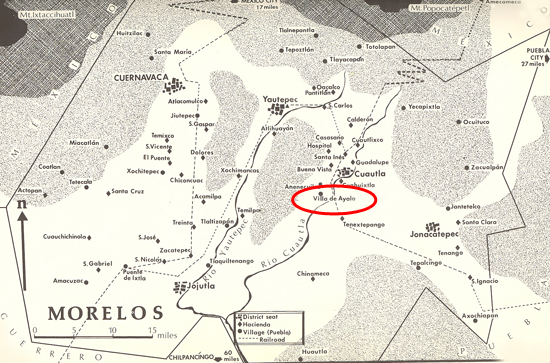
LOCATION OF VILLA DE AYALA, Morelos, Mexico - 1910
Click to enlarge
Implementing the Plan of Ayala
Zapata meant what he said and
expropriated as he went and executed if he had to. Here and there
things gotten out of hand but basically Zapata and his men stayed
true to their declared goals.
The idea of
guerrilla warfare is to avoid
open battle. Thus Zapata ambushed the rich, the national
institutions, and the federal army wherever and whenever possible
and thus supplied his men with food and ammunition.
It went reasonably well for Zapata. The peasants who received lands started working on it, keeping their
arms within reach. However, Zapata had trouble going from guerrilla
harassment to open warfare, which would have been desired in order
to bring in a lasting victory.
Equally annoying for Zapata was that
his army constantly lacked trained soldiers and sufficient ammunition.
Always suffering from a severe shortage of equipment, it was
impossible for Zapata's men to hold the
towns they had taken for any length of time.
Meanwhile in Mexico City:
General
Victoriano Huerta
overthrew
Francisco Madero
and made himself president, or rather dictator. Zapata
wasn't fond of this concept, he wanted an elected president. Hence
Zapata joined forces with other revolutionaries, such as
Pancho Villa,
and supported
Venustiano Carranza
for president.
Carranza was surrounded by a decently
numbered following himself, also known as the
Constitutionalist Army. Together they succeeded.
Huerta was exiled.
The Zapatistas and the Villistas
wanted General Eulalio Gutiérrez
as temporary president until elections could be held. The
Carrancistas wanted Carranza as president. Fighting broke out.
Now on each other's throat were:
the Moderates, aka the Carrancistas,
against
the Conventionsts, aka the Revolutionaries,
who were the Villistas and the Zapatistas.
In his neighborhood, Zapata reorganized and put reforms in place. He
became the Agrarian Leader, which also was the title of a
painting by Diego Rivera.
|
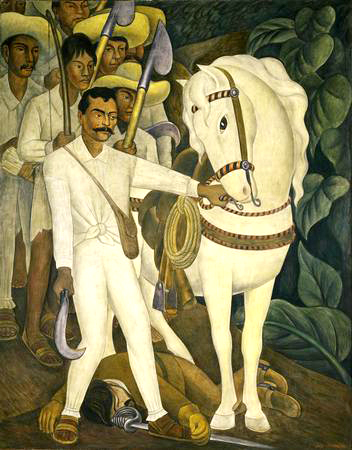
AGRARIAN LEADER ZAPATA
By
Diego Rivera, 1931
Library of Congress
... shows Zapata in traditional Cuernavacan garb equipped with a sugarcane knife. The guy who
came
on his horse wasn't invited. |
|
Things went downhill when Carranza
forces defeated Villa in 1915.
Zapata managed to
re-organize his home state Morelos and people were fairly content
with their lives there.
One thing Zapata didn't accept was
military officers who interfered in village affairs. Zapata refused
to organize a state police. He thought that was the obligation of
each individual village council.
All in all, life improved but these
changes only covered the Morelos area, which prompted the people of
Morelos to seek independence from the rest of the country. And there
was no way the rest of the country would let them do that, of
course.
By 1917 Villa was finished. |
Carranza became the official president
and completely ignored Zapata reform and reorganization wise, which
was a shame because Zapata had already managed to set up order and
justice within his surrounding area, thus proving that
The Plan of Ayala was indeed
practical.
Emilio Zapata's Staff
Among others, Zapata's generals were:
his brother
Eufemio Zapata,
Genovevo
de la O,
Francisco Pacheco, and
Gildardo
Magaña, who became Zapata's successor.
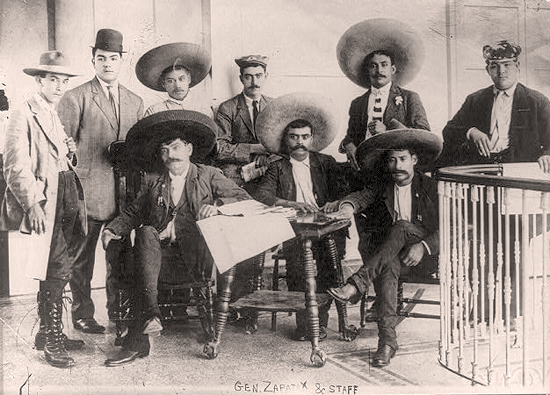
GENERAL EMILIANO ZAPATA AT
STAFF MEETING
Library of Congress
Emiliano Zapata's Death
Carranza wanted Zapata gone for good,
and he put
General Pablo González
in charge of this task. González suggested an ambush.
It went like this:
Colonel Jesús Guajardo pretended
he was ready to defect to the Zapatistas. He asked for a
meeting with Zapata at Chinameca, Morelos. Zapata came, was shot,
and his body buried in Cuautla. (See video clip of Zapata's funeral)
Now...
Some say Zapata let it purposely come
this far. These people argue that Zapata acted completely out of
character, completely against the advice of his aides, and
completely against the reports of his spies. Throughout his career,
Zapata constantly urged caution. The man was suspicious by nature.
Check the entries in the
timeline of the Mexican Revolution.
|
Emiliano Zapata's Short Biography
|
|
August 8, 1879 |
|
Birth in Anenecuilco, Morelos, Mexico |
|
April 15, 1906 |
|
Represents his village at a meeting with the governor of
Morelos to discuss the dire situation of the peasants |
|
February 7, 1909 |
|
Elections for Governor of the State Morelos |
|
September 12, 1909 |
|
Becomes the man in charge for defense in his village |
|
February 11, 1910 |
|
Joins army |
|
March 29, 1910 |
|
Works for the stable of
Ignacio de la Torre y Mier |
|
Mid 1910 |
|
Back home and busy
distributing lands among the peasants |
|
June 22, 1911 |
|
Announces retirement from
revolutionary activities |
|
June 26, 1911 |
|
Marries Josefa |
|
November 1911 |
|
Madero elected president |
|
February 1913 |
|
Huerta new president |
|
1914 |
|
Huerta flees, Zapata and Villa fight Carranza |
|
April 1915 |
|
Carranza forces defeat Villa |
|
May 1917 |
|
Venustiano Carranza officially new president |
|
April 10, 1919 |
|
Death in Morelos |
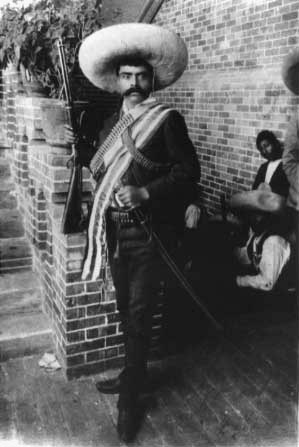
Guerrilla leader EMILIANO
ZAPATA
Archivo Cassola
Strengths
Zapata's loyalty for his countrymen
and their right to posses their own land. For this right he would
fight anybody without compromise.
Emiliano led an army, the Ejército Libertador del Sur, or Liberation Army of the South, fought a guerrilla war, and looked competent while doing it. His men
paid him respect.
At its peak, the Liberation Army of
the South consisted of about 25,000 troops.
Weaknesses
Some say Emiliano was a ruthless
revolutionary. Others refer to the fact that he always tried to keep
his men civil. When they entered a city, they humbly went from door
to door asking people for food. Yes, there were some incidents of
ruthless behavior, the Zapata supporters argue, but it was a
revolution, not a picnic.
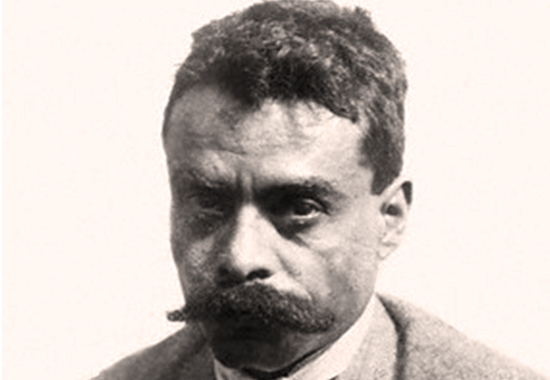
GENERAL EMILIANO ZAPATA IN 1914
Archivo Cassola
More History
|