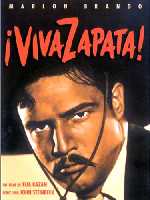
And if you are looking for something
that will help your students understand how the Mexican Revolution
got started, the movie
Viva Zapata (1952) might be for
them.
The Mexican Revolution
— When Did It Start? When Did It End?
The Mexican Revolution officially
started on November 20, 1910, although fighting broke out earlier
than that. However, November 20 it is because this date was chosen
by Francisco Madero in his
Plan of San Luis Potosí.
Historians disagree when it comes to
its ending point. Commonly used is the year 1920 but some say it was
in 1917, a few others even favor the year 1940.
What is the Number of
Casualties of the Mexican Revolution?
Hard to say. Historians estimate that
approx. 1,000,000 people died during the Mexican
Revolution. Some even say it was more than 2,000,000 people.
On top of that we have another approx. 300,000
people who died during the flu epidemic in 1918.
All agree on one fact, the human cost
of the Mexican Revolution was massive.
Much simplified, there were two main reasons for
discontent in Mexico. One was dictator Porfirio Díaz. The other was
the plantations owners.
Of course, a revolution is never that simple.
But
let's have a closer look at these two causes of the Mexican Revolution.
Causes of the Revolution —
Dictator Porfirio Díaz
After having been president for 20
years, Porfirio Díaz told an American journalist that he was looking
forward to retire and that he would welcome to see an opposition
party emerge. This was the
Creelman Interview and
stirred the entire nation.
There were two options: Either Díaz
spoke the truth or not.
Knowing Díaz, this could have
been a trick to detect and filter out his opponents. But it was
equally scary if he was indeed speaking the truth. How come?
Because Díaz had such
a tight grip on all governmental affairs and nobody else had been trained up to rule the
country.
Causes of the
Revolution — The Plantation
Owners
The industrial revolution brought
about newer and better milling machines. Hence, sugar, rum, and rice
plantations grew in size and importance until the plantation owners
owned pretty much every bit of land that had been up for sale.
The hacienderos still wanted more
but couldn't get the peasants to sell their land because it was
their livelihood. So the hacienda owners started
to trick, pressure, bribe, and blackmail the
peasants off their lands.
Entire villages disappeared and the
haciendas became huge.
What options did
José Doe have in those days?
a) He could
try to find other legal sources of revenue (very
limited option.)
b) He could become fully dependent on the haciendas,
which would eventually suck him dry. Typically, people first signed on as laborer, then
they moved in with their bosses on the
hacienda as a gente de casa,
aka serf.
c) He could become a criminal, which might or might
not beat becoming the slave of a plantation
owner.
People had their backs against the wall — the
fundamental requirement for any revolution.
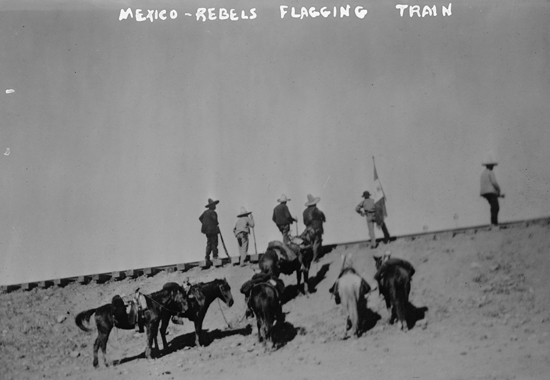
Mexico - Rebels flagging train
Library of Congress
Who fought the Mexican Revolution?
Here are some of the revolutionary forces, main combatants of the
Mexican Revolution and their armies:
The Revolutionary
Forces — División del Norte
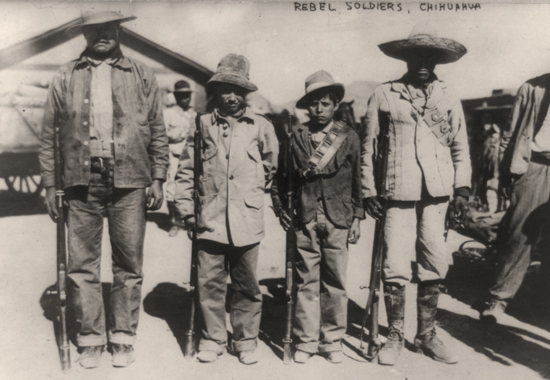
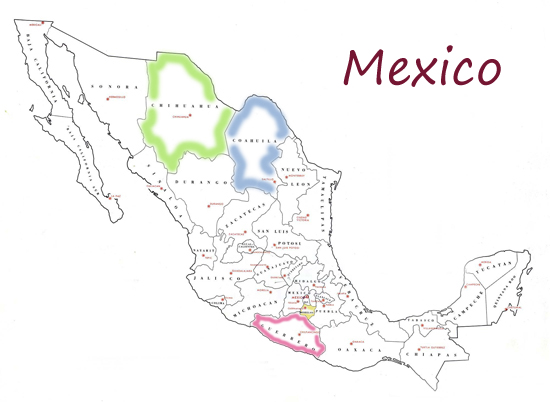
Pancho Villa and his men were fighting
in the Mexican state Chihuahua, and generally the
northern part of Mexico. Pancho Villa's army was called the
División del
Norte, the Division of the North.
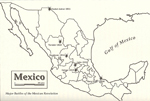
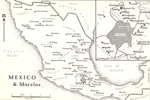
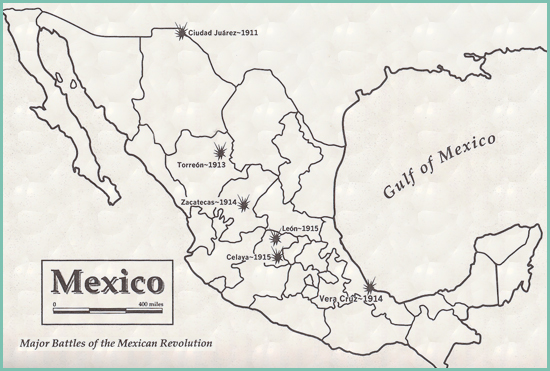
Chihuahua has the lime green border on the
map below.
The
Revolutionary Forces — Ejército Libertador del Sur
Other Revolutionary
Fractions — The Figueroa Brothers
Ambrosio Figueroa and his
brother Francisco Figueroa were rebel leaders in the
Mexican state Guerrero. They fought for Madero but against Diaz,
Huerta, and Zapata.
Manuel Asúnsulo was also a rebel leader in the state of
Guerrero. He is described as a courteous and young aristocrat, a
trained mining engineer, who was educated in the States.
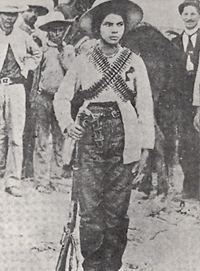
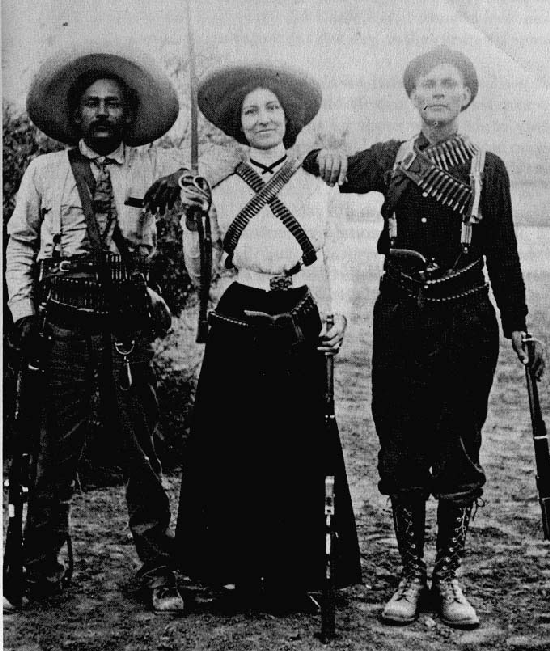
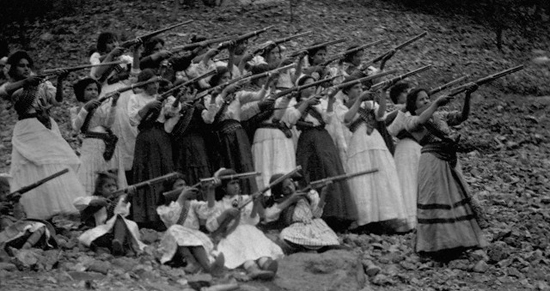
Many women traveled with the revolutionary armies and helped out
with the routine work in the camp.
But quite a few women also
participated in the fighting. Just as their male comrades, some of
these soldaderas had lost their families and homes, others
were in it out of conviction, and again others were in it just for the heck
of it.
Soldaderas fighting in the Mexican Revolution Left:
Soldadera around 1915 photo taken by Agustin Victor Casasola
Right: Archivo
Histórico, Universidad Nacional Autónoma de México
WOMEN IN THE MEXICAN REVOLUTION Source
unknown
WOMEN OF THE MEXICAN REVOLUTION - THE NO-NONSENSE UNIT Source
unknown
And to cite the great Manny Ozorio,
"Many women were support for the
troops, but some women, regardless of their beauty or lack thereof,
just jumped into the fun - a number of them really setting an
example on what heroism should be."
Here is La Adelita, a Mexican corrido stemming from
the Mexican Revolution.
Two of the 7 annual public holidays in Mexico today stem from the
Mexican Revolution:
Constitution
Day - February 5 Día de la Constitución. Observed on the first Monday of
February. Commemorates the Constitution of 1917, announced by
Venustiano Carranza on February 5, 1917.
Revolution
Day - November 20 Día de la Revolución. Observed on the third Monday of
November. Commemorates the official beginning of the Mexican
Revolution in 1910.
Furthermore, a huge centennial
celebration was in order when Mexico commemorated the 100th
anniversary of the Mexican Revolution in 2010. This festivity took place shortly after the bicentennial celebrations of the
Mexican Independence.
Franklin Lee Cleavenger moved
from Kansas to Chihuahua to work for the Chihuahuan phone company.
During the Mexican Revolution, he had his hands full repairing the
lines between El Paso and Chihuahua City. Franklin Lee also took
many photos, using coated glass plates (dry plates,) some of which
you can examine on the
Franklin Lee Cleavenger Collection
site.