The Axis Powers (Germany, Italy, Japan) fought the
Allies (France,
Great Britain, the United States, the Soviet Union, China).
Issues behind WWII
After the unsatisfactory peace treaties of
World War I and the
Great
Depression in the early
1930s, Germany, Italy, and Japan developed
into totalitarian regimes eager to expand
their national boundaries.
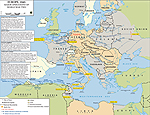
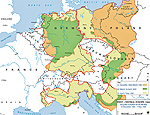
On a map, the world and Europe looked like
this before World War Two:
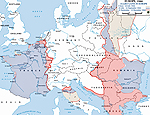
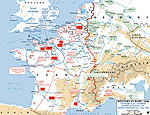
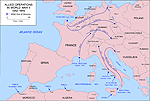
After years of committing military acts of aggression,
see map below, Germany
invaded Poland on September 1, 1939. Great Britain and France
declared war on Germany on September 3.
Italy surrendered to the Allies on September 8, 1943. Germany
surrendered unconditionally on May 8, 1945. This day became known as
VE-Day (Victory in Europe Day).
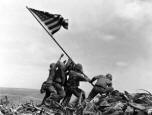
One of the most famous
photographs of WWII was taken on February 23, 1945. Five
marines and a Navy corpsman planted the
Stars and Stripes on
the rocky peak of Mount Suribachi.
Joe
Rosenthal was the guy who took the picture. He
died on August 20, 2006, age 94.
This was the second flag raising and
Alan Wood was the 22-year-old Navy officer who
provided the flag. Or, in other words, he gave this
37-square-foot flag to the Marine who asked for it, a flag
that he had found months before in a Pearl Harbor Navy
depot.
Alan Wood died on April 18,
2013, age 90.
Here is a quote from the May 2, 2000, NY Times article
Demystifying the Flag at Iwo Jima by Richard Bernstein:
Iwo Jima, an island that lay athwart the
main air route to Japan, was defended by
22,000 dug-in Japanese soldiers whose orders
were to kill 10 Americans each and then to
die. On the morning of Feb. 19, 1945, it was
invaded by 70,000 American marines, of whom
26,000 were to be killed or wounded as they
carried out the grim task of rooting out the
defenders, 21,000 of whom died by the time
it was over. "Death became demystified, an
occupational hazard," Mr. Bradley writes.
On the fourth day, according to Mr.
Bradley's careful reconstruction of the
battle, six men put up a flag on the
island's highest point. They were merely
replacing a smaller flag that had been
raised earlier by a different group of men.
Almost by accident, an Associated Press
photographer, Joe Rosenthal, snapped a
picture of the second flag-raising. He did
not, contrary to what is commonly said about
this historic moment, pose the photograph
beforehand. The picture was authentic, but
the sentiment that it aroused was not. In
fact, the second flag was basically
unnoticed by the marines on Iwo Jima, who
had cheered when the first flag went up.
Still, the picture -- The Photograph, as Mr.
Bradley aptly calls it -- became an icon of
American patriotism, and the act of raising
it was surrounded by a fabricated epic of
battlefield heroics.
Estimates of total
deaths caused by World War II vary from 40,000,000 to 60,000,000.
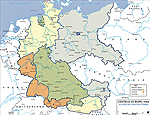
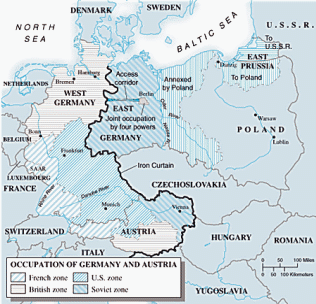
Germany was divided into four zones of occupation by UK, US, France,
and USSR forces. The country remained divided into two nations, East
and West Germany, until 1990.
Germany was divided into occupation
zones
which laid the foundation for the
Cold War
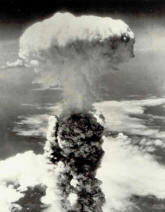
Atomic bomb on Nagasaki
Atomic Bomb
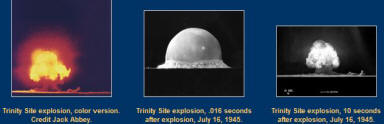
Made possible by the
Manhattan Project, on August 6, 1945, the first atomic bomb was dropped by the
United States on Hiroshima. It pulverized everything in the
explosion's immediate vicinity.
Four square miles were burned
out completely, 75,000 people were killed, and more than
70,000 were injured.
Three days later a second atomic bomb devastated Nagasaki. It
killed 40,000 people, injured the same amount, and devastated
1.8 square miles.
One of the reasons Russia's troops performed
badly against the invading Germans in June
1941, was Stalin's
Great Purges
which included the elimination of many
experienced military leaders.
All in all, the Soviet Union suffered an estimated total
of 18 million deaths in WWII, 7 million of which
were civilians.
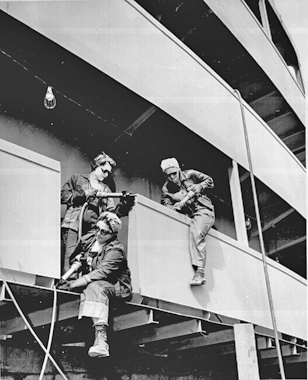
Women in World War
II
Women war
workers of Marinship Corp., 1942
National Archives
Talk about unfinished business. Japan wants its four islands back which Russia had taken at the end of WWII.
The dispute involves what Japan calls the Northern Territories and Russia calls the Southern Kuril Islands.
These are four islands (Etorofu/Iturup, Kunashiri/Kunashir, Shikotan, and the Habomai islet group) that
were occupied by Soviet forces in the final days of World War II in 1945.
Specifically, the Soviet invasion began after Japan's announcement of surrender on August 15, 1945, but before
the formal surrender ceremony on September 2, 1945.
Furthermore, by invading the Soviet Union broke their neutrality agreement:
The Soviet-Japanese Neutrality Pact was signed on April 13, 1941 in Moscow. It was a five-year agreement that was
supposed to last until April 13, 1946, unless either party gave notice of their intention not to extend it one
year before its expiration.
On April 5, 1945, the Soviet Union officially notified Japan that it would not renew the pact. However, even with
this notification, under the terms of the original agreement, the pact was supposed to remain in effect until April 1946.
Despite this, the Soviet Union declared war on Japan on August 8, 1945, and began military operations against
Japan on August 9, effectively breaking the pact before its intended expiration date.
Today, Japan and Russia (as the successor state to the USSR) still haven't signed a formal peace treaty to end
World War II, and the territorial dispute over these islands is the main reason for this.
It's worth noting that Japan did sign
the San Francisco Peace Treaty in 1951, which formally
ended the war between Japan and most Allied Powers. Russia (then the Soviet Union) refused to sign this
treaty, partly due to disagreements over these territories.
The sovereignty dispute continues to affect Japanese-Russian relations today. Japan maintains that the
islands are its inherent territory and were illegally occupied, while Russia considers them legally
acquired territory as a result of World War II.
The tipping point of World War II occurred between November 1942 and February 1943, when three synchronized events
across different theaters collectively ended Axis offensive capabilities and initiated irreversible Allied advances:
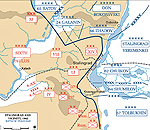
Battle of Stalingrad (November 1942 - February 1943)
The Soviet counteroffensive Operation Uranus encircled the
German Sixth Army in November 1942, leading to its surrender in February 1943. This devastating defeat cost
Germany 91,000 troops and permanently shifted the Eastern Front.
North African Campaign (October - November 1942)
Montgomery's victory at El Alamein (concluded November 11) and
Operation Torch landings (November 8) secured Allied control of North Africa and the Mediterranean.
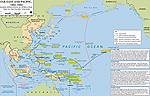
Pacific Theater
The Guadalcanal Campaign secured Henderson Field by November 1942, while the earlier Battle of
Midway (June 1942) had already crippled Japan's carrier fleet, ending Japanese expansion.
This period represents the strategic inflection point when the Allies transitioned from defensive containment to
sustained counteroffensives across all major fronts, ensuring eventual victory despite years of fighting still ahead.
Approximately six million Jews were killed by the Nazis in the
Holocaust.
The war paved the way for the
Cold War between the Western powers
(Capitalism) and the Eastern powers (
Communism).
World War
II Quotes
"Magnificent! Compared to war all other forms of human endeavor
shrink to insignificance. God help me, I do love it so!"
George Patton
American specialist of tank warfare in World War II
"Despite everything, I believe that people are really good at heart."
Anne Frank
Holocaust victim