In fact, more than a bulldog was necessary when Britain came face to face
with
 Adolf Hitler.
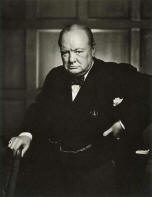
Winston Churchill
Winston Churchill's
Life in a Nutshell
Winston Churchill's parents were busy
people and his nanny, Mrs. Everest was the one who took
good care of young Winnie.
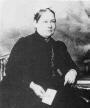
MRS. EVEREST
Churchill was sent to
the
Royal Military Academy Sandhurst.
You used to be able to check Churchill's group picture and
cadet register from 1894 on their website but apparently the site
has some problems.
After
joining the 4th Hussars, Churchill went to Cuba. Then India. Then
South Africa.
During the
Boer War,
which was fought in South Africa from 1899
to 1902, Churchill escaped, and was wanted Dead or Alive for the
bounty of £25.
Churchill then became a politician.
Winston Churchill and World War I
The disaster of the
Dardanelles Campaign prompted him to resign from office in November
1915.
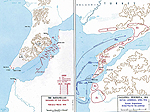
Dardanelles and
Gallipoli Peninsula - Feb-Apr 1915
Churchill packed his knapsack and became a soldier in France. But not
for long. In June 1916 he came back as a private member of
Parliament. Inspirational for anyone whose first career ended in the
toilet? Absolutely.
Winston Churchill and
World War II
On September 1, 1939, Germany invaded
Poland.
On May 10, 1940, the Germans attacked
the Netherlands. In the evening of that same day, British prime
minister
Arthur Neville Chamberlain, who had been criticized
for his optimistic interpretation of Hitler's intentions, resigned his office and
Winston Churchill became his successor.
Orator Churchill was quite fond of the
phrase blood, sweat, and tears. Already in 1931, in his work
The Unknown War: The Eastern Front, Churchill talks about the
army of the Russian Empire and mentions,
Their sweat, their tears, their
blood bedewed the endless plain.
On May 13, 1940, new Prime Minister Churchill addressed the
House of Commons with his
Blood, Toil, Tears and Sweat speech, keeping it on a sober
note and echoing Italian's tough bone
Giuseppe Garibaldi.
Go here for more about
Garibaldi's I Offer Hunger and Death speech.
Back to Churchill.
On June 4, 1940, Churchill gave his
We Shall Fight on the Beaches speech.
Shortly after, on June 18, 1940,
Churchill addressed the House of Commons with his famous
Finest Hour Speech.
Addressing the
Battle of Britain, Church gave his speech
The Few on August 20, 1940, to the House
of Commons. Who were The Few, by the way? The fighter pilots of the
Royal Air Force.
On
October 29, 1941, Churchill visited Harrow School in London
where he delivered his
Never Give In speech.
In February 1945, Churchill met with
Franklin Delano Roosevelt and
Joseph
Stalin in order figure out what would work best against the Nazis.
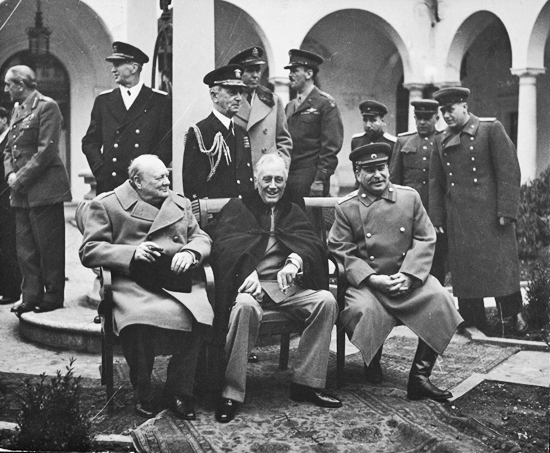
THE BIG THREE AT
YALTA: CHURCHILL, ROOSEVELT, AND STALIN
National Archives
Churchill's term as prime minister
ended in 1945. He lost re-election, which was a bitter pill for him.
Winston Churchill and
the Cold War
After the war, a new challenge arose.
On
March 5, 1946, Churchill delivered his
Iron Curtain speech.
Although others had used the phrase Iron Curtain before, it
was Churchill's speech that made it a household term.
Churchill became Prime
Minister once more 1951 - 1955.
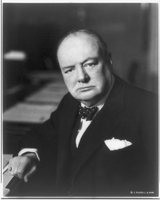
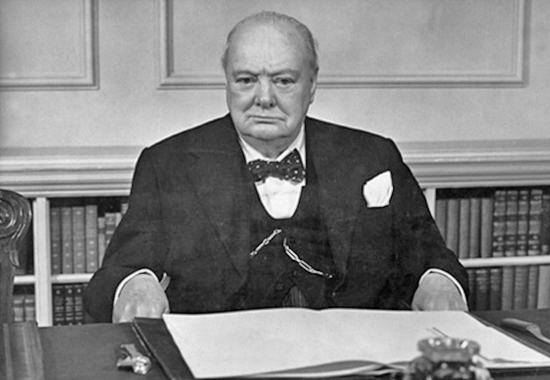
WINSTON CHURCHILL
Click on image to enlarge
Winston Churchill Critics
In the UK, some gentlefolk of the older generation aren't too fond
of Churchill. They say that Winston Churchill was a war
monger and that he could have stopped the war sooner.
Winston Churchill
Facts
Churchill supported the development of the tank.
Churchill's own intelligence center at home was often far ahead of the
government's.
Churchill,
Roosevelt, and
Stalin were
The Big Three that
shaped Europe after
World War II.
And here are
Churchill's speeches.
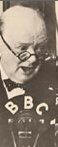
Winston Churchill
Trivia
Winston Churchill loved himself a good cigar and became quite old in spite of it. Don't tell your kids.
Churchill
liked painting. Was he any good as a painter? Here's a
review of his exhibition in the New York Times. Judge for
yourself.
Winston Churchill —
Short Biography
1874 November 30 - Birth at
Blenheim Palace, England
1888 Harrow School
1893 Royal Military College at Sandhurst
1895 War correspondent/soldier, Cuba, India, Sudan, South
Africa
1900 Enters Parliament in England
Meets
Mark Twain
in New York.
1906 Under Secretary of State for the Colonies
1908 President of the Board of Trade
1910 Home Secretary
1911 First Lord of the Admiralty
1915 Resigns after Dardanelles campaign
1915 Soldier in France
1917 Minister of Munitions
1919 Secretary of State for War and Air
1921 Head of Colonial Office
1924 Chancellor of the Exchequer
1929 Outside the government, continued to hold a Parliament
seat
1939 First Lord of the Admiralty
1940 Prime Minister until 1945
1951 Prime Minister until 1955, resigned due to ill health
1965 January 24 - Death in London
And here is a
Winston
Churchill Timeline
Winston Churchill
Quotes
"It is
a crime to despair.
We must learn to draw from misfortune
the
means of future strength."
- Winston Churchill
Churchill Book
Review
Winston Churchill (Penguin Lives)
By John Keegan, who was for many years Senior Lecturer in
Military History at the Royal Military Academy, Sandhurst.
Since 1986 he has been Defense Editor of the Daily Telegraph.
He is a Fellow of the Royal Society of Literature. He received
an OBE in the Gulf War honors list and was knighted in 2000.
2002. 181 pages. Easy-to-read biography. Clear. Not too long.
No keyword index.
Sandhurst, where the author lectured, was the Academy
Churchill entered in 1893. The author seemed to have managed,
however, an open minded approach.
Thumbs up.
Churchill
By Celia Sandys, who is the granddaughter of Sir Winston
Churchill. Her mother was Churchill’s eldest daughter. She has
lectured in Canada, Japan, Britain and America.
2003. 160 pages. Not the conventional sort of biography.
Entertaining and easy to read.
Extra features: brief chronology, Churchill family tree,
accompanied by VHS and DVD
Why not. Thumbs up.
Churchill (Life & Times) (Life and Times)
By Sebastian Haffner, who emigrated to London from Berlin in
the 1930s and was a vocal critic of the Nazi regime, writing
influential articles in the Observer. After the war, he became
Germany’s pre-eminent political commentator.
German 1996, English 2003. 182 pages. Not afraid of a more
critical view point. This can be refreshing and
thought-provoking after reading a row of biographies that
might have let Churchill off too easy.
Thumbs up.