|
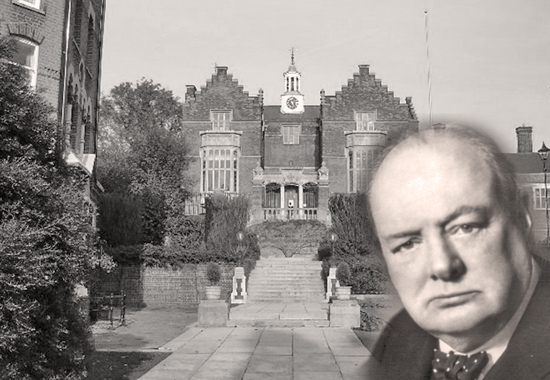
WINSTON CHURCHILL AND THE
HARROW SCHOOL IN LONDON
British History 1941
Never Give In
Go here for more about
 Winston Churchill.
Go here for more about
Winston Churchill's Never Give In
Speech.
It follows the full text transcript of
Winston Churchill's Never Give In speech, delivered
at Harrow School, London, UK - October 29, 1941.

 |
Almost a year has
passed since I came down here at your Head
Master's kind invitation in order to cheer
myself and cheer the hearts of a few of my
friends by singing some of our own songs. |
The ten months
that have passed have seen very terrible
catastrophic events in the world - ups and
downs, misfortunes - but can anyone sitting here
this afternoon, this October afternoon, not feel
deeply thankful for what has happened in the
time that has passed and for the very great
improvement in the position of our country and
of our home? Why, when I was here last time we
were quite alone, desperately alone, and we had
been so for five or six months. We were poorly
armed. We are not so poorly armed today; but
then we were very poorly armed. We had the
unmeasured menace of the enemy and their air
attack still beating upon us, and you yourselves
had had experience of this attack; and I expect
you are beginning to feel impatient that there
has been this long lull with nothing particular
turning up!
But we must learn to be equally good at what is
short and sharp and what is long and tough. It
is generally said that the British are often
better at the last. They do not expect to move
from crisis to crisis; they do not always expect
that each day will bring up some noble chance of
war; but when they very slowly make up their
minds that the thing has to be done and the job
put through and finished, then, even if it takes
months - if it takes years - they do it.
Another lesson I think we may take, just
throwing our minds back to our meeting here ten
months ago and now, is that appearances are
often very deceptive, and as Kipling well says,
we must "…meet with Triumph and Disaster. And
treat those two impostors just the same."
You cannot tell from appearances how things will
go. Sometimes imagination makes things out far
worse than they are; yet without imagination not
much can be done. Those people who are
imaginative see many more dangers than perhaps
exist; certainly many more than will happen; but
then they must also pray to be given that extra
courage to carry this far-reaching imagination.
But for everyone, surely, what we have gone
through in this period - I am addressing myself
to the School - surely from this period of ten
months this is the lesson: never give in, never
give in, never, never, never, never-in nothing,
great or small, large or petty - never give in
except to convictions of honor and good sense.
Never yield to force; never yield to the
apparently overwhelming might of the enemy. We
stood all alone a year ago, and to many
countries it seemed that our account was closed,
we were finished. All this tradition of ours,
our songs, our School history, this part of the
history of this country, were gone and finished
and liquidated.
Very different is the mood today. Britain, other
nations thought, had drawn a sponge across her
slate. But instead our country stood in the gap.
There was no flinching and no thought of giving
in; and by what seemed almost a miracle to those
outside these Islands, though we ourselves never
doubted it, we now find ourselves in a position
where I say that we can be sure that we have
only to persevere to conquer.
You sang here a verse of a School Song: you sang
that extra verse written in my honor, which I
was very greatly complimented by and which you
have repeated today. But there is one word in it
I want to alter - I wanted to do so last year,
but I did not venture to. It is the line: "Not
less we praise in darker days."
I have obtained the Head Master's permission to
alter darker to sterner. "Not less we praise in
sterner days."
Do not let us speak of darker days: let us speak
rather of sterner days. These are not dark days;
these are great days - the greatest days our
country has ever lived; and we must all thank
God that we have been allowed, each of us
according to our stations, to play a part in
making these days memorable in the history of
our race.
More History
|
|