Listen to an mp3 excerpt of the Iron Curtain speech.
It follows the full text transcript of
Winston Churchill's Iron Curtain speech, delivered
at Westminster College in Fulton, Missouri - March 5, 1946.
President McCluer,
ladies and gentlemen, and last, but certainly
not least, the President of the United States of
America:
I am very glad
indeed to come to Westminster College this
afternoon, and I am complimented that you should
give me a degree from an institution whose
reputation has been so solidly established. The
name "Westminster" somehow or other seems
familiar to me. I feel as if I have heard of it
before. Indeed now that I come to think of it,
it was at Westminster that I received a very
large part of my education in politics,
dialectic, rhetoric, and one or two other
things. In fact we have both been educated at
the same, or similar, or, at any rate, kindred
establishments.
It is also an honor, ladies and gentlemen,
perhaps almost unique, for a private visitor to
be introduced to an academic audience by the
President of the United States. Amid his heavy
burdens, duties, and responsibilities--unsought
but not recoiled from--the President has
traveled a thousand miles to dignify and magnify
our meeting here to-day and to give me an
opportunity of addressing this kindred nation,
as well as my own countrymen across the ocean,
and perhaps some other countries too. The
President has told you that it is his wish, as I
am sure it is yours, that I should have full
liberty to give my true and faithful counsel in
these anxious and baffling times. I shall
certainly avail myself of this freedom, and feel
the more right to do so because any private
ambitions I may have cherished in my younger
days have been satisfied beyond my wildest
dreams. Let me however make it clear that I have
no official mission or status of any kind, and
that I speak only for myself. There is nothing
here but what you see.
I can therefore allow my mind, with the
experience of a lifetime, to play over the
problems which beset us on the morrow of our
absolute victory in arms, and to try to make
sure with what strength I have that what has
gained with so much sacrifice and suffering
shall be preserved for the future glory and
safety of mankind.
Ladies and gentlemen, the United States stands
at this time at the pinnacle of world power. It
is a solemn moment for the American Democracy.
For with primacy in power is also joined an
awe-inspiring accountability to the future. If
you look around you, you must feel not only the
sense of duty done but also you must feel
anxiety lest you fall below the level of
achievement. Opportunity is here and now, clear
and shining for both our countries. To reject it
or ignore it or fritter it away will bring upon
us all the long reproaches of the after-time. It
is necessary that the constancy of mind,
persistency of purpose, and the grand simplicity
of decision shall rule and guide the conduct of
the English-speaking peoples in peace as they
did in war. We must, and I believe we shall,
prove ourselves equal to this severe
requirement.
President McCluer, when American military men
approach some serious situation they are wont to
write at the head of their directive the words
"over-all strategic concept". There is wisdom in
this, as it leads to clarity of thought. What
then is the over-all strategic concept which we
should inscribe to-day? It is nothing less than
the safety and welfare, the freedom and
progress, of all the homes and families of all
the men and women in all the lands. And here I
speak particularly of the myriad cottage or
apartment homes where the wage-earner strives
amid the accidents and difficulties of life to
guard his wife and children from privation and
bring the family up the fear of the Lord, or
upon ethical conceptions which often play their
potent part.
To give security to these countless homes, they
must be shielded form two gaunt marauders, war
and tyranny. We al know the frightful
disturbance in which the ordinary family is
plunged when the curse of war swoops down upon
the bread-winner and those for whom he works and
contrives. The awful ruin of Europe, with all
its vanished glories, and of large parts of Asia
glares us in the eyes. When the designs of
wicked men or the aggressive urge of mighty
States dissolve over large areas the frame of
civilized society, humble folk are confronted
with difficulties with which they cannot cope.
For them is all distorted, all is broken, all is
even ground to pulp.
When I stand here this quiet afternoon I shudder
to visualize what is actually happening to
millions now and what is going to happen in this
period when famine stalks the earth. None can
compute what has been called "the unestimated
sum of human pain". Our supreme task and duty is
to guard the homes of the common people from the
horrors and miseries of another war. We are all
agreed on that.
Our American military colleagues, after having
proclaimed their "over-all strategic concept"
and computed available resources, always proceed
to the next step -- namely, the method. Here
again there is widespread agreement. A world
organization has already been erected for the
prime purpose of preventing war. UNO, the
successor of the League of Nations, with the
decisive addition of the United States and all
that that means, is already at work. We must
make sure that its work is fruitful, that it is
a reality and not a sham, that it is a force for
action, and not merely a frothing of words, that
it is a true temple of peace in which the
shields of many nations can some day be hung up,
and not merely a cockpit in a Tower of Babel.
Before we cast away the solid assurances of
national armaments for self-preservation we must
be certain that our temple is built, not upon
shifting sands or quagmires, but upon a rock.
Anyone can see with his eyes open that our path
will be difficult and also long, but if we
persevere together as we did in the two world
wars -- though not, alas, in the interval
between them -- I cannot doubt that we shall
achieve our common purpose in the end.
I have, however, a definite and practical
proposal to make for action. Courts and
magistrates may be set up but they cannot
function without sheriffs and constables. The
United Nations Organization must immediately
begin to be equipped with an international armed
force. In such a matter we can only go step by
step, but we must begin now. I propose that each
of the Powers and States should be invited to
dedicate a certain number of air squadrons to
the service of the world organization. These
squadrons would be trained and prepared in their
own countries, but would move around in rotation
from one country to another. They would wear the
uniforms of their own countries but with
different badges. They would not be required to
act against their own nation, but in other
respects they would be directed by the world
organization. This might be started on a modest
scale and it would grow as confidence grew. I
wished to see this done after the first world
war, and I devoutly trust that it may be done
forthwith.
It would nevertheless, ladies and gentlemen, be
wrong and imprudent to entrust the secret
knowledge or experience of the atomic bomb,
which the United States, great Britain, and
Canada now share, to the world organization,
while still in its infancy. It would be criminal
madness to cast it adrift in this still agitated
and un-united world. No one country has slept
less well in their beds because this knowledge
and the method and the raw materials to apply
it, are present largely retained in American
hands. I do not believe we should all have slept
so soundly had the positions been reversed and
some Communist or neo-Facist State monopolized
for the time being these dread agencies. The
fear of them alone might easily have been used
to enforce totalitarian systems upon the free
democratic world, with consequences appalling to
human imagination. God has willed that this
shall not be and we have at least a breathing
space to set our world house in order before
this peril has to be encountered: and even then,
if no effort is spared, we should still possess
so formidable a superiority as to impose
effective deterrents upon its employment, or
threat of employment, by others. Ultimately,
when the essential brotherhood of man is truly
embodied and expressed in a world organization
with all the necessary practical safeguards to
make it effective, these powers would naturally
be confided to that world organizations.
Now I come to the second of the two marauders,
to the second danger which threatens the cottage
homes, and the ordinary people -- namely,
tyranny. We cannot be blind to the fact that the
liberties enjoyed by individual citizens
throughout the United States and throughout the
British Empire are not valid in a considerable
number of countries, some of which are very
powerful. In these States control is enforced
upon the common people by various kinds of
all-embracing police governments to a degree
which is overwhelming and contrary to every
principle of democracy. The power of the State
is exercised without restraint, either by
dictators or by compact oligarchies operating
through a privileged party and a political
police. It is not our duty at this time when
difficulties are so numerous to interfere
forcibly in the internal affairs of countries
which we have not conquered in war. but we must
never cease to proclaim in fearless tones the
great principles of freedom and the rights of
man which are the joint inheritance of the
English-speaking world and which through Magna
Carta, the Bill of rights, the Habeas Corpus,
trial by jury, and the English common law find
their most famous expression in the American
Declaration of Independence.
All this means that the people of any country
have the right, and should have the power by
constitutional action, by free unfettered
elections, with secret ballot, to choose or
change the character or form of government under
which they dwell; that freedom of speech and
thought should reign; that courts of justice,
independent of the executive, unbiased by any
party, should administer laws which have
received the broad assent of large majorities or
are consecrated by time and custom. Here are the
title deeds of freedom which should lie in every
cottage home. Here is the message of the British
and American peoples to mankind. Let us preach
what we practice -- let us practice what we
preach.
though I have now stated the two great dangers
which menace the home of the people, War and
Tyranny, I have not yet spoken of poverty and
privation which are in many cases the prevailing
anxiety. But if the dangers of war and tyranny
are removed, there is no doubt that science and
cooperation can bring in the next few years,
certainly in the next few decades, to the world,
newly taught in the sharpening school of war, an
expansion of material well-being beyond anything
that has yet occurred in human experience.
Now, at this sad and breathless moment, we are
plunged in the hunger and distress which are the
aftermath of our stupendous struggle; but this
will pass and may pass quickly, and there is no
reason except human folly or sub-human crime
which should deny to all the nations the
inauguration and enjoyment of an age of plenty.
I have often used words which I learn fifty
years ago from a great Irish-American orator, a
friend of mine, Mr. Bourke Cockran, "There is
enough for all. The earth is a generous mother;
she will provide in plentiful abundance food for
all her children if they will but cultivate her
soil in justice and peace." So far I feel that
we are in full agreement.
Now, while still pursing the method -- the
method of realizing our over-all strategic
concept, I come to the crux of what I have
traveled here to say. Neither the sure
prevention of war, nor the continuous rise of
world organization will be gained without what I
have called the fraternal association of the
English-speaking peoples. This means a special
relationship between the British Commonwealth
and Empire and the United States of America.
Ladies and gentlemen, this is no time for
generality, and I will venture to the precise.
Fraternal association requires not only the
growing friendship and mutual understanding
between our two vast but kindred systems of
society, but the continuance of the intimate
relations between our military advisers, leading
to common study of potential dangers, the
similarity of weapons and manuals of
instructions, and to the interchange of officers
and cadets at technical colleges. It should
carry with it the continuance of the present
facilities for mutual security by the joint use
of all Naval and Air Force bases in the
possession of either country all over the world.
This would perhaps double the mobility of the
American Navy and Air Force. It would greatly
expand that of the British Empire forces and it
might well lead, if and as the world calms down,
to important financial savings. Already we use
together a large number of islands; more may
well be entrusted to our joint care in the near
future.
the United States has already a Permanent
Defense Agreement with the Dominion of Canada,
which is so devotedly attached to the British
Commonwealth and the Empire. This Agreement is
more effective than many of those which have
been made under formal alliances. This principle
should be extended to all the British
Commonwealths with full reciprocity. Thus,
whatever happens, and thus only, shall we be
secure ourselves and able to works together for
the high and simple causes that are dear to us
and bode no ill to any. Eventually there may
come -- I feel eventually there will come -- the
principle of common citizenship, but that we may
be content to leave to destiny, whose
outstretched arm many of us can already clearly
see.
There is however an important question we must
ask ourselves. Would a special relationship
between the United States and the British
Commonwealth be inconsistent with our
over-riding loyalties to the World Organization?
I reply that, on the contrary, it is probably
the only means by which that organization will
achieve its full stature and strength. There are
already the special United States relations with
Canada that I have just mentioned, and there are
the relations between the United States and the
South American Republics. We British have also
our twenty years Treaty of Collaboration and
Mutual Assistance with Soviet Russia. I agree
with Mr. Bevin, the Foreign Secretary of Great
Britain, that it might well be a fifty years
treaty so far as we are concerned. We aim at
nothing but mutual assistance and collaboration
with Russia. The British have an alliance with
Portugal unbroken since the year 1384, and which
produced fruitful results at a critical moment
in the recent war. None of these clash with the
general interest of a world agreement, or a
world organization; on the contrary, they help
it. "In my father's house are many mansions."
Special associations between members of the
United Nations which have no aggressive point
against any other country, which harbor no
design incompatible with the Charter of the
United Nations, far from being harmful, are
beneficial and, as I believe, indispensable.
I spoke earlier, ladies and gentlemen, of the
Temple of Peace. Workmen from all countries must
build that temple. If two of the workmen know
each other particularly well and are old
friends, if their families are intermingled, if
they have "faith in each other's purpose, hope
in each other's future and charity towards each
other's shortcomings" -- to quote some good
words I read here the other day -- why cannot
they work together at the common task as friends
and partners? Why can they not share their tools
and thus increase each other's working powers?
Indeed they must do so or else the temple may
not be built, or, being built, it may collapse,
and we should all be proved again unteachable
and have to go and try to learn again for a
third time in a school of war incomparably more
rigorous than that from which we have just been
released. The dark ages may return, the Stone
Age may return on the gleaming wings of science,
and what might now shower immeasurable material
blessings upon mankind, may even bring about its
total destruction. Beware, I say; time may be
short. Do not let us take the course of allowing
events to drift along until it is too late. If
there is to be a fraternal association of the
kind of I have described, with all the strength
and security which both our countries can derive
from it, let us make sure that that great fact
is known to the world, and that it plays its
part in steadying and stabilizing the
foundations of peace. There is the path of
wisdom. Prevention is better than the cure.
A shadow has fallen upon the scenes so lately
light by the Allied victory. Nobody knows what
Soviet Russia and its Communist international
organization intends to do in the immediate
future, or what are the limits, if any, to their
expansive and proselytizing tendencies. I have a
strong admiration and regard for the valiant
Russian people and for my wartime comrade,
Marshall Stalin. There is deep sympathy and
goodwill in Britain -- and I doubt not here also
-- towards the peoples of all the Russias and a
resolve to persevere through many differences
and rebuffs in establishing lasting friendships.
We understand the Russian need to be secure on
her western frontiers by the removal of all
possibility of German aggression. We welcome
Russia to her rightful place among the leading
nations of the world. We welcome her flag upon
the seas. Above all, we welcome, or should
welcome, constant, frequent and growing contacts
between the Russian people and our own people on
both sides of the Atlantic. It is my duty
however, for I am sure you would wish me to
state the facts as I see them to you. It is my
duty to place before you certain facts about the
present position in Europe.
From Stettin in the Baltic to Trieste in the
Adriatic an iron curtain has descended across
the Continent. Behind that line lie all the
capitals of the ancient states of Central and
Eastern Europe. Warsaw, Berlin, Prague, Vienna,
Budapest, Belgrade, Bucharest and Sofia, all
these famous cities and the populations around
them lie in what I must call the Soviet sphere,
and all are subject in one form or another, not
only to Soviet influence but to a very high and,
in some cases, increasing measure of control
from Moscow. Athens alone -- Greece with its
immortal glories -- is free to decide its future
at an election under British, American and
French observation. The Russian-dominated Polish
Government has been encouraged to make enormous
and wrongful inroads upon Germany, and mass
expulsions of millions of Germans on a scale
grievous and undreamed-of are now taking place.
The Communist parties, which were very small in
all these Eastern States of Europe, have been
raised to pre-eminence and power far beyond
their numbers and are seeking everywhere to
obtain totalitarian control. Police governments
are prevailing in nearly every case, and so far,
except in Czechoslovakia, there is no true
democracy.
Turkey and Persia are both profoundly alarmed
and disturbed at the claims which are being made
upon them and at the pressure being exerted by
the Moscow Government. An attempt is being made
by the Russians in Berlin to build up a
quasi-Communist party in their zone of occupied
Germany by showing special favors to groups of
left-wing German leaders. At the end of the
fighting last June, the American and British
Armies withdrew westward, in accordance with an
earlier agreement, to a depth at some points of
150 miles upon a front of nearly four hundred
miles, in order to allow our Russian allies to
occupy this vast expanse of territory which the
Western Democracies had conquered.
If no the Soviet Government tries, by separate
action , to build up a pro-Communist Germany in
their areas, this will cause new serious
difficulties in the American and British zones,
and will give the defeated Germans the power of
putting themselves up to auction between the
Soviets and the Western Democracies. Whatever
conclusions may be drawn from these facts -- and
facts they are -- this is certainly not the
Liberated Europe we fought to build up. Nor is
it one which contains the essentials of
permanent peace.
The safety of the world, ladies and gentlemen,
requires a new unity in Europe, from which no
nation should be permanently outcast. It is from
the quarrels of the strong parent races in
Europe that the world wars we have witnessed, or
which occurred in former times, have sprung.
Twice in our own lifetime we have seen the
United States, against their wished and their
traditions, against arguments, the force of
which it is impossible not to comprehend, twice
we have seen them drawn by irresistible forces,
into these wars in time to secure the victory of
the good cause, but only after frightful
slaughter and devastation have occurred. Twice
the United State has had to send several
millions of its young men across the Atlantic to
find the war; but now war can find any nation,
wherever it may dwell between dusk and dawn.
Surely we should work with conscious purpose for
a grand pacification of Europe, within the
structure of the United Nations and in
accordance with our Charter. That I feel opens a
course of policy of very great importance.
In front of the iron curtain which lies across
Europe are other causes for anxiety. In Italy
the Communist Party is seriously hampered by
having to support the Communist-trained Marshal
Tito's claims to former Italian territory at the
head of the Adriatic. Nevertheless the future of
Italy hangs in the balance. Again one cannot
imagine a regenerated Europe without a strong
France. All my public life I never last faith in
her destiny, even in the darkest hours. I will
not lose faith now. However, in a great number
of countries, far from the Russian frontiers and
throughout the world, Communist fifth columns
are established and work in complete unity and
absolute obedience to the directions they
receive from the Communist center. Except in the
British Commonwealth and in the United States
where Communism is in its infancy, the Communist
parties or fifth columns constitute a growing
challenge and peril to Christian civilization.
These are somber facts for anyone to have recite
on the morrow a victory gained by so much
splendid comradeship in arms and in the cause of
freedom and democracy; but we should be most
unwise not to face them squarely while time
remains.
The outlook is also anxious in the Far East and
especially in Manchuria. The Agreement which was
made at Yalta, to which I was a party, was
extremely favorable to Soviet Russia, but it was
made at a time when no one could say that the
German war might no extend all through the
summer and autumn of 1945 and when the Japanese
war was expected by the best judges to last for
a further 18 months from the end of the German
war. In this country you all so well-informed
about the Far East, and such devoted friends of
China, that I do not need to expatiate on the
situation there.
I have, however, felt bound to portray the
shadow which, alike in the west and in the east,
falls upon the world. I was a minister at the
time of the Versailles treaty and a close friend
of Mr. Lloyd-George, who was the head of the
British delegation at Versailles. I did not
myself agree with many things that were done,
but I have a very strong impression in my mind
of that situation, and I find it painful to
contrast it with that which prevails now. In
those days there were high hopes and unbounded
confidence that the wars were over and that the
League of Nations would become all-powerful. I
do not see or feel that same confidence or event
he same hopes in the haggard world at the
present time.
On the other hand, ladies and gentlemen, I
repulse the idea that a new war is inevitable;
still more that it is imminent. It is because I
am sure that our fortunes are still in our own
hands and that we hold the power to save the
future, that I feel the duty to speak out now
that I have the occasion and the opportunity to
do so. I do not believe that Soviet Russia
desires war. What they desire is the fruits of
war and the indefinite expansion of their power
and doctrines. But what we have to consider here
today while time remains, is the permanent
prevention of war and the establishment of
conditions of freedom and democracy as rapidly
as possible in all countries. Our difficulties
and dangers will not be removed by closing our
eyes to them. They will not be removed by mere
waiting to see what happens; nor will they be
removed by a policy of appeasement. What is
needed is a settlement, and the longer this is
delayed, the more difficult it will be and the
greater our dangers will become.
From what I have seen of our Russian friends and
Allies during the war, I am convinced that there
is nothing for which they have less respect than
for weakness, especially military weakness. For
that reason the old doctrine of a balance of
power is unsound. We cannot afford, if we can
help it, to work on narrow margins, offering
temptations to a trial of strength. If the
Western Democracies stand together in strict
adherence to the principles will be immense and
no one is likely to molest them. If however they
become divided of falter in their duty and if
these all-important years are allowed to slip
away then indeed catastrophe may overwhelm us
all.
Last time I saw it all coming and I cried aloud
to my own fellow-countrymen and to the world,
but no one paid any attention. Up till the year
1933 or even 1935, Germany might have been saved
from the awful fate which has overtaken here and
we might all have been spared the miseries
Hitler let loose upon mankind. there never was a
war in history easier to prevent by timely
action than the one which has just desolated
such great areas of the globe. It could have
been prevented in my belief without the firing
of a single shot, and Germany might be powerful,
prosperous and honored today; but no one would
listen and one by one we were all sucked into
the awful whirlpool. We surely, ladies and
gentlemen, I put it to you, surely, we must not
let it happen again. This can only be achieved
by reaching now, in 1946, by reaching a good
understanding on all points with Russia under
the general authority of the United Nations
Organization and by the maintenance of that good
understanding through many peaceful years, by
the whole strength of the English-speaking world
and all its connections. There is the solution
which I respectfully offer to you in this
Address to which I have given the title, "The
Sinews of Peace".
Let no man underrate the abiding power of the
British Empire and Commonwealth. Because you see
the 46 millions in our island harassed about
their food supply, of which they only grow one
half, even in war-time, or because we have
difficulty in restarting our industries and
export trade after six years of passionate war
effort, do not suppose we shall not come through
these dark years of privation as we have come
through the glorious years of agony. Do not
suppose that half a century from now you will
not see 70 or 80 millions of Britons spread
about the world united in defense of our
traditions, and our way of life, and of the
world causes which you and we espouse. If the
population of the English-speaking Commonwealths
be added to that of the United States with all
that such co-operation implies in the air, on
the sea, all over the globe and in science and
in industry, and in moral force, there will be
no quivering, precarious balance of power to
offer its temptation to ambition or adventure.
On the contrary there will be an overwhelming
assurance of security. If we adhere faithfully
to the Charter of the United Nations and walk
forward in sedate and sober strength seeking no
one's land or treasure, seeking to lay no
arbitrary control upon the thoughts of men; if
all British moral and material forces and
convictions are joined with your own in
fraternal association, the highroads of the
future will be clear, not only for our time, but
for a century to come.
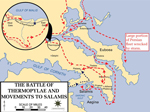
Also called the
Persian Wars, the Greco-Persian Wars were
fought for almost half a century from 492 BC -
449 BC. Greece won against enormous odds. Here
is more: