|
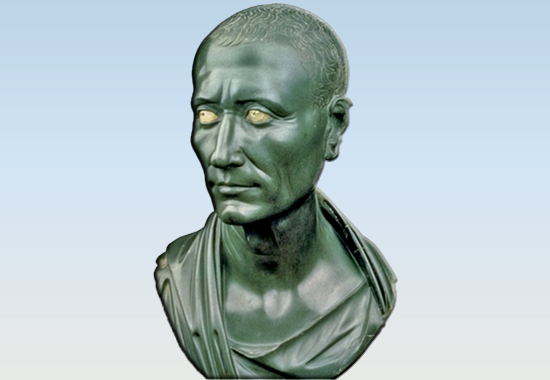
Gaius Julius Caesar 100 - 44 BC
Roman general and
statesman Gaius Julius Caesar was energetic, intelligent, and generous.
|
|
Image Above
Green basanite [quartz] bust of
Julius Caesar. And the British Museum comments:
This portrait is most likely
an image of Caesar made fifty years or more after his murder
in 44 BC. The stone is from Wadi Hamamat in Upper Egypt, and
the facial structure, with high cheekbones and prominent
chin, is reminiscent of many Egyptian portraits.
British Museum London
|
The Russian word czar and
the German word kaiser derive from Julius Caesar's name.
Although he was
imperator, he never ruled an empire.
See more under
 Forms of Governments -
Empire.
Forms of Governments -
Empire.
As it was
common and accepted in his culture, Caesar was a lover of both
genders.
Julius Caesar's
Life: 100-75 B.C.
Julius was born into a misgoverned and chaotic Rome, its streets
filled with revolutions and massacres. Julius's father, Gaius Caesar, died when Julius was 16 years old.
His mother's name was Aurelia. Julius decided upon a political
career. In the year 84 B.C. Julius married Cornelia. Because Cornelia's
folks were known as political radicals, Julius was pressured to
divorce her. He refused and thought it would be a good idea to leave
Italy for a while. In the year 78 Julius came back to Rome and
resumed his political career as a lawyer. He also studied oratory
and became an excellent public speaker.
Julius Caesar
and the Pirates
Julius was a man of enormous pride and courage. One day, while on his way to
Rhodes to study oratory, Julius was captured by pirates. Julius was
outraged by the low ransom the pirates demanded for his life. So, he
made them raise the amount of the ransom and told them that he, once
set free, would return to kill them all. And so he did.
Gaius Julius Caesar
Julius Caesar's
Life: 74-59 B.C.
Rome was at odds with
Mithradates, king of Portus. Both factions desired domination
over Asia Minor. When Rome was going to annex
Bythantia,
Mithradates started the
Third Mithradatic War in 74 B.C. Julius drummed up a private
army and joined the fight. The war lasted until the year
63 B.C.
Cornelia died in the year 69 B.C.
(or in the year 68 B.C., thanks CP for
pointing this out!) and
Julius moved on and married Pompeia.
In the year 68 B.C., Julius was
elected
Quaestor of
Farther Spain. His career took off and in 65 B.C. he was elected as
one of the
Curule
Aediles, and in 63 B.C. he was elected
Pontifex
Maximus.
Julius was on the roll and in 62
B.C. he was elected
Praetor. In the same year he divorced Pompeia. Good things kept
coming Julius's way and in the year 61 B.C. he was made Governor of
Farther Spain and formed with
Pompey and
Crassus
the
First Triumvirate.
Up the career ladder, Julius was
made consul in the year 59 B.C. Also in the year 59 B.C. he
married Calpurnia.
CONQUEST OF GAUL 58 - 50 B.C. - THE GALLIC WARS
In 58 BC Julius Caesar begun his conquest of Gaul. However, our knowledge of the Gallic Wars comes
primarily from Julius Caesar's firsthand account, "Commentarii de Bello Gallico" (Commentaries on the Gallic
War).
Caesar wrote – partly with his lieutenants – this seven-book work throughout the war, in the
third person singular, with an eighth book added
by his officer Aulus Hirtius. For a large part, it was written for the Roman Senate, to which, serving as proconsul from
58 to 51 BC, Caesar was accountable for his activities.
Caesar's account is our main source but presents his perspective as a military commander with personal ambition and political
motivations. His narrative justifies his actions to the Roman Senate and public while enhancing his reputation.
Supporting evidence includes:
o Archaeological findings (weapons, fortifications, battle sites, coins, artifacts from Celtic/Gallic civilization)
o Brief mentions in other Roman works by Cicero, Suetonius, and Plutarch.
The lack of contemporary Gallic written accounts means our understanding remains heavily influenced by Caesar's
Roman perspective, creating an inherently biased historical record.
With that in mind, here the Gallic Wars in a little bit more detail:
In 58 BC, Caesar defeated the Helvetii in the
Battle of Bibracte.
In 57 BC, the Nervii, the Viromandui, and the Atrebates were defeated at
the Battle of the Sabis, which corresponds to the modern
River Selle.
In 56 BC,
Julius Caesar destroyed the huge fleet of the Veneti in
Quiberon Bay.
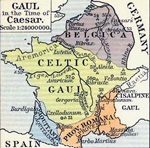
1st Century
BC Gaul
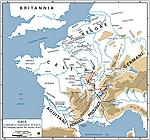
Map of Caesar's Campaign Against the Helvetii 58 BC
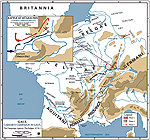
September 58 BC - Battle at Mulhouse
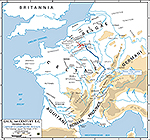
57 BC Caesar's Campaign Against the
Belgae
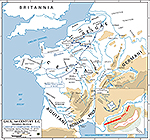
57 BC / 56 BC Caesar's Campaign
Against the Belgae
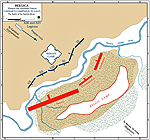
Map of the Battle of the Sabis 57 BC
RAIDS ON BRITAIN
...
and the Gallic Wars continue
In 55 B.C. Julius Caesar
led raids on Germany and Britain. In 54 B.C. followed his second
raid on Britain on which occasion the
Catuvellauni were
defeated.
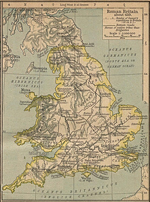
CAESAR'S ROUTES IN BRITAIN
Click map to enlarge
Here is more on
Roman Britain
In 54 / 53 BC followed Ambiorix's revolt:
Ambiorix, a chieftain of the Eburones, ambushed and
destroyed 15 Roman cohorts, which were led by Quintus Titurius Sabinus and Lucius Aurunculeius Cotta.
The ambush took place at Atuatuca Tungrorum, which is modern-day Tongeren in Belgium.
More here.
In 52 BC, Caesar had to deal with another Gallic crisis, a Gallic revolt led by
Vercingetorix
.
The
Romans lost the
Battle of
Gergovia, but Julius Caesar had again everything under control later that year after
the Siege of Alesia, in which he employed the innovative double-walled circumvallation.
The double-walled circumvallation was a revolutionary military engineering achievement that trapped Vercingetorix's Gallic
forces between two concentric fortification systems:
-
Inner wall (circumvallation): 11 miles of fortifications surrounding Alesia, preventing Vercingetorix's army from escaping.
-
Outer wall (contravallation): 13 miles of defenses facing outward to repel the massive Gallic relief army.
Both walls featured:
- Trenches (some filled with water)
- Wooden palisades and ramparts
- Towers every 80 feet
- Stimuli (buried spikes)
- Lilies (concealed pits with sharpened stakes)
- Cippi (tree trunks with sharpened branches)
This dual-wall system allowed Caesar's outnumbered force (45,000-60,000 Romans vs. 80,000 trapped Gauls plus 250,000 relief forces) to
effectively fight on two fronts simultaneously, eventually forcing Vercingetorix's surrender after failed breakout attempts and
the defeat of the relief army.
:: Harsh Aftermath ::
Vercingetorix was brought before Caesar
in chains and later paraded and executed in Rome.
The inhabitants of Alesia faced grim fates: Many women and children were expelled but were trapped between the Roman lines and the
settlement, leading to starvation or capture. Up to 70,000 Gauls were deported, with most being sold into slavery — a common Roman
practice.
The Siege of Alesia ended the Gallic Wars. Gaul and Belgica became part of the Roman State, and were henceforward known as Gallia Lugdunensis,
Gallia Belgica, Gallia Aquitania, and Gallia Narbonensis.
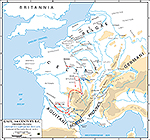
54 BC Outbreak of the
Gallic Revolt
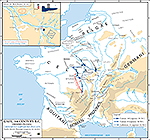
53-52 BC Gallic Revolt
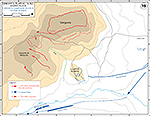
52 BC Siege of Gergovia - Part One
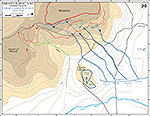
52 BC Siege of Gergovia - Part Two
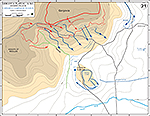
52 BC Siege of Gergovia - Part Three
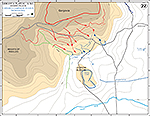
52 BC Siege of Gergovia - Part Four
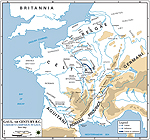
52 BC Gaul: From Gergovia to Alesia
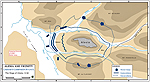
52 BC Siege of Alesia
To recap:
:: Why Were the Gallic Wars Fought? ::
According to Caesar's own account in his "Commentarii de Bello Gallico" (Commentaries on the Gallic War), he
presented multiple justifications for his military campaign, but the most prominent initial reason he gave
was to protect the Aedui, who were officially recognized as "friends and allies of the Roman people"
(amici et socii populi Romani).
Caesar specifically cited the migration of the Helvetii tribe as the immediate trigger for his
intervention, claiming they posed a threat to Roman allies, particularly the Aedui. He also mentioned concerns
about Ariovistus, a Germanic leader who had been harassing the Aedui and other Gallic tribes.
While Caesar publicly framed his actions as defensive and protective of Rome's allies, historians generally
agree that his personal motivations included gaining military glory, wealth, and political power — as well as
addressing his enormous personal debts.
The expansion of Roman territory and influence was also a significant factor.
:: Major Battles of the Gallic Wars (58-50 BC) ::
- 58 BC
- Battle of the Arar (modern Saône River) against the Helvetii
- Battle against the Helvetii (near Bibracte)
- Battle against Ariovistus and the Suebi (Alsace)
- 57 BC
- Battle of the Axona (Aisne River) against the Belgae
- Battle of the Sabis (Selle River) against the Nervii
- Siege of the Aduatuci stronghold
- 56 BC
- Naval battle against the Veneti (Bay of Quiberon)
- Campaign against the Aquitani
- 55 BC
- Battles against Germanic tribes (Usipetes and Tencteri)
- First expedition to Britain - skirmishes near Kent
- 54 BC
- Second expedition to Britain - defeat of Cassivellaunus
- Attack on Quintus Cicero's camp by the Nervii
- Battles against Ambiorix and the Eburones
- 53 BC
- Punitive campaigns against the Eburones
- Defeat of Indutiomarus and the Treveri
- 52 BC
- Siege of Vellaunodunum
- Siege of Cenabum (Orléans)
- Siege of Avaricum (Bourges)
- Siege of Gergovia (Caesar's defeat)
- Battle of Lutetia
- Battle of Alesia (decisive victory against Vercingetorix)
- 51-50 BC
- Siege of Uxellodunum (last significant resistance)
And here you can read The Gallic Wars by
Julius Caesar, translated by W. A. McDevitte and W. S. Bohn.
ROMAN CIVIL WAR 49 - 45 B.C.
Also called "Second Roman Civil War". The First Roman Civil War, also known as the Social War or the War of the Allies,
was fought from 91 BC to 88 BC. This conflict arose due to the grievances of Rome's Italian allies, who sought Roman citizenship
and the rights that came with it.
This here Second Roman Civil War, also called Great Roman Civil War, or
"Caesar's Civil War," was a major conflict within the Roman Republic between
Julius Caesar
and the Populares faction (reformist politicians)
against
Pompey the Great and the Optimates (conservative senators)
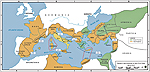
Map of the Roman Civil War 49-45 BC
Julius Caesar was a member of the
First Triumvirate. However, this political agreement
failed him and so did his net of supporters in Rome. In
December 50 BC, Senate demanded that Caesar should lay down
his command.
Caesar had other plans.
By Roman law a general and his
army was not allowed to cross the borders out of
his assigned province into the Roman Republic. Julius
Caesar was ready to revise this custom, and on January 10,
49 BC, he crossed the tiny river Rubicon near Ariminum (modern-day Rimini) with his troops,
heading for Rome.
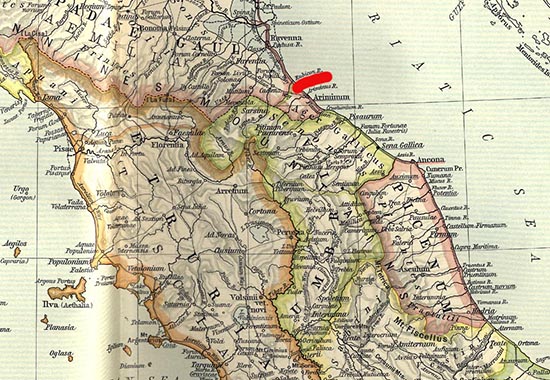
Map Location of the Rubicon River
Click map to enlarge
As expected, Rome saw this as an act of aggression
and the Roman Civil War begun.
How much did the fact that Caesar had to come up with a solution for his veterans of the Gallic Wars, i.e. accommodation, future income,
reward for service rendered etc, have an impact on his decision making?
Caesar and his Veterans
The welfare of his veterans played a crucial role in Julius Caesar’s decision-making, shaping both his political strategies and military actions.
His legions, fiercely loyal to him, were driven by the expectation of land and financial security upon retirement — a longstanding Roman tradition.
This loyalty enabled Caesar to undertake bold measures, including his fateful crossing of the Rubicon.
However, fulfilling these promises was fraught with difficulty. By Caesar’s time, public land was scarce, and securing territory for his veterans
required significant political maneuvering, often at odds with the Senate’s authority. Beyond ensuring loyalty, championing veteran welfare also
served as a powerful political tool, enhancing Caesar’s popularity among both his soldiers and the broader populace while strengthening his
position against the Senate and the Optimates.
The Senate’s resistance to his proposed reforms, particularly those addressing land distribution, heightened tensions and threatened both his
political ambitions and his credibility among his troops. This opposition further compelled Caesar to assert his power through decisive and
aggressive means.
The Siege of Brundisium
The first significant battle of the Roman Civil War was the Siege of Brundisium (modern Brindisi) in March 49 BC.
After crossing the Rubicon in January, Caesar rapidly advanced through Italy. Pompey and many senators retreated to Brundisium, intending
to cross to Greece. Caesar besieged the port city but was unable to completely blockade it due to lacking a navy, while
Pompey successfully evacuated his forces across the Adriatic before Caesar could capture them.
While technically a tactical success for Pompey (preserving his army), it ceded control of Italy to Caesar and forced the Pompeian forces
to fight from exile.
Caesar thus drove
Pompeius (Pompey) out of
Italy, besieged Massilia (naval Battle of Tauroento, July 31, 49 BC), conquered his enemy's forces in Spain by means of his
Campaign of Ilerda, and then passed
into Greece, where Pompeius and the other aristocratic
chiefs had assembled a large army.
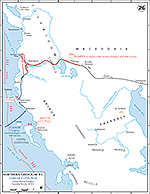
Roman Civil War: Opening Moves 48 BC
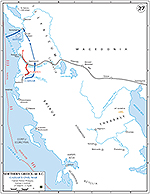
48 BC - March 27- April 3 - Roman
Civil War: Antony's Arrival
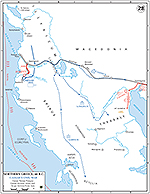
Roman Civil War: Scipio's Arrival 48
BC
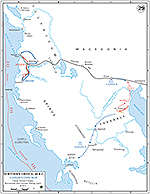
Roman Civil War: Movements During
April 48 BC
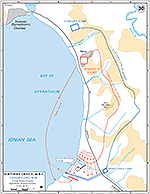
Roman Civil War: Operations Around
Durazzo - July 6, 48 BC
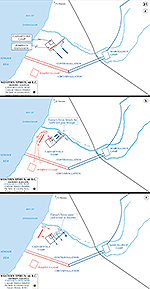
Roman Civil War: Battle of Dyrrachium
- July 9, 48 BC
On August 9, 48 BC, Caesar delivered a decisive victory at the great Battle of Pharsalia, also called
Battle of Pharsalus.
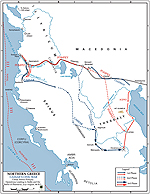
48 BC Roman Civil War: Moves to
Pharsalus
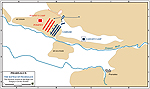
48 BC Battle of Pharsalus
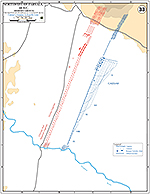
Roman Civil War: Battle of Pharsalus
August 9, 48 BC - Caesar Creates a Fourth Line
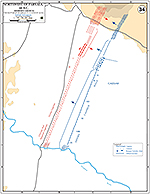
Roman Civil War: Battle of Pharsalus
August 9, 48 BC - Initial Advances
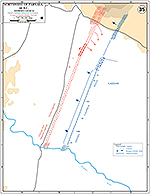
Roman Civil War: Battle of Pharsalus
August 9, 48 BC - Pompey's Cavalry Breaks Through
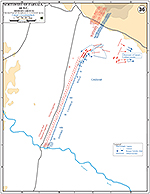
Roman Civil War: Battle of Pharsalus
August 9, 48 BC - Caesar's Counter-Attack
Pompeius fled for refuge to Alexandria, where he was assassinated. Caesar, who had followed him,
got involved in a war with the Egyptians, in which he was finally
victorious.
The celebrated
Cleopatra was made Queen of Egypt
and in the year 48 B.C. while in Alexandria, Egypt, Julius Caesar
and Cleopatra became real good friends.
In 47 BC, Caesar marched into Pontus,
and defeated the son of
Mithridates,
Pharnaces II, who had taken part in the war against him
at the Battle of Zela.
He then went back to Rome and
afterwards proceeded to the Roman
province of Africa, where some of the Pompeian chiefs had
established themselves, aided by Juba, a native
prince.
In 46 BC, Caesar overthrew them at the
Battle of Thapsus
and went back home to Rome. He was again obliged to lead an army into Spain, where the
sons of Pompeius, Gnaeus Pompeius and Sextus Pompeius, had collected the wrecks of their father's
party.
By the way, Gnaeus Pompeius and Sextus Pompeius were not sons of Julius Caesar's daughter Julia, who was Pompey's fourth wife. Instead,
they were the sons of Pompey the Great and his third wife, Mucia Tertia. Julius Caesar's daughter, Julia did not have any children with Pompey.
She died in childbirth, and the child did not survive.
On March 17, 45 BC, Caesar crushed the last of his
enemies at the
Battle of Munda, which ended the Civil War.
Julius won the Roman Civil War and
became ruler of the Roman Republic in the fashion of dictator.
During his rule, Caesar introduced numerous reforms, including the Julian calendar, a precursor to the modern calendar.
His policies also led to social upheaval, notably through changes in land ownership, as many veterans were settled on
confiscated lands.
Despite his achievements, his concentration of power alarmed the Senate, leading to his assassination in 44 BC by conspirators
including Brutus and Cassius.
Julius Caesar's
Assassination, Death & Legacy
A conspiracy among several aristocrats
resulted in the assassination of Gaius Julius Caesar. He was stabbed
to death on the Ides of
March (March 15) 44 B.C. in the Senate House.
What in the world are
the ides?
Some of the conspirators were his closest friends,
for instance Brutus.
Check out
Assassinations in History.
Caesar’s death did not restore the Republic; rather, it precipitated another series of civil wars. His loyal supporters, including Mark Antony and his adopted heir Octavian, vied for control.
Ultimately, Octavian emerged victorious, transforming Rome from a Republic into an Empire and taking the title Augustus:
Augustus Caesar (Gaius Octavius) became the first Roman Emperor. Not
until after Augustus's death succeeding Roman rulers named themselves
Caesar and used it as a title.
Caesar was used as a title of emperors
down to Hadrian, who died in 138 A.D.
After Julius' death, the Civil wars are soon renewed, Brutus
and Cassius being at the head of the aristocratic party, and
the party of Caesar being led by
Mark Antony and Octavianus
Caesar, afterwards Augustus.
Then in 42 BC - the defeat and
death of Brutus and Cassius at Philippi. Dissensions soon
break out between Octavianus Caesar and Antony.
Julius Caesar's
Children
Julius had a daughter named Julia
by Cornelia. He also had a son named Caesarion (the later
Ptolemy XV) by
Cleopatra VII.
Rome's
Expansion
Here is the map:
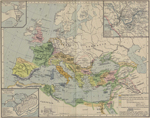
MAP BEFORE AND AFTER GAIUS JULIUS CAESAR
Click to enlarge
Julius Caesar
and the Calendar
In Julius's honor, the Roman calendar month Quintilis was renamed
July, as it was the month of his birth. Was this done during
his lifetime or after his death? Historians can't agree.
Julius also made calendar reforms.
We are still using the Julian calendar today but
Pope
Gregory XIII made some amendments in the year 1582 A.D. Thus, we are
calling it the
Gregorian calendar.
|
Caesar Salad
|
|

|
Julius was not responsible for our Caesar Salad.
Allegedly, the salad was invented by a Mexican Restaurant owner.
Here is a
good looking Caesar salad recipe.
|
Julius Caesar's Writings
You can read Julius's writings online for free in Latin and English side by side
Caesar wrote De bello Gallico and
De bello civili.
The Bellum Alexandrinium, on the wars of 47 BC,
De bello Africo, and De bello
Hispaniensi are all anonymous but contemporary with Caesar and
usually included with his works.
Julius Caesar Quoted
-
"Et tu, Brute?" ("You too, Brutus?") were Caesar's famous last words
when he realized that his close companion was involved in the plot
to assassinate him.
Please note - this is a legendary quote, which means Caesar
probably didn't actually say these exact words. But Shakespeare
decided he did. See Act III, Scene 1, of Julius Caesar, which has Caesar utter these words as his
final line when he sees Brutus among his assassins.
Thanks
John for your request to clarify this!
In fact, Shakespeare's play "Julius Caesar" (1599), was written over 1,600 years after Caesar's assassination.
Ancient historical sources closest to the event (Plutarch, Suetonius) report different final words. According to
Suetonius, Caesar said nothing. Plutarch suggests he may have said something in Greek to Brutus,
possibly "καὶ σὺ, τέκνον" ("You too, my child?").
-
"Veni, vidi, vici" ("I came, I saw, I conquered") is Julius's
description of his swift victory of the Battle of Zela, which he fought against a local king, Pharnaces II, in
Anatolia in 47 B.C. Unlike "Et tu, Brute," this phrase is historically documented, it is recorded by Plutarch and Suetonius.
→ Pronunciation of "vici":
- Classical Latin: "WEE-kee" (with a hard 'k' sound)
- Ecclesiastical Latin: "VEE-chee" (with a 'ch' sound like in "church")
The classical pronunciation is closest to how Caesar would have said it.
In more detail:
Classical vs. Ecclesiastical Latin Pronunciation of "Vici"
The difference between these two pronunciations reflects the evolution of Latin over time and its varying
uses across history.
Classical Latin Pronunciation ("WEE-kee")
This is how Julius Caesar himself would have pronounced "vici" in the 1st century BC:
- The letter 'v' in Classical Latin was pronounced like our modern 'w' sound
- The first 'i' is pronounced as a long "ee" sound
- The 'c' is always hard like our 'k' sound
- The final 'i' is another long "ee" sound
So when Caesar triumphantly declared "Veni, vidi, vici," it would have sounded approximately like
"WAY-nee, WEE-dee, WEE-kee" with emphasis on the first syllable of each word.
Ecclesiastical Latin Pronunciation ("VEE-chee")
This developed much later (around the 3rd-7th centuries AD) and became standardized in church usage:
The letter 'v' shifted to sound like our modern 'v'
The 'c' before 'i' softened to a "ch" sound (like in "cheese")
The vowels remained similar
This pronunciation emerged as Latin evolved and became the liturgical language of the Catholic Church.
It's heavily influenced by Italian phonology.
The shift from Classical to Ecclesiastical pronunciation happened gradually as the Roman Empire transformed.
By the time Latin became primarily a scholarly and religious language rather than a vernacular one, the
pronunciation had already evolved significantly.
The Classical pronunciation has been reconstructed through careful linguistic analysis of poetry
(where meter reveals pronunciation), descriptions by ancient grammarians, spelling variations in
inscriptions, and comparisons with other Indo-European languages.
When scholars, historians, or Latin enthusiasts aim for historical accuracy in representing Caesar's
famous phrase, they use the Classical pronunciation.
Julius Caesar and
Shakespeare
As mentioned above, in AD 1599,
Shakespeare wrote a tragedy in five acts, named Julius Caesar,
which you can read online for free on this site.
Julius Caesar and the
Opera
In 1724, German born composer
Georg Friedrich
Händel presented his opera Julius Caesar in Egypt.
Julius Caesar and the C-Section
The etymology of the term "caesarean section" (also spelled "cesarean") derives from the Latin
verb "caedere," meaning "to cut."
As in:
"Hodie arbores in horto caedere debeo."
(Today I must cut down the trees in the garden.)
"Caesus" is the past participle of "caedere."
Therefore, a caesarean section literally translates to a "cutting operation."
:: Connection to Roman Law ::
The procedure was mentioned in Roman law during the time of Numa Pompilius (715-673 BC),
long before Julius Caesar was born.
This law, known as Lex Caesarea, required that if a pregnant woman died,
the child should be cut from her womb in an attempt to save it.
Therefore, the procedure derived its name from this law rather than from Julius Caesar.
Was Julius Caesar born by this procedure?
Highly unlikely.
No contemporary Roman sources mention Caesar being born this way.
In ancient times, caesarean sections were typically performed only on dying or dead women, as the survival rate for the
mother was extremely low without modern surgical techniques. And Julius Caesar's mother, Aurelia, lived for many years
after his birth and was known to have been alive during his adulthood.
JC's Name
The cognomen "Caesar" was hereditary within the Julian family, and Caesar's father and grandfather also bore the name.
In Roman naming conventions, it was the third part of Gaius Julius Caesar's full name:
Praenomen: Gaius (personal name)
Nomen: Julius (clan or gens name)
Cognomen: Caesar (family branch within the gens)
During his lifetime, it was not a title. It was only after his death and the rise of his adopted son Octavian (later Augustus)
that "Caesar" began its transformation into a title for emperors.
Julius Caesar's timeline.
More History
|