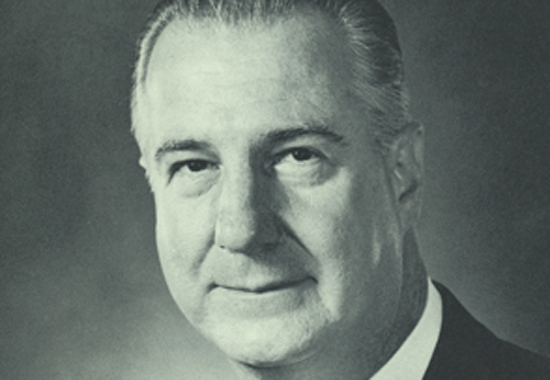
Spiro Theodore
Agnew was the first vice president who
resigned under duress. Welcome to the Nixon administration.
From 1969 to 1973, Agnew
was the 39th Vice President of the United
States under
Richard M. Nixon,
who served as the 37th U.S. President.
This made the
Vietnam
War one of Agnew's problems to deal with. Although, it
was more the American opponents of this war
Agnew had a problem with.
Spiro Agnew resigned his vice
presidency on October 10, 1973.
Why Did Spiro Agnew
Have to Quit His Job?
Agnew was under investigation by a
Baltimore grand jury for extortion, bribery, and tax evasion. The charges reached all the way back to the days when Spiro
T. Agnew had been the governor of Maryland. But it was rumored that he
was still very fond of receiving a gift here or there, even as vice president.
Spiro argued he was
untouchable, threw a tantrum, and chained himself to his office chair. When the
impeachment clouds over Nixon's head got darker because of Nixon's
involvement in the
Watergate Scandal, Spiro's own
people were all of a sudden eager to see him retire. Why was that?
If Nixon would have received the boot via
impeachment proceedings, Vice President Agnew would have been
the new president. Given Agnew's own, and separate, knapsack of
criminal investigations, federal indictments were in the air all
around.
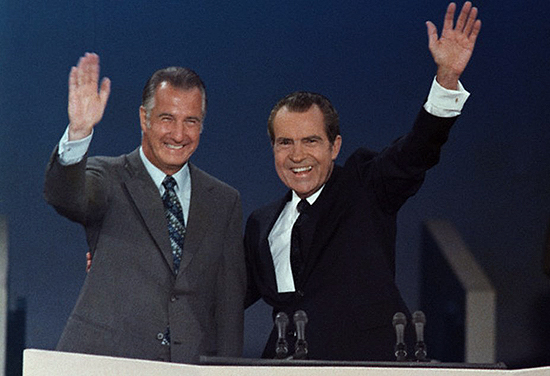
SPIRO T. AGNEW AND RICHARD NIXON
1969 Front Cover Crooks Unite
What did the spin doctor order?
A deal was negotiated, Agnew pleaded
guilty to one tiny count of income-tax evasion.
Frank Sinatra loaned
him some bucks and Agnew paid $160,000 in back taxes.
Agnew wrote his
letter of resignation and forwarded it to Secretary of State
Henry Kissinger.
He then cleaned
up his desk, was fined $10,000, moved to Rancho Mirage in
California, offered his services as a private business consultant,
and grew bitter.
On October 12, 1973, Nixon, who was
still in the saddle at this point, appointed House Republican Leader
Gerald R. Ford as the new vice president.
Ford took office on December 6, 1973.
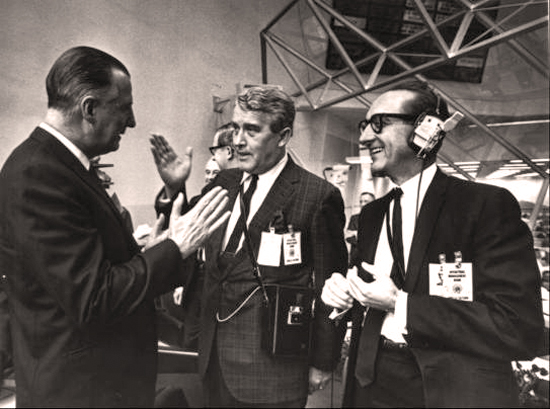
Waiting for Apollo 9 lift off:
Wernher von Braun (center),
George Mueller (with headphones) and Spiro Agnew
in the launch control room at Kennedy Space Center March 3, 1969
Photo NASA
Spiro Agnew's Roots and Family
Spiro Agnew's
father was Greek immigrant
Spiro Theodore Anagnostopoulos.
Spiro Sr changed his last name to Agnew, which
rolled a bit easier off the tongue.
In 1942, Spiro Jr
married Judy, in full
Elinor Isabel Judefind.
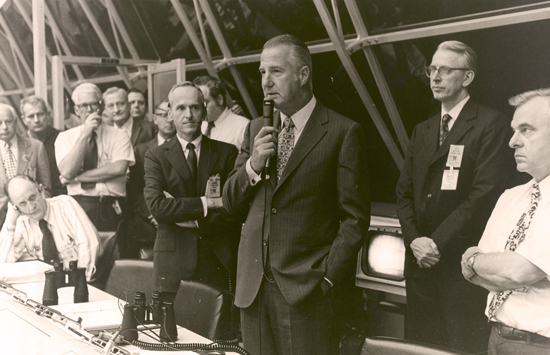
SPIRO T. AGNEW congratulates
APOLLO 17 launch team personnel
December 7, 1972
Photo NASA
Spiro Agnew's Speeches
If you like
interesting speeches and colorful expressions,
you like Spiro Agnew.
Agnew was particularly
outspoken against the folks from the media. The "nattering
nabobs of negativism" was perhaps one of his
best lines.
Here are
a few more excerpts:
Spiro Agnew and the Hippies
On November 13, 1969, Spiro T. Agnew delivered his
Television News Coverage speech
at the Mid-West Regional Republican Committee Meeting in Des Moines,
Iowa.
Patrick J.
Buchanan was Agnew's speech writer.
Spiro T. Agnew's Short Biography
November 9, 1918
Birth
in Baltimore, Maryland
Attends public schools
1937
Studies chemistry at Johns Hopkins
University
Studies law at the University of
Baltimore Law School
1942
Marries
Gets
drafted into the army during
World War II,
comes home with a Bronze Star for
his service in France and Germany
1947
Receives law degree and practices
law practice in a Baltimore firm
Sets
up his own law practice in Towson, a
Baltimore suburb
1962
Elected to public office Baltimore
county
1967
Governor of Maryland
1968
Nomination for vice presidency
1969 -
1973
Vice
president under President Richard
Nixon
Summer
1973
Investigation by Baltimore grand
jury
October 10, 1973
Resigns vice presidency
1974
Disbarred by the state of Maryland
1994
Nixon
dies. Despite his bitterness, Agnew
attends Nixon's funeral. "I decided
after twenty years of resentment to
put it aside."
September 17, 1996
Death
of leukemia in Berlin, Maryland
Spiro Agnew's Writings
Spiro Agnew
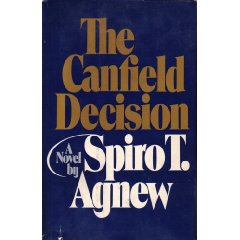
authored his memoir, Go Quietly... Or Else
(1980). He also wrote a novel, The Canfield
Decision (1976).
Greco-Persian Wars
Also called the
Persian Wars, the Greco-Persian Wars were
fought for almost half a century from 492 to
449 BC. Greece won against enormous odds. Here
is more: