|
RED SCARE
1917 - ...
From Fear to Hysteria and Back to Fear
The term Red Scare
stands for the general fear of Communism and all
things connected.
|
|
Historians sometimes apply the term Red Scare to a specific time period
during which fear, alarm, and dread of Communism were flying especially
high, at times bordering on paranoia.
The Red Scare began to spread in the West after the Communists
came to power during the
 Russian Revolution of 1917. Russian Revolution of 1917.
After
World War II, the
Cold War
renewed strong feelings of anti-communism.
|
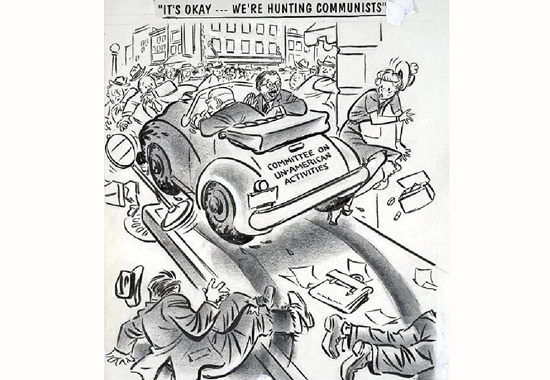
Illustration Above
October 31, 1947 - Drawing published in the Washington Post. Library of
Congress.
The Red Scare 1917 - 1920
The first wave of Red Scare was the result of the Communist takeover in Russia in
1917 and the apparent inclination of the revolutionaries to resort to
violence if considered necessary. Gruesome case in point was the slaughtering of
Czar Nicholas II and his family in 1918.
April 1919 - A series of letter bombs were
posted to several prominent Americans, such as Supreme Court Justice
Oliver Wendell Holmes. Rumors of a
nationwide conspiracy prospered.
Thousands of people were put under arrest,
some were deported.
The Red Scare 1945 - 1955
The first years of the
Cold War.
1945
World War II left Europe with a border to
the Communist Eastern Bloc.
1947
The U.S. Congress revived the House Committee on Un-American Activities (HUAC.)
See illustration above.
1948
Alger Hiss, a U.S.
State Department official, was accused of being a Soviet spy.
1949
Maoists came to power in China and the Soviets detonated their first
atomic bomb.
1950
The
Korean War broke out. US-supported
forces fought Communist forces.
At home, in February 1950, Wisconsin Senator
Joseph R. McCarthy (R) claimed that 205
Communist spies had infiltrated the State Department. McCarthy was
exploiting people's fear and couldn't
prove a thing, but with his contribution, also called
McCarthyism, the Red Scare gained
momentum.
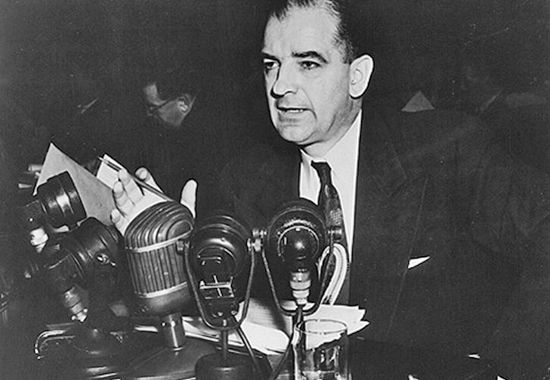
JOSEPH RAYMOND MCCARTHY
BRAIN-FARTING 1950 - 1954
U.S. National Archives and Records
Administration
One of the few who
managed to keep her knickers on was
 Margaret
Chase Smith. Also Republican, just as McCarthy, the
lady showed courage, an ability to think clearly, and she shared how she felt about "unproved
charges." Margaret
Chase Smith. Also Republican, just as McCarthy, the
lady showed courage, an ability to think clearly, and she shared how she felt about "unproved
charges."
Smith delivered her
Declaration
of Conscience on the Senate Floor on June 1, 1950, a speech
to which President Truman later referred as
"one of the finest things that
has happened here in Washington
in all my years in the Senate and the White
House."
However, the damage was done and in the entertainment industry,
for example, lists of potential Communist-friendly individuals circulated
like a Playboy magazine in a teenage boys' locker room.
Careers were ruined by the hundreds.
1951
Julius and Ethel Rosenberg actually
were Communist spies. The two were
collecting information on how to build a nuclear weapon, forwarded it to the
government of the Soviet Union, got caught in 1951, and executed in
1953 in Sing Sing prison, NY.
See also the
American Timeline.
More History
|