|
MAGNA CARTA
Magna Carta 1215
Magna Carta
is Latin and means Great Charter.
|
|
What Makes
Magna Carta so Special?
It holds the king accountable to the law.
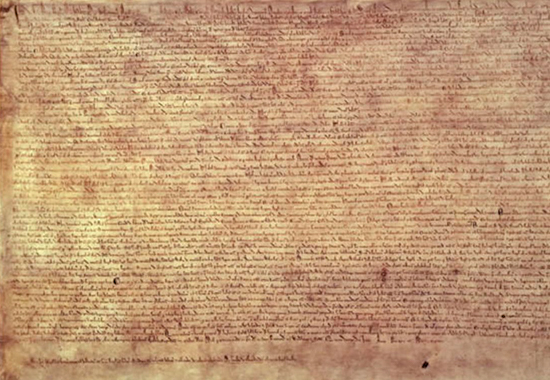
Magna Carta is the most famous document of English
constitutional history.
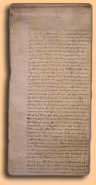
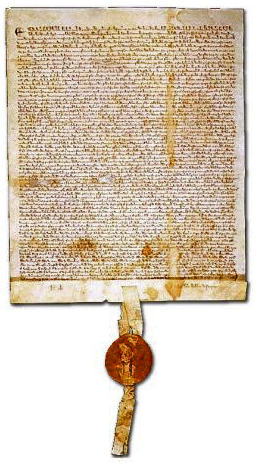
You can find the original, shown above, at the
British Library in London. |
Magna Carta was written in
Latin and sealed by
 King John of
England in the year 1215.
King John of
England in the year 1215.
Explore the
original document. (archived content - British Library)
Read the full
English translation of Magna Carta. (archived content - British Library)
Why Was Magna Carta
Written?
Magna Carta was written to
prevent misuse of power by the king. Obviously, King John didn't come up with
this sort of document himself. Why did he approve of it anyway?
The Story Behind Magna
Carta
King John owned land in France and the
French wanted it back. After waging war with John, the French
succeeded for the most part. Having lost this war and quite a bit of
money, John made life a little harder for his subjects,
for example by demanding very high taxes and by allowing his
deputies to treat the people arbitrarily.
In January 1215, a group of English barons had
had it. They demanded a guarantee for fair treatment from, and signed by, King John.
To show that they meant business, the barons armed themselves and captured London in May 1215.
Thus threatened with civil war, King
John reasoned correctly that negotiating was the idea of the day and
met with the barons at Runnymede, a meadow by the River
Thames, between Windsor and Staines.
Runnymede is located in today's county of Surrey. If you visit
Runnymede, you'll find this memorial
erected by the American Bar Association.
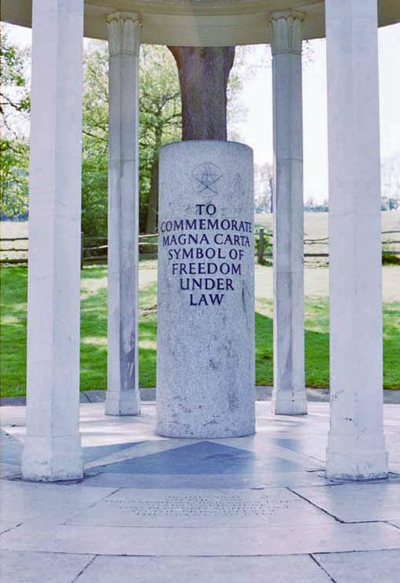
COMMEMORATING MAGNA CARTA IN
RUNNYMEDE
Back to the year 1215.
On June 15, 1215,
a draft, called the
Articles of the Barons, was agreed upon and sealed by King John.
The next few days were spent on refining the rough copy.
On June 19,
1215, the final document, Magna Carta, was completed.
In a Nutshell, What
Does Magna Carta Say?
Magna Carta is a
preamble and 63 clauses.
The clauses can be divided into nine
groups, regarding:
1. church
2. feudal law
3. feudal law -
subtenants
4. towns, trade, merchants
5. reforms of law
6.
behavior of governmental officials
7. royal forests
8. immediate
issues, e.g. dismissal of John's foreign mercenaries
9. ensuring
the king is acting according to this agreement
What Immediate Impact
Did Magna Carta Have?
The barons were pleased and renewed their oath of allegiance to the
king on the same day Magna Carta had been agreed upon — June 19, 1215.
However, as soon as he had
arrived back home, King John picked up
the phone and asked the Pope to revoke the agreement.
The Pope took sides
with the king.
The barons were outraged and made a couple of phone
calls themselves. French knights came over in support of the English
barons and civil war, also called the
First Barons' War,
broke out the same year in which the Magna Carta was signed.
The First Baron's War was fought
from 1215 to 1217.
King John
died in 1216 and later that year the first Magna Carta amendments were
written.
The document was reprinted in the name of John's son
Henry
III. Further changes were issued in 1217 and 1225.
Although a crucial document at the time, Magna Carta was not as big a deal as it became
for future
generations. How so?
What Importance Does Magna Carta Have
in History?
Magna Carta became the symbol against
oppression, the symbol of the constitution over the king, or as seen
in the photo above, a symbol of freedom under law.
And since oppression has always been of concern whenever people had power over
people, Magna Carta became
more and more famous whilst history dragged on.
Magna Carta
influenced future law and constitution making, such as the
Petition
of Right (England, 1628), the Habeas Corpus Act (England, 1679), and
the
Bill of Rights (United States, 1791).
The 1225 version of Magna Carta was integrated into British statue
law.
How Many Copies of the
Original Magna Carta exist?
There are four surviving copies of the original Magna Carta of 1215.
Each copy differs a little in size, shape, and text. Two of these
copies are at the British Library in the British Museum in London.
Another one is at Lincoln Cathedral and the other one is at
Salisbury Cathedral. It is not known how many copies of the 1215
version were made.
Re-issues were made in 1216, in 1217, in
1225, in 1264 (all by Henry III), and in 1297 (by
Edward I). At Durham
Cathedral are versions from 1216, 1217, and 1225.
Of the 1297 issue, four copies still
exist. One of them was gift wrapped by the British government and
given to the people of Australia, who put it on display in
Parliament
House at Canberra.
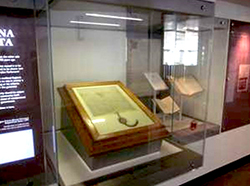
Magna Carta,
Parliament House, Canberra
� Commonwealth of Australia
The Only Magna Carta
Permanently Residing in the United States
The only Magna Carta permanently residing in the United States is a 1297
(Edward I) version. It is stored at the National Archives and you
are welcome to visit it.
Here's the website.
MAGNA CARTA
More History
|