|
Timeline of the French
Revolution: 1791
Go here for the
 French Revolution in a
Nutshell.
French Revolution in a
Nutshell.
February 25, 1791
Vincent Oge and
Jean-Baptiste Chavannes are
executed for initiating an uprising on Saint Domingue in
October
1790.
February 28, 1791
Vincennes Affair (Affaire de
Vincennes), the
Conspiracy of the Knights of the
Dagger (Conspiration des Chevaliers du Poignard),
the Day of Daggers (Journée
des Poignards).
All the terms above refer to today's
events. The claim that it was a conspiracy was invented. But what exactly happened?
The aunts of Louis XVI had recently
left France for Rome. Today, the Constituent Assembly discussed a
decree that would outlaw emigration.
A large anti-royalist crowd of around
1,200 men (organized or spontaneous — we can't be sure), shuffled
direction Vincennes to bust open the gates of the old chateau, which
they believed was used as a prison. Lafayette and his National Guard
arrived in the afternoon and restored order. He arrested around 60
men and brought them back to Paris.
Meanwhile, 300 to 400 alarmed nobles
armed themselves and assembled at the Tuileries castle to protect Louis XVI from a
potential mob attack.
Louis didn't know what hit him when they arrived, and, spooked by previous attempts on
his life, ordered them to abandon their weapons and leave with the
quickness. Lafayette, who recently had also become a moving target
for assassins, and the National Guard enforced the King's order. The
humiliation for the nobles was considerable.
Today, Louis thus lost many of his
loyal supporters as well as major points with royalists in general.
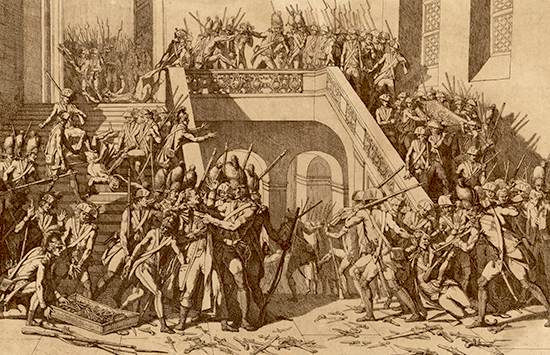
Affaire des Poignards,
Château des Tuileries, Paris, France - 28 Février1791
Bibliothèque Nationale de
France
March 10, 1791
Pope Pius VI condemns not only
the Civil Constitution of the Clergy
(Constitution Civile Du Clergé), but the entire Revolution.
March 13, 1791
Thomas Paine publishes
his Rights of Man in which he defends the French Revolution.
Part II will be published on February 17, 1792.
April 2, 1791
Mirabeau dies at age 42.
April 13, 1791
A letter from the Pope, aka Charitas:
The Catholic church declares all elections under the Civil Constitution of the Clergy
void and condemns the entire decree and its "foolish form of Church
government".
The French government will respond on
June 9, 1791.
May 11, 1791
At the
National Constituent Assembly,
Lafayette speaks in favor of equality and abolition of the slave
trade:
"... les
hommes libres, propriétaires, contribuables
d’une colonie, sont des colons. Or les gens
de couleur dont il est question sont
propriétaires, cultivateurs, contribuables,
libres. Sont-ils des hommes ? Moi je le
pense."
In other words:
"... free men,
landowners, taxpayers of a colony, are
colonists. Yet, it is disputed that people
of color are landowners, farmers, taxpayers,
free men. Are they men? I think so."
May 13, 1791
Antoine Barnave, member
of the Colonial Assembly representing the colonists of
Saint-Domingue,
speaks out in favor of keeping slavery alive and well in all French
colonies.
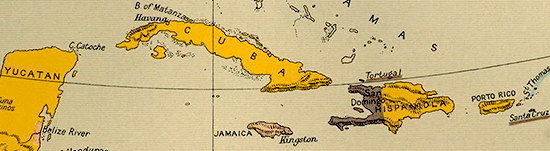
Saint Domingue or
Santo Domingo, today's Haiti
Click map to enlarge.
Following Barnave's proposition, the Constituent Assembly decrees
that
"no law on the status of the unfree people
can be made for the colonies, except by a
formal and spontaneous demand by the
colonial assemblies."
In effect, this
resolution decrees the continuation of slavery, at the
discretion of the colonists.
June 3, 1791
Before the
National
National Constituent Assembly
(Assemblée nationale constituante), and echoing
Dr. Guillotin's proposals from
October 9, and December 1, 1789, Félix Le
Pelletier demands decapitation for the death
penalty.
This time, the Assembly adopts the
proposal.
Here is more.
June 9, 1791
In response to the Catholic communication from April 13, 1791, the
National Constituent Assembly issues a decree on the publications
from the Pope. No message from the head of the Catholic church can
be published, unless it has been sanctioned by the king.
June 14, 1791
Le Chapelier Law.
Jean Le Chapelier's idea to ban worker's strikes and associations.
June 15, 1791
Late this evening, the Comte d'Artois (Louis XVI's brother)
arrives in Coblenz. After having left France in July 1789, he went
to Turin, then Mainz, now Coblenz, where many émigrés
welcome him.
June 20, 1791
The king and his family try to flee the country. They will be
caught tomorrow.
June 21, 1791
The royal family
is caught at Varennes
and brought back to Paris.
July 16, 1791
The Club des Feuillants
(
Club of the Feuillants) is founded.
July 17, 1791
Champs-de-Mars Shooting (Fusillade du Champs-de-Mars)
At the Champs de Mars in Paris,
protesters, organized by the
Club des Cordeliers, demanded the abdication of the King.
The mayor of Paris,
Jean-Sylvain Bailly, orders his
National Guards, led by
Lafayette, to
open fire, thus turning a protest into a massacre, and 50 or so were seriously injured or killed. Lafayette
has just buried his popularity. So did Bailly. He will retire on
November 16, 1791. The Club of the Cordeliers will be temporarily
closed.
August 22, 1791
The night of August 22 to 23, 1791:
Revolt of around 50,000 of the slaves on Saint Domingue (today's
Haiti), led
first by Jean-François and
Georges Biassou, and then by Toussaint Louverture.
The Declaration of the Rights of Man and of the Citizen from August
1789 declared that "Men are born and remain free and equal in
rights." But the powerful white plantation owners of Saint Domingue
refused to submit to this law. Without slavery they wouldn't have a
business left.
The
Haitian Revolution breaks out.
This slave uprising will play a
crucial role in the abolition of the transatlantic slave trade. Its
effect will concern all European colonies.
August 23, 1791
In 1998, UNESCO will invite to annually commemorate August 23
as International Day for the Remembrance of the Slave Trade and
of its Abolition.
August 27, 1791
Declaration of Pillnitz:
Austria and Prussia ask all European monarchs to join in the fight
to reinstate the French monarchy.
September 3, 1791
The National Assembly introduces the Constitution of September 3,
1791. Freedom and equal rights were the guiding principles in the
drafting of this constitution.
It also states that "the king's person
is inviolable and sacred," a principle that will be challenged on August 13, 1792
(Louis' imprisonment) and on December 10, 1792 (Louis' trial).
September 13, 1791
King Louis XVI
accepts the new constitution. He will
sign it tomorrow.
September 14, 1791
King Louis XVI
signs the new constitution in front of
the National Assembly.
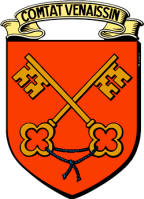
Also on September 14, 1791: The
Assembly issues a decree that approves the integration of the city
of Avignon and the province Comtat Venaissin, formerly property of
the Pope. After more than 500 years, they are once again part of
France.
|
 |
 |
|
Comtat
Venaissin Map Location
State
Historical Society of North Dakota |
Comtat
Venaissin Coat-of-Arms
St. Peter's Keys
State
Historical Society of North Dakota |
See also:
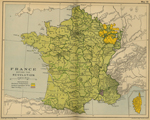
France 1789
September 25, 1791
The deputies of the National Constituent Assembly adopt the first
version of the
Penal Code (French: Code
Pénal), a set of rules
governing violations and criminal responsibility.
September 27, 1791
Emancipation of the Jews, who are fully recognized French citizens
as of today. Protestants have enjoyed this privilege since December
24, 1789.
September 28, 1791
Updating the status with regards to French slavery, the National
Assembly declares,
"Tout individu est libre aussitôt qu'il est
entré en France."
In other words,
"Every individual is free as soon as they
enter France."
September 30, 1791
The
National Constituent Assembly
becomes the the
Legislative Assembly.
On September 21, 1792, the Legislative Assembly will be replaced by
the
National
Convention.
October 1791
Lafayette resigns as commander
of the National Guards.
Louis XVI makes him commander
of the Army of the North.
October 14, 1791
Louis XVI
issues a statement in which he asks the émigrés to return to
France.
During the night of October 14 / 15, 1791,
Nicolas Jacques Pelletier attempts to rob a person,
and kills his victim in the process. Pelletier thus qualified
himself to become the first person to meet the
guillotine, an encounter
that will take place on
April 25, 1792.
November 9, 1791
The Legislative Assembly issues a decree ordering the émigrés
to return to France. Those who won't return by January 1, 1792,
will be suspect of conspiracy against France for which the only
answer is the death penalty.
Louis XVI will veto this decree on
November 11, 1791.
November 11, 1791
King Louis XVI vetoes the Assembly's decree from November 9 against
the émigrés.
November 29, 1791
At the Legislative Assembly, Assemblée Législative, the
deputy from Var, Maximin
Isnard, gets his compatriots excited with a passionate speech.
Here
is an excerpt:
Fear not to
bring upon yourselves a war with the great
powers. Interest has already decided their
intentions. Your measures will not change
them, but will oblige them to explain
themselves. The conduct of the Frenchman
ought to correspond with his new destiny. A
slave under Louis XVI, he was nevertheless
intrepid and great. Now that he is free,
ought he to be weak and timid? They are
mistaken, said Montesquieu, who imagine that
a people in a state of revolution are
disposed to be conquered. They are ready, on
the contrary, to conquer others.
Capitulations
are proposed to you. It is proposed to
increase the power of the King — of a man
whose will can paralyze that of the whole
nation — of a man who receives thirty
millions, while thousands of citizens are
perishing from want!
It is proposed to bring
back the nobility. Were all the nobles on
earth to attack us, the French, holding
their gold in one hand and the sword in the
other, would combat that haughty race, and
force it to endure the punishment of
equality.
Talk to the
ministers, to the King, and to Europe, the
language befitting the representatives of
France. Tell the ministers that, so far, you
are not satisfied with their conduct, and
that by responsibility you mean death.
Tell
Europe that you will respect the
constitutions of all other countries, but
that, if a war of kings is raised against
France, you will raise a war of people
against kings.
Let us tell
her that the
battles which nations fight at the command
of despots are like the blows which two
friends, excited by a perfidious instigator,
strike at each other in the dark. The moment
a light appears they embrace, and take
vengeance on him who deluded them. In like
manner, if, at the moment when the hostile
armies shall be engaged with ours, the light
of philosophy bursts upon their sight, the
nations will embrace one another before the
face of dethroned tyrants, of consoled
earth, and of delighted Heaven!
Finally, let
us tell her that 10 million Frenchmen alone,
inflamed by the fire of liberty, armed with
the sword, the pen, with reason and
eloquence, could change the face of the
world and make all tyrants tremble on their
thrones of clay.
When Isnard ends his speech the members of the Assembly come up to
him and embrace him.
On this day, the Assembly decrees that
the King should demand from neighboring countries a ban of all
emigrant gatherings within
their territories.
December 6, 1791
The Defense Minister is
Louis-Marie-Jacques-Almaric de Narbonne. He succeeds
Louis Le Begue de Presle Duportail.
December 14, 1791
In response to the decree of November 29,
King Louis XVI addresses the
Assembly.
He explains that he had given the
electors a deadline until January 15, 1792, to break up all
emigrant-inspired gatherings of troops within their realms. Should
they not meet this deadline, he will consider them enemies of
France.
The king further informs the Assembly
that he had also written to the
Emperor Leopold II, notifying
him that he was prepared to declare war in case his demands should
not be met.
Next, the Count of Narbonne-Lara
addresses the Assembly on the subject of war preparations. He
proposes to station an army of 100,000 men along the Rhine River.
These troops should be under the command of three men:
General Nicolas Luckner,
General Rochambeau, and
General Lafayette, who
was to be jerked out of his well-deserved retirement.
In other words:
The Army of the Center is created.
Commander: Lafayette.
The Army of the North is created. Commander: Rochambeau.
The Army of the Rhine is created. Commander: Luckner.

French Revolution timelines for the
years 1792-1799
are included in the French Revolutionary Wars timelines.
(See right column)
Alternatively, go here for all
Key Events of the French Revolution.
More History
|