|

 Explorers, Scientists &
Inventors
Explorers, Scientists &
Inventors
Musicians, Painters &
Artists
Poets, Writers &
Philosophers
Native Americans & The Wild
West
First Ladies
Popes
Troublemakers
Historians
Archaeologists
Royal Families
Tribes & Peoples

Assassinations in History
Who
got slain, almost slain, when, how,
why, and by whom?
Go to the
Assassination Archive



Online History Dictionary A - Z
All-Time Records in
History
What was the
bloodiest battle, the battle with the least
casualties, who was the greatest military leader?
Go to
Records in History
|
|
The Barons' Wars 1215-1217 &
1264-1267
The
First Barons' War
was fought 1215 until 1217.
|
|
Cause of the war was
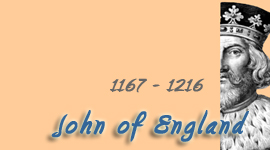
King John's
refusal to act according to what he had agreed upon by signing the
Magna Carta.
Controversy
Some may say Magna Carta
was not voluntarily agreed upon by John and some clauses were
outright unrealistic; that John had the barons up to the ears, and
simply signed to get them off his back.
The First Barons' War
Ensues
In any event, John
refused to co-operate and the French sent over some knights to support the barons
and their demands. The French found the timing perfect for
Louis VIII,
son of King
Philip II of France, to rule England instead of
John.
In 1216, Louis landed in
Kent. John fled and Louis was proclaimed king.
Turning Point of the
First Barons' War
In October 1216, King John died. Public opinion preferred
John's son Henry III as king rather than French Louis VIII.
Many barons felt the same way. Thus John's son Henry
III became king in 1216 when he was nine years old. Louis VIII was not welcome to rule anymore.
|
New king Henry III
later re-issued a revised Magna Carta, first in 1225 and again in
1264.
One of the decisive battles
of the First Barons' War was the Battle at Lincoln on May 20, 1217. The
barons were defeated and Louis had to agree to the Treaty of
Kingston-upon-Thames of September 12, 1217. The treaty granted
amnesty for the rebels and Louis had to promise to keep a low
profile.
The
Second Baron's
War was fought 1264 - 1267. Simon de Monfort was the driving
force behind the barons in this war. His family had come to England with
William the Conqueror in 1066.
Simon married Henry III's sister Eleanor and managed to become unofficial ruler
for a short period of time.
In May 1264, the Battle of Lewes was won
by Monfort. He captured the king and the king's heir. Another battle
fought was the Battle of Evesham in 1265, in which Simon de Monfort died.
More History
|



