|
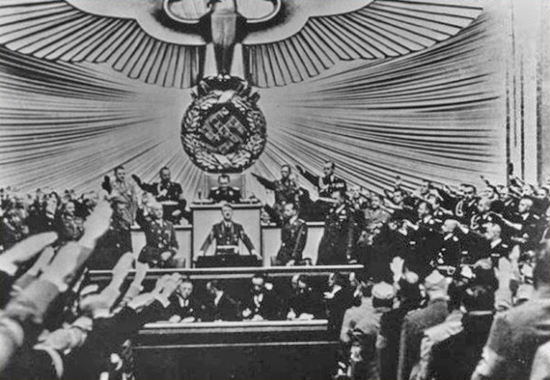
"Love Cannot Remain a One-Sided
Affair!" — September 1,
1939, in Berlin
Returning Fire
(German:
Es wird jetzt zurückgeschossen)
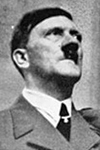
Go here for more about
 Adolf Hitler.
Go here for more about
Hitler's Returning Fire Speech.
It follows the English translation of the German full text transcript of
Adolf Hitler's Returning Fire speech, delivered
before the Reichstag in Berlin, Germany, on September 1, 1939.
Source: Domarus' The Complete Hitler / DNB text,
September 1, 1939. Domarus' footnotes to this speech are
added in blue.
Go here for the original
German version of the speech.

 |
Deputies, Men of
the German Reichstag! |
For months a
problem has tormented all of us. Long ago the
Diktat of Versailles bestowed this problem
on us. In its depravity and degeneracy it has
now become insufferable. Danzig was a German
city and is a German
city! The Corridor was German and is German!
These
regions owe their cultural development
exclusively to the German Volk. Without this
Volk, these eastern regions would still be
plunged in the depths of barbarism.
Danzig was
torn from us! Poland annexed the Corridor! The
German minorities living there are being
persecuted in the vilest manner imaginable. In
the years 1919 and 1920 over one million men of
German blood were forced to leave their
homeland.
As always, I
sought to bring about a change by peaceful
means, by offering proposals to remedy this
situation which meanwhile had become unbearable.
It is a lie when others in the world claim that
we sought to carry out our revisions by the use
of force exclusively. Fifteen years before National
Socialism's rise to power, there was ample
opportunity to carry out these revisions by
peaceful means. Nothing of the sort was done. In
any event, I made proposals for a revision not
once, but many times.
You know that all
these proposals were rejected. There is no need
for me to enumerate them: my proposals on the
limitation of arms; if necessary, even for the
complete elimination of weaponry; my proposals
for limited warfare, for the abolition of
methods employed in modern warfare which, in my
eyes, are hardly reconcilable with international
law. You know of my proposals on the necessity
of restoring German sovereignty to the territory
of the German Reich. You know of the endless attempts I made for a peaceful
resolution of the problem of Austria, and
later of the problem of the Sudetenland,
of Bohemia, and Moravia. It was all for naught.
There is one thing that is simply not possible:
to demand that an impossible situation be
resolved by means of peaceful revision — and
then to consistently deny resolution by peaceful
means.
It is likewise not
possible to claim that the one who, under the
circumstances, resorts to resolving this
situation by himself, who undertakes the
revisions on his own, is in breach of the law.
For the Diktat of Versailles does not constitute
law for us Germans.
You simply cannot
uphold and proclaim a signature to represent
sanctified law when it was extorted by holding a
pistol to the signatory's head and threatening
to starve millions of human beings if he failed
to comply!
Thus I attempted,
also in the case of Danzig and the Corridor, to
obtain a resolution by means of proposals and
their peaceful discussion. That these problems
had to be resolved was entirely clear. That the
western states were unconcerned with the time
table is understandable. Yet it is of concern to
us. It was — and had to be — of concern
especially to those suffering.
In my talks with Polish statesmen I once more
expounded those thoughts which you already heard
in my last speech before the Reichstag.
[1] No man
can accuse me of employing inappropriate methods
or of applying inappropriate pressure in an
uncalled-for manner. It was I who had the German
proposals formulated in the end, and I must
repeat here that there is nothing more modest or
loyal than these proposals. I should like to say this to the world: I alone was in the position
to make such proposals! I know very well that in
doing so I brought myself into opposition to
millions of Germans.
These proposals have been
rejected. And not only this! They were answered
by mobilization, augmented terror, increasing pressure
on ethnic Germans in these regions. The
previously slow and exclusively economic and
political throttling of the Free City of Danzig
within the last few weeks has spilled over into
an outright war against it, a choking off of
traffic there and military isolation.
Poland has unleashed this war against the Free
City of Danzig! It was not willing to settle the
question of the Corridor in one manner or
another, in a manner both reasonable and
rendering justice to the interests of both
states. And ultimately this meant that it was
not willing to uphold its obligations toward minorities.
And here I must establish the fact that Germany
has fulfilled its obligations! The minorities
living within the Reich are not subject to
persecution. There is not one Frenchman who can
stand up to claim that the French in the Saar
territory are being oppressed, tortured, or
robbed of their rights. Not one can claim as
much!
I have been
silently standing by and observing the situation
for four months now. Yet I have issued warnings
repeatedly. And I have intensified these
warnings of late.
As long as three
weeks ago, I already had the Polish Ambassador
informed that if Poland should send further
notes to Danzig, in the nature of an ultimatum;
if it should implement further discriminatory
measures against the Germans there; of if it
should attempt to destroy Danzig economically by
imposing high customs on it; then Germany could
simply no longer be expected to stand by without
taking action.
I left no
doubt that it would be a grave mistake in this
context to compare the Germany of today to the
Germany of days past.
There were
attempts to justify recriminations against
ethnic Germans by claiming that these
constituted a response to prior "provocations."
I know not what type of "provocations" those
women and children had allegedly perpetrated who
were abused and abducted. Nor can I imagine what
provocations had been perpetrated by those who
were sadistically and bestially tortured only to
be murdered in the end.
Yet there is one
thing I do know: no honorable great power could
calmly tolerate such a state of affairs in the
long run!
Nevertheless, I
made one last effort. And this even though, in
my heart, I was convinced that the Polish
Government - especially given its dependence on
the rabble of soldiers now freed of inhibitions
- was not serious about attaining a true
understanding. Nevertheless, I accepted the
proposal at mediation of the British Government. The
British suggested that while they were not
willing to negotiate themselves, they would open
a direct line of communication between Poland
and Germany to initiate talks once more.
And now I am
forced to state the following: I accepted this
proposal! It was for this new round of
negotiations that I drafted the proposals known
to you. For two whole days I sat with my
Government [2] and waited to see whether it was
convenient for the Polish Government to send a
plenipotentiary or not. Up to last night, it has
not commissioned any such plenipotentiary.
Rather it has informed us, through the offices
of its Ambassador, that it is presently
contemplating whether or not it is in a position
to consider the English proposals. It would
impart as much to England later.
My
Deputies! Should someone have the impertinence
to expect the German Reich and its head of state
to accept this, and should the German Reich and
its head of state tolerate this, then truly the
German nation would deserve no better than to
take leave of the political stage! For I am
wrongly judged if my love for peace and my
patience are mistaken for weakness or even
cowardice!
Last night I informed the British
Government that, under the circumstances, I no
longer see any willingness by the Polish
Government to enter into serious negotiations
with us. And thus all attempts at mediation must
be considered to have failed. For we had indeed
received a response to our proposals which
consisted of:
1. general
mobilization in Poland and
2. renewed, heinous atrocities.
Similar events
repeated themselves in the course of last night.
And this after the recent perpetration of
twenty-one border transgressions in the span of
one single night. Yesterday fourteen additional
violations of the border were recorded, among
them three of a most serious nature. I have
therefore resolved to speak to Poland in the
same language that Poland has employed towards
us in the months past.
Now that statesmen
in the West go about declaring that this
infringes on their interests, I can only regret
this position. This cannot and will not,
however, make me waver for a minute in the
fulfillment of my duty. I have solemnly assured
the Western states, and I repeat this here, that
we desire nothing of them. We shall never demand
anything of them. I have assured them that the
border separating France and Germany is a final
one. Time and time again I have offered
friendship, and if necessary close cooperation,
to England. But love cannot remain a one-sided
affair. It must be met by the other side.
Germany is not
pursuing any interests in the West. The West
Wall delineates the Reich's border for all time.
Our ambitions for the future are no different.
And nothing shall ever change the Reich's
standpoint in this matter.
The other European
states, in part, comprehend our stance. Here I
wish, above all, to thank Italy, which lent us
support during this entire time. You will
understand that we do not wish to appeal to a
foreign power for assistance in this struggle.
This is our task, and we shall carry it out
ourselves.
The neutral states
have already assured us of their neutrality. We
earlier guaranteed this neutrality. We are
deadly serious (es ist us heiliger Ernst)
in making this assertion.
[3] As long as other
powers do not violate this neutrality, we shall
likewise respect it scrupulously. For how could
we wish to, or desire to, conduct ourselves
differently towards these states?
I am happy to be
able to inform you of a special development at
this point. You know that two different
doctrines govern Russia and Germany. There
remained but one question to be resolved: as
Germany has no intent of exporting its doctrine,
and at the moment that Soviet Russia no longer
contemplates exporting its doctrine to Germany,
I no longer see any compelling reason why we
should continue to take opposite stances. Both
of us are aware that any struggle between our
two peoples would merely benefit third parties.
Hence we have determined to enter into a pact
which shall preclude the application of force
between us for all time.
[4] It also obliges us to
seek mutual consultation in certain European
questions. Moreover, it shall render possible
economic cooperation and, above all, ensure that
the strength of the two great states is not
squandered in rivalry with each other. Any
attempt by the West to change this is doomed to
failure! And of one thing I would like to assure
all of you here today: this decision signals a
fundamental change for the future and is a final
one!
I believe the
entire German Volk welcomes this political
resolve. Russia and Germany fought each other in
the World War only to suffer its consequences
equally in the end. This shall not happen a
second time!
Yesterday in
Moscow and Berlin, the Non-Aggression and Mutual
Assistance Pact — which had originally entered
into force upon signature — was accorded final
ratification. In Moscow this
pact was as warmly welcomed as you welcomed it
here. I second every world of the Russian
Foreign Commissar Molotov's speech.
Our goals: I am
determined to resolve
1. the
question of Danzig and
2. the question of the Corridor, and to see
to it that
3. a change of tone comes about in
German-Polish relations, so as to warrant
peaceful coexistence.
Meanwhile I am
equally determined to wage this war until the
present Polish Government judges it opportune to
assent to these changes, or another Polish
Government shall be willing to do so.
I will cleanse
Germany's borders of this element of insecurity,
this civil-war-like circumstance. I will take
care that our border in the East enjoys the same
peace as along any other of our borders.
I will take the
measures necessary in a fashion that does not
contradict what I have pronounced to be my
proposals to the world before you, my Deputies.
This means I do
not wish to lead this war against women and
children. I have instructed my Luftwaffe to
limit its attacks to military objectives.
Should, however, the enemy regard this as giving
him license to employ reverse measures against
us, then he shall receive so powerful a response
that stars dance before his eyes!
This night for the first time Polish regular
soldiers fired on our own territory. We have now
been returning the fire since 5:45 a.m.!
[5] (Seit
5.45 Uhr wird jetzt zurückgeschossen!)
Henceforth, bomb will be met with bomb.
He who fights with
poison shall be fought with poison gas. He who
distances himself from the rules for a humane
conduct of warfare can only expect us to take
like steps. I will lead this struggle, whoever
may be the adversary, until the security of the
Reich and its rights have been assured.
For over six years
I worked on the rearmament of the German
Wehrmacht. I have spent over 90 billion
[6] of the
rearmament of the Wehrmacht. Today it is among
the best-equipped in the entire world. It
completely defies comparison to that of 1914!
My confidence in
it is unshakeable! When I call on this Wehrmacht,
and when I now demand sacrifice from the German
Volk, even the ultimate sacrifice should there
be need, then it is because I have a right to do
this, because today I am as willing as I was
before to make any personal sacrifice. I am
asking of no German man more than I myself was
ready to do through four years!
Germans should not
be asked to make any sacrifices I myself would
not make without an instant's hesitation!
[7]
I now wish to be
nothing other than the first soldier of the
German Reich. Therefore I have put on that tunic
which has always been the most holy and dear to
me. [8] I shall not take it off again until after
the victory is ours, or — I shall not live to
see the day!
Should something
happen to me in this struggle, then my immediate
successor shall be Party comrade Göring.
Should anything
happen to Party comrade Göring, then his
successor shall be Party comrade Hess. You shall
owe this man — as your Führer — the same loyalty
and blind obedience you owe to my person!
Should anything
happen to Party comrade Hess, then through the
offices of law I shall call upon the Senate,
which is to determine the most worthy, i.e. the
most valiant from its midst.
[9]
As a National Socialist and
a German soldier I
enter into this struggle with a strong heart! My
life was but one struggle for the German Volk,
for its resurrection, for Germany. This struggle
was governed by only one creed: faith in this
Volk!
There is one word
which I have never known and this word is:
capitulation!
[10]
If some now believe that we are
facing hard times, then I would like to ask them
to bear in mind that once a Prussian king with a
ludicrously small state faced off a far more
powerful coalition. And three battles later he
stood victorious in the end, for he possessed
that strong, believing heart, the kind which we
need in these times as well.
[11] I would like to
assure the world around us of one thing: there
shall never ever be another November 1918 in
German history!
Since I myself
stand ever ready to lay down my life for my Volk
and Germany, [12] I demand the same of everyone else!
Whoever believes he can oppose this national
commandment shall fall! We will have nothing to
do with traitors!
And all of us
pledge ourselves to the one ancient principle:
it is of no importance if we ourselves live — as
long as our Volk lives, as long as Germany
lives! This is essential.
I expect of all of
you as the Reich's emissaries henceforth that
you shall do your duty wherever you may be
assigned! You must carry the banner of
resistance forth regardless of the cost.
May no one
approach me to report one day that morale is low
in his Gau, in his Kreis, or in his group or
cell. The one responsible for morale is you —
the responsibility is yours!
[13] I am the one
responsible for the morale of the German Volk.
You are responsible for morale in your Gaus, in
your Kreise! No one has the right to cast off
this responsibility. The sacrifices demanded of
us today are no greater than those made by
countless earlier generations. All men who have
set out on this most bitter and strenuous of
paths for Germany have accomplished nothing else
than what we must also accomplish. Their
sacrifice was not made without cost or
suffering. It was no easier to make than the one
demanded of us.
I expect every
German woman to integrate herself into the great
community-in-struggle in an exemplary fashion
and with iron discipline!
It goes without
saying that the German youth will fulfill, with
a radiant heart, the tasks the nation, the
National Socialist state, expects and demands of
it. [14]
Provided all of us
form part of this community, sworn together,
determined never to capitulate, then our will
shall master all need.
I conclude with
the avowal I once pronounced as I began my
struggle for power in the Reich. Back then I
said: When our will is strong enough that need
can no longer vanquish it, then our will and our
German state will vanquish and conquer need.
Deutschland —
Sieg Heil!
[1] Reference to the
Reichstag address April 28, 1939.]
[2] The claim that
he and his "Government . . . sat and waited . .
. for two whole days" was untrue. Actually,
Hitler had mostly been waiting alone during the
two days in question (August 30 and 31, 1939),
while Göring or Ribbentrop had kept him company
on occasion.]
[3] On April 9, 1940, both Denmark and Norway would
find out precisely how "deadly serious" Hitler
was in making these assertions. The assault upon
Poland merely set the stage for surprise attacks
on non-belligerents which had explicitly
declared their neutrality. On May 10, 1940,
German troops moved toward France and in the
process violated the neutrality of three states:
Luxembourg, Belgium, and the Netherlands. On
April 6, 1941, Yugoslavia and Greece became
Hitler's next victims, and the Soviet Union
followed suit on June 22, 1941.]
[4] This future "for all time" ended prematurely on
June 22, 1941.]
[5] The attack was launched
at 4:45 a.m. according to plan and not at 5:45
a.m. as Hitler erroneously stated.]
[6] This in fact meant that
nearly 14 billion Reichsmarks were allocated for
rearmament every fiscal year. In light of this,
there apparently was little truth to Hitler's
1932 claim that the final repayment of the three
billion Reichsmarks outstanding in reparations
would spell the ruin of Germany. In this 1939
statement, Hitler once more greatly exaggerated
the sum spent on rearmament. According to
research by Heinrich Stübel the figure more
accurately had to be placed around 63 billion
instead of the 90 billion Hitler cited. Cf.
Heinrich Stübel, "Die Finanzierung der
Aufrustung im Dritten Reich," in Europa-Archiv,
6 (1951), pp. 4128 ff.]
[7] Further developments
revealed that Hitler had no intention of placing
his own life in danger or suffering the same
privations the German people did because of the
policies he espoused.]
[8] The tunic Hitler
sported that day had little in common with the
jacket he had worn during World War I; only the
color was the same. Aside from this, cut and
quality of the material had markedly improved:
it was no longer the tunic of a mere corporal,
but rather it was to clothe the Supreme
Commander of the Wehrmacht. The tunic was
replete with golden buttons and an eagle in gold
on the left sleeve. The tunic made plain that
Hitler occupied a higher rank than an ordinary
Wehrmacht general whose golden insignia was
placed on the right chest. Moreover, the Supreme
Commander naturally was in a position superior
to that of a Waffen SS general whose insignia,
while embroidered on the left sleeve as well,
was in silver only.]
[9] As Hitler felt his
position in power threatened by like bodies,
this senate was never actually in session. Six
years earlier, Hitler had also announced the
creation of a senate whose members one day would
convene to elect a new Führer. Needless to say,
this senate never met either. See Hitler's
three-hour-long speech to Reichsleiters and
Gauleiters at the Obersalzberg on August 6, 1933.]
[10] For Hitler, capitulation meant "submission to
the will of another." For himself, this was out
of the question. He made this unmistakably clear
in a speech on April 29, 1941: "As a National
Socialist, there was one word I refused to
acknowledge in the struggle for power:
Capitulation! I never knew this word and I shall
never know this word as the Führer
of the German Volk and as
your Supreme Commander. Once more, this one word
is 'capitulation' and all it means is submission
to the will of another — never, never!"]
[11] Here once again Hitler's
"Fridericus Complex" surfaced, a delusion many
Germans suffered from as well. It was based upon
the premise that, despite serious setbacks and
an international coalition sworn against him,
the Prussian King Frederick II the Great (Fridericus
Rex) had reigned victorious at the end of the
Seven Years' War because of his steadfastness.
The truth of the matter was, however, that
Frederick's role in this war was a peripheral
one as the hostilities between Prussia and
Austria were not at the center of the conflict.
The rivalry between England and France
determined the war's outcome; had Frederick the
Great been allied with France, instead of with
victorious England, neither his steadfastness
nor any other virtue would have saved him from a
fate no different from that of defeated Austria
in 1763. Austria had fought on the French side
as France's chief ally in the conflict.]
[12] Hitler was
not in the least disposed to risk his life for
the cause; rather he was very careful as far as
his personal well-being was concerned.]
[13] This statement is a
characteristic one for Hitler. Already at the
beginning of the war, he made certain that his
cohorts knew they were to report good news
exclusively: victories, successful campaigns,
and great enthusiasm amongst the common folk.]
[14] According to Hitler,
it was the main mission in the life of Germany's
youth to die a hero's death; however, that they
were to do so with a "radiant heart" was indeed
a new turn of the phrase.]
More History
|