|
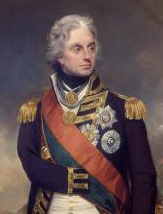
Horatio Nelson 1758-1805
Horatio Nelson, officially the
Viscount Nelson of the
Nile and Burnham Thorpe, was a British naval hero, a
brilliant tactician, and the one who spoiled
 Napoleon
Bonaparte's plan to conquer Britain. Napoleon
Bonaparte's plan to conquer Britain.
The
French Revolutionary War and the
Napoleonic Wars were the wars that made Nelson famous.
The Family of
Horatio Nelson
Horatio's father was the Reverend
Edmund Nelson. His mother was
Catherine Nelson, née Suckling. Catherine's grandmother,
by the way,
was
Sir Robert Walpole's
sister.
Nelson's parents were not only responsible
for naming him Horatio (after his godfather, the second Baron
Walpole) they also had eleven children all in all. Horatio was
child number six.
In 1787, Nelson married widow
Frances Nisbet (also called Fanny Nisbett) née Woolward. He
met her
and her five-year-old son Josiah, on the island of
Nevis.
Francis and Josiah followed Horatio Nelson home to Norfolk.
In 1801, Frances and Horatio
separated. In 1830, Josiah died and in 1831 Frances did the
same.
Horatio
Nelson had two daughters by
Emma Hamilton, one of them was
Horatia.
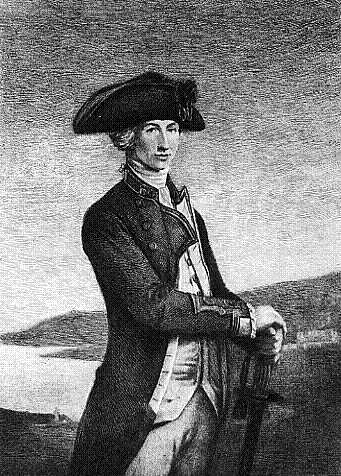
CAPTAIN HORATIO NELSON IN 1781,
AGED TWENTY-TWO
Gutenberg Project
Who Was
Emma Hamilton?
While married to Frances, Nelson had a heavy duty affair with
Lady Emma Hamilton, who herself was married to Sir
William Hamilton.
At the time, William Hamilton was the British ambassador to the
Kingdom of
Naples. It so happened that Horatio Nelson was sent to collect
reinforcements at Naples.
Some say that it was thanks to Emma
Hamilton's influence that Nelson obtained
permission from Naples for a refueling stop at Sicily when he
was on his way to fight the French. This would mean that Emma
Hamilton helped Horatio Nelson win the Battle of the Nile in
1798. In any event, the two celebrated his victory
together.
After the separation from Frances,
Nelson and the Hamiltons settled at Merton Place, a posh 160
acre estate near
London.
Why didn't William Hamilton
divorce his two-timing wife, go back to Jamaica where his father used to be
governor, and enjoy a drink with an umbrella?
We will never
know. Horatio Nelson's rising reputation as national hero might have had something to do
with it. Instead, William died in 1803 with both, Emma and Horatio,
sitting at his bedside.
Back to Nelson...
What Was Horatio
Nelson's Brilliance?
Admirers of Nelson would argue
that he disregarded the traditional naval tactics of
his time and encouraged his men to put their individual
thinking caps on. He was a strategic genius and an inspiration
for his men.
Occasionally, Nelson felt comfortable to disregard orders, a conduct unacceptable in the
Royal Navy. Nelson's former experience in the merchant navy,
who despised the Royal Navy, might have been the motivation
in those cases.
Horatio Nelson
Controversy
On June 28, 1799, at Naples, aboard his vessel the
Minerva, Nelson tried and executed
Francesco Caracciolo, the Duke di
Brienza.
Furthermore, the killing of 99
prisoners of war at Naples in June 1799 gives reason to wish
for a closer look at Nelson's saintliness.
Here is the Telegraph's article
Was Nelson a War Criminal?
Horatio Nelson's
Main Victories
- The
Battle of Cape St. Vincent
in 1797
- The
Battle
of the Nile in 1798
- The
Battle of Copenhagen in 1801
- The
Battle of Trafalgar in 1805
Horatio Nelson's Brief Biography
1758 Birth at Burnham Thorpe, Norfolk, England
1768 Grammar school
1770 Joins Royal Navy
1771 Sails to Jamaica and Tobago
1773 Sails to Spitzbergen, East Indies
1775 Contracts malaria
1776 Promoted Fourth Lieutenant
1777 Promoted Lieutenant
1779 Promoted Captain
1780 Siege of the fort of San Juan
1782 Falls in love with 16-year-old Mary Simpson in Quebec
1783 Returns home from fighting in the
American Revolution
1784 Asks Elizabeth Andrews to marry him, but she declines.
1788 The beginning of five years of unemployment
1793 Commander of the Agamemnon
1794 Liaison with
Adelaide Correglia
1796 Promoted Commodore
1797 Knighted because of the Battle of St. Vincent
1798 Made Baron because of the Battle of the Nile
1799 Helps
King Ferdinand I to recapture Naples
and shatter the
Parthenopean
Republic the French had set up in Naples. In turn,
Ferdinand makes him Duke of Bronte, which is a town in
eastern Sicily, the home of pistachio nuts and Nelson's new cozy little weekend
retreat Castello di Maniace
1801 Promoted Vice Admiral; Viscount
1802 Promoted Commander-in-chief
1802
Treaty of Amiens
1805 Death at sea, off Cape Trafalgar, Spain
Life and Limb
The good man went in
bits. In 1794, Horatio Nelson lost his right
eyesight almost completely at the siege of Calvi, Corsica.
Attacking Tenerife in 1797, Horatio lost his right arm. The
Battle of the Nile in 1798 brought with it a severe head
wound. In 1804, Horatio Nelson had enough and asked the
Admiralty for leave because of ill-health.
Death and Funeral
During the course of the Battle of Trafalgar, a sharpshooter
positioned himself atop the mast of the French ship Redoutable.
The sniper's musket ball passed through Nelson's left
shoulder, his lung, and lodged in his spine. Nelson was carried below deck and
spoke his last words,
"Thank God, I have done my duty."
Thus he spoke and thus he died
at 4.30 pm that afternoon. Nelson was put in a cask filled
with brandy to preserve his body. The cask was brought to
Gibraltar where the brandy was replaced by spirits of wine and
nobody inquired into the final whereabouts of the first fill.
Let sailors be sailors.
Nelson's body finally made it
home to England on December 4, 1805, where
William Beatty
performed the autopsy and extracted the fatal musket ball.
What to do with the body of a
hero after an autopsy?
Nothing seemed appropriate enough, so back
into the liquid. This time a lead coffin served as receptacle.
After two weeks Nelson's
corpse was put into a coffin made from the mainmast of the French ship
L'Orient, which Nelson had managed to blow up during the
Battle of the Nile.
Russian
doll like, this wooden coffin was put into another lead
coffin, and the lead coffin again into another one of wood.
The entire load went to Greenwich Hospital where people were given
the opportunity to pay their last respects. Approx.
100,000 people showed up to do so.
But the journey wasn't over.
Nelson-in-the-box (boxes) was brought to the Admiralty in
Whitehall. A funeral had been arranged for January 9, 1806 at
St. Paul's Cathedral and Admiral Horatio Nelson would have enjoyed
the extent of the festivities in his honor. In fact, never before in British
history did a common man receive a state funeral.
An incredibly huge crowd and at
least 30,000 troops lined the streets to watch the procession
that went from Whitehall to St Paul's Cathedral. The
procession itself included more than 10,000 people. A
five-hour-long service was held and the intensity was more
than some folks could handle. People went bananas and ripped
off pieces of the flag that was put on Nelson's coffin to take
home as souvenirs.
Finally, after order had been
restored, Horatio Nelson's coffin(s) was (were) put into
a marble sarcophagus originally intended for
Cardinal
Wolsely' s corpse in St Paul’s Cathedral’s crypt.
The things you find in storage.
Horatio Nelson's
Impact on History
Nelson's victory at the Battle of the Nile put an end to
Napoleon's dream of conquering the East.
Nelson's victory at
the Battle of Trafalgar saved the British Isles from invasion
and secured British supremacy at sea.
The Times reported,
"We do
not know whether we should mourn or rejoice. The country has
gained the most splendid and decisive Victory that has ever
graced the naval annals of England; but it has been dearly
purchased. The great and gallant NELSON is no more."
Subsequently and appropriately, monuments, streets,
inns, everybody, everything, and their dog were named in honor
of Horatio Nelson.
Horatio Nelson
Quoted
|
 |
A fleet of British ships of war are the best negotiators in
Europe. |
Horatio Nelson
Trivia
More History
|