|
King Arthur
King Arthur and the Knights of the Round
Table are a legend.
|
|
But, as is the case with all
ancient tales, some true events might have been woven into
it.
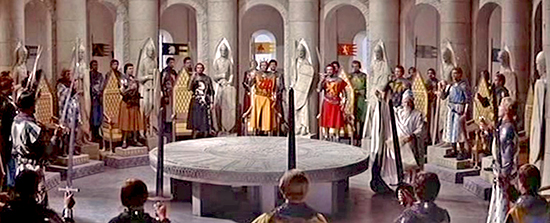
Image Above
Scene from the 1953 MGM movie
Knights of the Round Table.
Robert Taylor is Lancelot, Ava Gardner is Guinevere, and Mel
Ferrer is Arthur. |
What's True?
What Isn't?
Nobody has a clue if King Arthur's tale is based on a real person or
not. So, if you're smart you purchase a piece of antique furniture,
invent a good story, and live off the money that tourists will pour
over your town.
In this fashion acted the good people of
Winchester.
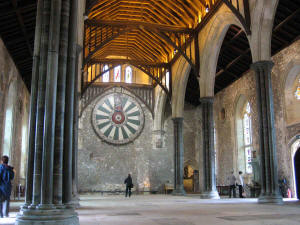
KING ARTHUR'S ROUND TABLE
PINNED ON THE WALL
IN THE GREAT HALL OF WINCHESTER CASTLE
When Did King
Arthur Live?
As the story goes, King Arthur lived between
AD 400 and 600.
According to Nennius, a Welsh
historian, a successful military leader really lived around this
time. But he was just that and not a king.
The Tale of King
Arthur and His Knights of the Round Table
Of course, there are many versions of
the tale, the bunch of them being known as
Arthurian legend. In time, various characters from the
main story became heroes in numerous spin-offs.
But in a
nutshell:
There was King Arthur, at his headquarters at
Camelot, who gathered his
12 or 24 knights around a round table to convey the idea of equality.
Everybody went looking for the very
cup Christ had used at his last supper. These search parties were on
their
Quest for the
Holy Grail.
One of Arthur's knights was
Sir
Lancelot. He was the poster child of chivalry and the father of
Sir Galahad. He also shagged King Arthur's wife
Queen Guinevere.
Arthur's sword was named
Excalibur.
By magic, the sword was stuck in a stone and nobody could get the
darn thing out of the rock except Arthur. Either that, or, in another
version, the sword was given to him by
the Lady of the Lake, which is also cool.
The story ends on a sad note. The
society of the Round Table gets dissolved, Arthur dies, his kingdom
gets destroyed.
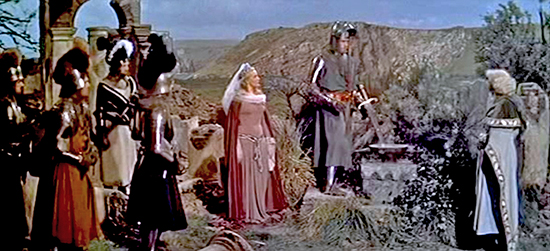
Arthur About to
Extract the Magic Sword. No doubt, He's The One.
MGM
Who Came Up With
the Story?
It is unknown where exactly the story originated. Some say it all
started in Wales, and nobody is surprised. Others say the tale started further north on the
island.
Who all contributed to
the story? That list would be probably endless. Let's just name a
few:
Writer:
Gildas, British monk and
historian of the 6th century, his work: De excidio et conquestu
Britanniae, which means The Overthrow and Conquest of Britain.
He tells Arthur's story but doesn't mention him by name.
Work: Gododdin, written around
the year 600
Writer:
Nennius, Welsh writer of
the 9th century, his work: Historia Brittonum. He is the one
mentioned earlier. Nennius states that there was an Arthur, but he
wasn't king.
Work: Annales Cambriae, 10th
century
Work: Kulhwch and Olwen, Welsh
story from the 12th century
Writer:
Geoffrey of Monmouth,
12th century, Work: Historia regum Britanniae
Writer:
Wace, poet of the 12th
century, Work: Roman de Brut
Writer:
Chrétien de Troyes, 12th
century, Chretien wrote five books on Arthur: Erec, Cligès,
Lancelot, ou Le Chevalier à la charrette,
Yvain, ou Le
Chevalier au lion, and Perceval, ou Le Conte du Graal.
Work: Lancelot, 13th century
Writer:
Robert de Boron, Work:
Merlin, 13th century
Writer:
Sir Thomas Malory, Work:
Le Morte Darthur, 15th
century
Writer:
 Alfred Tennyson,
Work: Idylls of the King, 19th century
Alfred Tennyson,
Work: Idylls of the King, 19th century
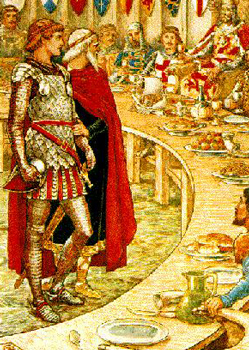
And then there came the movies...
Monty Python and
the Holy Grail (1975)
Excalibur (1981)
Camelot (1982)
King Arthur (2004)

Arthur's and
Guinevere's Grave at Glastonbury Abbey, Somerset, UK
Tom Ordelman / Wiki
And talking about Winchester, here is
the map
Winchester in the Middle Ages
More History
|