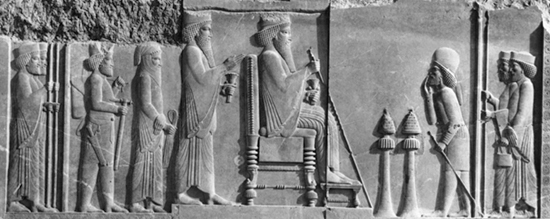
The two poles between the king and the first dignitary were
not utilized for a rope line but are called censers.
A censer is also vessel in which incense is burnt, which
only makes sense because we can't be sure if the dignitaries
were awarded the opportunity of a quick shower after their
long journey.
The above image is
of the stone relief from the Treasury, which was
part of the marvelous palace complex in
Persepolis, Iran. The relief is now in the
Archaeological Museum, Tehran. Image copyright
Oriental
Institute, the University of Chicago.
And in this photo you can
estimate the proportions of the above stone relief relative
to the size of a person.

STONE RELIEF
FROM THE COURTYARD OF THE TREASURY, PERSEPOLIS
Oriental
Institute, the University of Chicago
Here is a map of Persepolis Terrace, the entire
palace complex. Darius I the Great started
construction on this palace project around 518
BC. It was laid in ruins by
 Alexander
the Great around 331 BC.
Alexander
the Great around 331 BC.
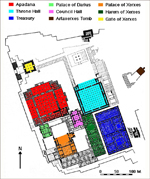
Persepolis Palace Layout
Click image to enlarge
The Family of
Xerxes I
King Xerxes I the Great was a member of the
Achaemenian Dynasty.
Xerxes' father was
Darius I the Great.
Xerxes' grandfather (his mother's father) was
Cyrus II the Great.
Great ran in the family.
And let's get the family straight:
Cyrus the Great's daughter
was Atossa. Atossa became the wife of Darius I. Atossa and Darius
I's son was Xerxes I.
Apparently, Xerxes co-ruled with his
father Darius from the year 496 BC. Xerxes became sole ruler of the
Persian Empire
in
486 BC, the year his father Darius died.
Xerxes re-conquered Egypt in the second year of his reign, which was
the year 484 BC. Egypt had revolted from the Persians in 487 BC.
The Children of Xerxes
I
Xerxes I had at least three children: his son
Darius, his son
Hystaspes, and his son Artaxerxes I Longimanus, who followed him to
the throne.
The Character of
Xerxes I
In our local library, I found the interesting and ancient book
History of Xerxes
the Great by Jacob Abbott,
which is aimed at the young historian. In it, Xerxes is described as a tender-hearted,
self-confident, and generous but suggestible king.
You can read the work
online.
More about Jacob Abbott
here.
Other Names for Xerxes
I
Xerxes is believed to have been
the king Ahasuerus who is mentioned in the bible book Esther.
Xerxes' old Persian name was Khshayarsha.
How Xerxes I Became Heir to the Throne
Xerxes had an elder brother,
Artabazanes (or Artabanus). Why then didn't Artabazanes become king instead?
Two reasons:
First reason:
They had different mothers. Xerxes was the son of Darius I and
Atossa. Artabazanes was the son of Darius and another woman, not
Atossa. Let's remember, Atossa was the princess, Darius I was only a
noble. Xerxes, therefore, was of royal blood. Artabazanes wasn't.
Second reason: Artabazanes was
born before Darius I became king. Xerxes was the first son born
after Darius became king.
Thus, Xerxes became king.
Xerxes I and the
Invasion of Greece
Xerxes went to conquer the
Greeks with an army of approx. 360,000 men and 800 ships.
Herodotus
says it was 5,000,000 troops out of 50 nations, but you can't always
take the good man literally.
Fact is, it was a huge army.
The march from what is today Turkey
to Greece was a major operation. A bridge was built over what is today's
Dardanelles Strait and an
important victory was won at the
Battle of Thermopylae in
mid-August 480 BC. It was the destruction of the three hundred
Spartans.
Go here for
the movie 300.
Also in August 480 BC, the naval
Battle of Artemisium was
fought for three days and won by the Persians. Indecisive actions
between the Persian and Greek fleets near Artemisium, located on the
north coast of Euboea, came to an end when the Greek vessels
withdrew southward after having received the news of the Greek
defeat at Thermopylae.
Here is Thermopylae, Artemisium, and
Euboea on a map:
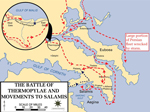
Map of the Battle of
Thermopylae 480 BC
Click map to enlarge
Later that year, on September 21, 480 BC, Xerxes sacked Athens.
However, the huge size of Xerxes' army had its weak point: logistics. The Greeks had major difficulties supplying their troops and, after a defeat in
the naval
Battle off the island of Salamis near Athens on
September 29, 480 BC, Xerxes was eager to get back home
ASAP.
Xerxes left Mardonius in charge of
fighting the Greeks and returned to Asia.
Back home in Persia, Xerxes launched
a huge construction program.
Meanwhile in 479 BC, Mardonius and his
Persian troops lost the
Battle of Plataea,
in which Mardonius was killed. Another Greek victory was secured at the
Battle of Mycale. The Greeks
were on the roll.
Damage assessment: The
Persians lost all their conquests in Europe, and many on the coast
of Asia.
Here is more about the
Greco-Persian Wars.
Continuing court intrigues finally found Xerxes
himself a victim. Xerxes was murdered by the chief of his guard,
Artabanus.
Xerxes's son
Artaxerxes I succeeded him to the throne.
Why Did Xerxes I Want
to Invade Greece?
Xerxes wasn't the first to think of an invasion of the Greeks. His
father, Darius I, was defeated in the
Battle of Marathon in
September 490 BC. Darius prepared right away for a vengeance
expedition against Greece but died before he could carry it out.
Exactly ten years later, in September 480 BC,
Xerxes pillaged Athens. Happy anniversary!
Interesting
Contemporaries
There was Artemisia I, Queen of Halicarnassus and the island
of Cos, who had the command over at least five warships in Xerxes
fleet to invade Greece. She was apparently a smart one because Xerxes kept asking for her advice. The ancient Greek city of
Halicarnassus is now Bodrum in Turkey, by the way.
Demaratus was king of Sparta. He
had to flee to Persia and warned Xerxes that the Spartan soldiers
were tough fighters. That proved to be true at the
Battle of
Thermopylae. Even though the Persians were triumphant in this
battle, they made big eyes when 300 Spartan soldiers, led by Spartan
king Leonidas, got the better of many Persian warriors
and fought to the last man. Xerxes ordered to bury part of the
fallen Persian soldiers because he was so embarrassed by the great
number the Spartans managed to slay.
Themistocles was a Greek politician and a navy man. In the
Battle
of Salamis, Themistocles sent a messenger to Xerxes, saying he was
ready to change sides. This was a fake message and it worked. Xerxes
was thus lured into ordering an all-out attack which laid
the foundation for the defeat of the Persian fleet.
The Greek diver Scyllias was
captured by Xerxes to retrieve Persian treasures that had been lost
when a storm destroyed several Persian ships. Scyllias later managed
to escape.