|
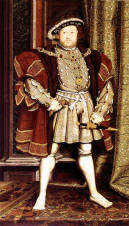
Henry VIII 1491-1547
Henry was the king of England from 1509 - 1547.
Henry VIII was
the second of five
 Tudor family members to rule England. Being an
egomaniac, he always did things his way while appearing perplexed
that life could have so many troubles in store for such a good
person as he. Tudor family members to rule England. Being an
egomaniac, he always did things his way while appearing perplexed
that life could have so many troubles in store for such a good
person as he.
The man had a wearing effect on his environment. When hunting, he
easily tired eight to ten horses. In politics he drained even the
most talented ministers. And, most infamously, in marriage he
exhausted six wives.
Henry had the charisma of a leader but lacked other necessary
qualities. However, he possessed considerable understanding of
political affairs. Unfortunately, he made it a habit to blame others
for his mistakes.
Henry was six feet tall, powerfully built, intelligent, and very
religious. He spoke French, Latin, and Spanish. Henry wrote books,
loved hunting, tennis, art and music.
Henry's Family
Henry's father was Henry VII
and his mother was Elizabeth of York.
|
First wife - Catherine of Aragon.
This marriage was annulled. One surviving daughter, the future
queen, Mary I. Catherine died in 1536 of natural causes. |
 |
|
|
|
|
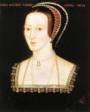
Second wife - Anne Boleyn.
She had one surviving daughter, the future queen,
Elizabeth I.
Anne was charged with adultery and executed in 1536.
Historians speculate, however, that the charges were trumped
up and Anne could have avoided her death by producing a male
heir. |
 |
|
|
|
|
Third wife - Jane Seymour.
She bore a son who was later to become Henry's successor,
Edward VI. Jane died in childbirth in 1537. |
 |
|
|
|
|
Fourth wife - Anne of Cleves.
They married in 1540 in order for Henry to form a political
alliance with the German Protestants. Sadly, Henry was very
disappointed by her appearance and dull personality. He soon
had the marriage annulled. |
 |
|
|
|
|
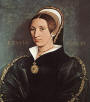
Fifth wife -
Catherine Howard.
She and Henry were married in 1540, three weeks after
annulment of his marriage to Anne. Catherine was executed in
1542 after Henry learned about her premarital affairs. No
children. |
 |
|
|
|
|
Sixth wife - Catherine Parr.
She married in 1543 and was the lucky winner
who survived Henry.
No children. |
 |
|
Henry's
Titles
Henry wrote the book Declaration of the Seven Sacraments against
Martin Luther. For this work he was rewarded by the pope with the
title "Defender of the Faith" (Latin: Fidei Defensor).
This title is still borne by British monarchs and appears on British
coins abbreviated as FID DEF or FD.
Henry's Divorce From Wife and Church
Henry's first wife, Catherine, failed to give birth to a male heir.
Consequently, Henry sought to divorce her, an unthinkable step for a
Catholic.
Henry pressured the pope to annul this marriage, arguing that it had
been illegal in the first place, since Catherine was Henry's brother Arthur's widow.
For the following reasons the pope refused to comply: First, the
marriage was declared legal by a previous pope. Reversing the
verdict would compromise the pope's authority. Second, Rome was in
the tight grip of the German Emperor
Charles V, who also happened to
be Catherine's nephew.
Henry took matters into his own hands. In 1534, he declared himself head of
the Church of England and issued several laws that significantly cut
back the pope's power in England. In response, the pope
excommunicated Henry. This didn't cause Henry much concern, however.
His marriage with Catherine was finally declared invalid, and Anne
Boleyn became queen.
But by reducing the pope's influence, Henry also unwillingly made
way for all protestant influences; thus he unintentionally started
the English Reformation.
Interestingly, Henry himself still preferred the Catholic faith and
by an act of Parliament he later reaffirmed Catholic doctrines. This
was a huge disappointment for protestant reformers.
Henry's Budget
Henry had an eye on the enormous wealth of the Church. To get an
idea of how rich the Church in England and Wales really was, Henry
commissioned an official Church Valuation, the Valor
Ecclesiasticus. The year? 1535.
He also passed a law that henceforward
all taxes on Church income had to be paid to the Crown instead of
the Pope.
In 1536, Henry started to close down
monasteries and confiscate their assets.
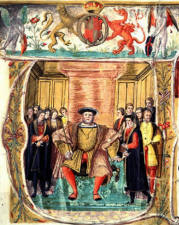
from the title page of
Valor Ecclesiasticus,
HENRY'S CHURCH VALUATION
And here is
Henry VIII's timeline.
More History
|