The man's full name was Charles André Joseph Marie de
Gaulle. He was a French soldier and politician.
Pronounce DE GAULLE
The Life of Charles de
Gaulle
Charles attended the Military Academy of Saint Cyr. He later
returned to the Academy for a year as a teacher.
He fought in both World Wars.
During
World War I
Charles de Gaulle saw battle at
Verdun.
On June 6, 1940, during
World War II,
de Gaulle became undersecretary of state for defense and war. A few
days later he fled to
London because he opposed Marshal Pétain's German-French peace agreement
which Petain saw necessary after the Germans had invaded the Low
Countries and France in May 1940. Welcome to the blitzkrieg.
While
de Gaulle was abroad, a French military court at home sentenced him to death.
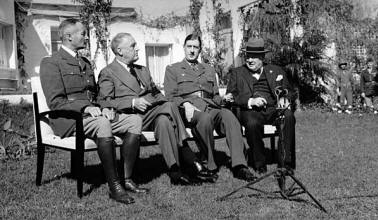
Still in the UK, de Gaulle organized and rallied the Free French forces,
which later set up headquarters in Algeria.
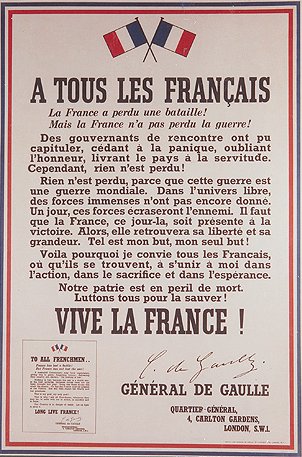
Announcements of this message were
posted all over town.
"FRANCE LOST A BATTLE BUT NOT THE
WAR"
In Paris, the Germans came and went. On
August 25, 1944, Charles de Gaulle could finally proclaim a
Paris Liberated.
Go here for the original French version
of the speech -
Paris
Libéré.
And speaking of Algeria.
Algeria came under French rule in 1848.
In the 1950s it became apparent that the people were ready to go
their own ways, and de Gaulle had his hands full. France recognized
Algeria's independence in 1962. Many people lost their lives in the
process.
Attempted
Assassinations on Charles de Gaulle
September 8, 1961, at Crancey, France - The following is an
excerpt from the excellent book Just 2 Seconds (Gavin de
Becker et al.)
De Gaulle and his wife were being
driven in their Citroën Deesse to their country home. A bomb
made from a propane cylinder filled with 100 pounds of plastic
explosives was buried in a sand pile alongside the road. A
canister holding 15 liters of napalm lay next to the cylinder.
De Gaulle's car approached the site
at about 70mph as the bomb was detonated. The heavy car lurched
and de Gaulle ordered the chauffeur to drive through the
fireball. No one was harmed, but they stopped to change cars at
a nearby barrack.
There were 31 documented attempts to
assassinate de Gaulle, but they all failed.
August 22, 1962, at Petit-Clamart, France
De Gaulle and his wife were being
driven again to their country home, except this time an
identical Citroën with several bodyguards drove in front and
several motorcycles followed behind. Cars filled with fifteen
OAS terrorists armed with submachine guns, grenades, and Molotov
cocktails were waiting in ambush.
Due to the dark and the high speed
of de Gaulle's motorcade, the attackers didn't have time to
block the road, and simply opened fire on the motorcade. The
motorcade continued on without stopping, and the bodyguards
relied on evasive driving and speed to escape.
Twelve bullets pierced de Gaulle's
car, a front tire was shot out as well as the back window, but
the de Gaulle's were uninjured.
And speaking of vintage Citroen:
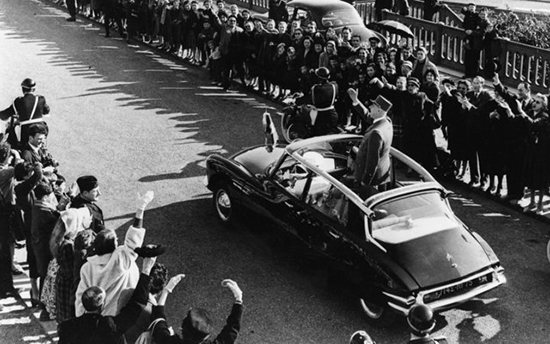
Here is de Gaulle in his Déesse:
Short-attention-spanners: Hang in
there at least until 0:45,
that is IF you like the vintage DS.
Vive la Déesse ! Vive
la France !
Charles de Gaulle and Canada
In 1967, Canada's 100th birthday, the
Canadians invited Charles de Gaulle for a visit on the occasion of
the opening of the EXPO World Fair at Montreal. De Gaulle accepted
the invitation and caused an outrage, which might or might not have
been deliberately, with his
Vive le Québec Libre ! speech on July 24, 1967.
1924 -
La Discorde chez l'ennemi (Discord Among the Enemy)
1932 - Le Fil de l'épée (The Edge of the Sword) 1934 -
Vers l'armée de métier (The Army of the Future) 1938 -
La France et son armée (France and Her Army)
Greco-Persian Wars
Also called the
Persian Wars, the Greco-Persian Wars were
fought for almost half a century from 492 to
449 BC. Greece won against enormous odds. Here
is more:


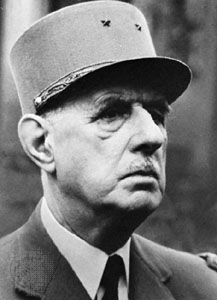
 Pronounce DE GAULLE