|
Manhattan Project 1942-1945
The Manhattan Project was the name of a
US government research project with the objective to create the
first atomic bomb.
The clock was ticking. Intelligence
indicated that the Germans were almost done with a similar research
project of their own.
Already in 1939 scientists and United
States government were working to this effect. Much of it took place
at Columbia University, Manhattan, NY, NY, hence the name.
The entire task was given a priority
when the US joined
 World War
II on December 8, 1941. By 1943, scientists of Great Britain
and Canada were on board as well.
World War
II on December 8, 1941. By 1943, scientists of Great Britain
and Canada were on board as well.
Work commenced at three large facilities
that were constructed.
At Oak Ridge, near Knoxville, Tennessee,
and at Hanford, Washington, the nuclear fuels, uranium and
plutonium, were developed.
In 1943, J.R. Oppenheimer became
director of the newly created laboratory at Los Alamos, New Mexico.
Oppenheimer is credited with being the driving force behind building
a workable bomb by the end of the war.
Trinity Site
Los Alamos scientists devised two bomb
designs, one using uranium 235 and another using plutonium. The
uranium bomb was a simple design and scientists were confident it
would work without testing. The plutonium bomb was more complex and
project leaders decided a test of the plutonium bomb was essential
before it could be used as a weapon of war.
From a list of eight sites in
California, Texas, New Mexico and Colorado,
Trinity Site was chosen.
The area was already controlled by the government because it was
part of the Alamogordo Bombing and Gunnery Range which was
established in 1942. The secluded Jornada del Muerto was perfect as
it provided isolation for secrecy and safety, but was still close to
Los Alamos.
Here are the maps
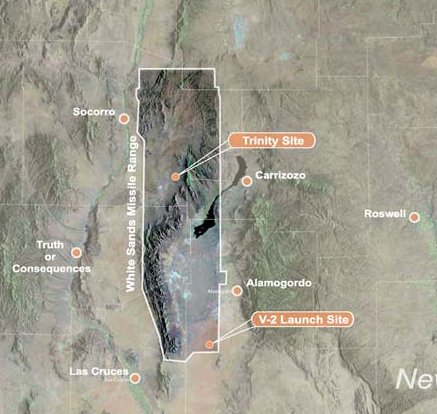
MAP TRINITY SITE
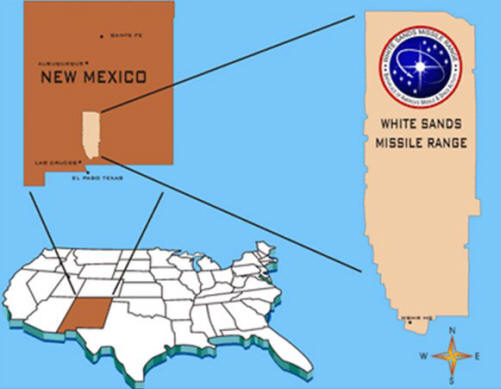
MAP WHITE SANDS
MISSILE RANGE
Jumbo
Because of the possibility of a dud, a huge steel container called
Jumbo was designed and built in Ohio. Originally, it was 25 feet
long, 10 feet in diameter and weighed 214 tons. Scientists were
planning to put the bomb in this steel jug to contain the plutonium
if the nuclear chain reaction failed to materialize. If the
explosion occurred as planned, Jumbo would be vaporized.
Jumbo was brought to Pope, N.M., by rail, and unloaded. A
specially-built trailer with 64 wheels was used to move Jumbo the 25
miles to Trinity Site.
As confidence in the plutonium bomb design grew, it was decided not
to use Jumbo. Instead, it was placed under a steel tower about 800
yards from ground zero. The blast destroyed the tower, but Jumbo
survived intact.
Today it rests at the entrance to ground zero so all can see it. The
ends are missing because, in 1946, the Army placed eight 500-pound
bombs inside it and detonated them.
The First Atomic Bomb
Success at last on July 16, 1945, at
5.30 in the morning. The location? Alamogordo Military Base, New
Mexico.
First the intense light flash, then a
sudden wave of heat, then a tremendous roar, then the mushroom
cloud.
And here is the photo
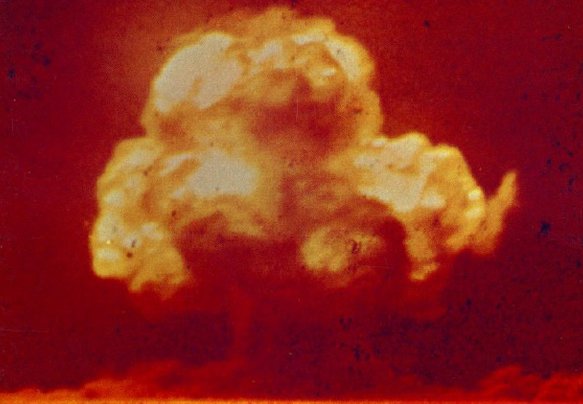
Monday, July 16, 1945, at
5:29:45 a.m. Mountain War Time at Trinity Site,
White Sands Missile Range
A month later, two atomic bombs produced by the project were dropped
on Hiroshima and Nagasaki, Japan. The first used uranium-235 and the
second plutonium.
Twice a year, you can
visit
the site where the first atomic bomb was exploded today.
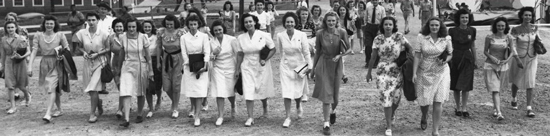
The Gals at Site X, Oak Ridge, Tennessee, aka
Atomic City
And go here for the
Untold Story of the Women Who Helped Win World
War II by Denise Kiernan.
More History
|