|
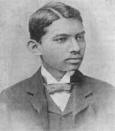
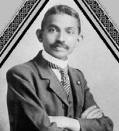
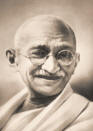
Mohandas Karamchand Gandhi 1869-1948
|
|
According to
 Historian William L. Shirer,
Gandhi spent a total of six and a half years of his life in prison:
2,089 days in India, and 249 days in South Africa. Historian William L. Shirer,
Gandhi spent a total of six and a half years of his life in prison:
2,089 days in India, and 249 days in South Africa.
Yet, he is
recognized as the father of his country.
What's the story? |
Gandhi's Name
Gandhi means grocer
in the Gujarati language. That's the language they speak in
Gujarat, Gandhi's home
state.
His byname was Mahatma, which means
Great Soul in Sanskrit.
What
in the world is Sanskrit?
They also called him bapu,
which means Little Father.
Gandhi's Life in a Nutshell
Gandhi managed to become 78 years
old and was then assassinated.
His life was made into a
movie -
Gandhi, 1982.
History remembers him as
great political and spiritual leader of India. He became famous for
his nonviolent campaigns of civil disobedience.
Gandhi's Early Years
Gandhi grew up in the state of Gujarat in northwest India. He
was brought up as a Hindu but developed a vast interest in
religion.
He spent the years 1888 until 1891 in England. He
graduated in London as a barrister-at-law. His work brought
him to Natal, South Africa, where he became a successful
lawyer and fought racial prejudice against the Indian minority
in the country.
Back in India
When India was under
British jurisdiction, Gandhi became famous for his nonviolent
campaigns of civil disobedience. For these activities Gandhi was
arrested innumerable times by the British authorities. When they
arrested him on a Monday he, of course, wouldn't say a word, as
Monday
was his day of silence.
Back in India, his fight against injustice included the
boycott of British manufactures and institutions. Mass arrests
followed and people cheerfully went to prison.
Gandhi later
concentrated on a national education program against poverty,
promoting the trades of hand spinning and weaving.
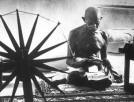
Gandhi promoted a "Back to the
roots" program for India.
He gave up Western ways, began wearing a loincloth and shawl,
and started spinning.
One of Gandhi's most
spectacular campaigns was his 200 mile march to extract salt from
the sea. This was to show his protest against British tax on salt.
People were impressed by his charisma, courage, and sense of humor in spite of
trouble. Maybe most remarkable was Gandhi's ability to
influence people's consciences.
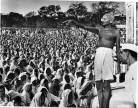
Gandhi led India in a
nonviolent fight against British rule.
Gandhi's Speeches
On February 4, 1916, and on
occasion of the opening of the Hindu Central University College at
Benares (which is your Varanasi today), Gandhi delivered his
Benares Hindu University speech.
He spoke after Mrs. Annie
Besant, who had spearheaded the founding of the college and who had
just finished her address.
In the audience were many members of
India's high society, including the viceroy of India, Charles
Hardinge.
Gandhi was not able to finish his speech
because his words hit a raw nerve with several individuals who
interrupted him and stormed out. Annie Besant was one of them. All
in all it was felt that Gandhi's speech was leaning a little bit too
far towards anarchy.
Gandhi later said that if they would
have let him finish, it would have been clear that he did not
endorse anarchy per se.
On August 8, 1942, Gandhi
delivered his
Quit India speech,
also known as the Do or Die speech, demanding from the
British to pull out of the country immediately.
Gandhi gave his
speech in Bombay before the A.I.C.C., which is the All India
Congress Committee.
The speech can be divided into three
parts.
Part One - Delivered in Hindustani.
Gandhi's remarks before the Congress passed the Quit India
resolution.
Part Two - Delivered in Hindustani.
Gandhi's remarks after the Congress passed the Quit India
resolution.
Part Three - Delivered in English.
Gandhi's final remarks and conclusions.
Gandhi's Heart
One of the saddest
things for Gandhi to swallow was the constant trouble between Hindus
and Muslims in India. When India was finally freed from British
rule, the country was split at the same time into Pakistan and
India.
Gandhi skipped the "Freedom from the Brits" party. He
couldn't attend, he was too sad.
Gandhi's Family
His parents were Karamchand
and Putlibai Gandhi.
He was married to his wife, Kasturba, when both
were 13 years of age. Kasturba died February 22, 1944, at the age of
seventy-four, while in detention at the
Aga Khan Palace in Pune.
Gandhi had four sons: Harilal, Manilal, Ramdas,
and Devdas.
Gandhi had three siblings. Two brothers, Laxmidas and
Karsandas, and one sister, Raliatbehn.
GANDHI'S
ASSASSINATION
On his way to his evening
prayer in Delhi on January 30, 1948, he was shot down by
Nathuram Godse, a young Hindu, who was angered by Gandhi's
tolerant attitude towards Muslims. Thirty-nine year old Godse
put three bullets into Gandhi's chest and Gandhi died on the
spot.
Godse and several accomplices were arrested and Godse
himself was hanged November 15, 1949.
On the evening of January 30, 1948,
Jawaharlal Nehru addressed the nation with his
The
Light Has Gone Out of Our Lives speech.
See also
Assassinations in
History.
Gandhi's
Contemporaries
Among others, Gandhi's
contemporaries were
Theodore
Roosevelt,
Vladimir
Ilyich Lenin,
Winston
Churchill, and
Martin
Luther King, Jr., who was inspired by Gandhi's
satyagraha campaigns.
Satyagraha has been translated as holding to the truth or
zeal for truth.
Gandhi's Writings
Gandhi was a prolific
writer. The collected edition of his writings comprises almost 100 volumes.
This is his autobiography:
Gandhi An Autobiography: The Story of My Experiments With Truth
Mahatma Gandhi Trivia
People remember the beginning
of Gandhi's non-violent resistance in South Africa, which took place
a hundred years ago.
Ghandhi's grandson, Arun Gandhi, and his
wife, Sunanda, started the
M.K.
Gandhi Institute for Nonviolence in 1991.
Another one of Ghandi's grandsons,
Rajmohan Gandhi, wrote another biography on Mahatma. The book is
called Mohandas - A True Story of a Man, his People and an Empire,
and it was published January 2007.
You could qualify for the
Gandhi Peace Award,
as
Eleanor Roosevelt did.
Mahatma Gandhi
Timeline
Here the Swedes explain why Gandhi never received the Nobel Peace Prize
Gandhi Book Reviews
Gandhi's Passion : The Life and Legacy of Mahatma Gandhi
By Stanley Wolpert. Oxford University Press, 2001,
308 pages.
Stanley is Professor of South Asian
History Emeritus at the UCLA., or was at the time. Interesting what made him decide
to write this book: It was 1998, the year India announced its
possession of nuclear power. Everybody seemed excited and
nobody seemed to remember Gandhi's ideas. Reason enough to
write a book. Thumbs up.
GANDHI A MEMOIR (A Touchstone book)
By William L. Shirer. Simon and Schuster, New York, 255 pages.
William Shirer actually met Gandhi live and in 3D. He also met Martin
Luther King Jr and others. Thus, the
book has a very lively touch to it. All thumbs up.
More about
William L. Shirer here.
Maybe, see also
Human Rights
More History
|