|
Henry V 1387-1422
Henry V was king of England from 1413 -
1422.
Because of the
 Hundred Years' War, Henry fought and won at the
Battle of
Agincourt in 1415.
Hundred Years' War, Henry fought and won at the
Battle of
Agincourt in 1415.
Henry V and
Shakespeare
In his play Henry V (act IV, scene 3),
William Shakespeare had the
king deliver a speech just before the Battle of Agincourt on Saint Crispin's Day.
St. Crispin, by the way, is the patron
saint of shoemakers. His feast day is October 25, the anniversary of
the Battle of Agincourt. Now, the speech goes as follows:
[King to Westmerland:]
What's he that wishes so?
My Cousin Westmerland. No, my faire Cousin:
If we are mark'd to die, we are enow
To do our country loss; and if to live,
The fewer men, the greater share of honour.
God's will! I pray thee, wish not one man more.
By Jove, I am not covetous for gold,
Nor care I who doth feed upon my cost;
It yearns me not if men my garments wear;
Such outward things dwell not in my desires.
But if it be a sin to covet honour,
I am the most offending soul alive.
No, faith, my coz, wish not a man from England.
God's peace! I would not lose so great an honour
As one man more methinks would share from me
For the best hope I have. O, do not wish one more!
Rather proclaim it, Westmoreland, through my host,
That he which hath no stomach to this fight,
Let him depart; his passport shall be made,
And crowns for convoy put into his purse;
We would not die in that man's company
That fears his fellowship to die with us.
This day is call'd the feast of Crispian.
He that outlives this day, and comes safe home,
Will stand a tip-toe when this day is nam'd,
And rouse him at the name of Crispian.
He that shall live this day, and see old age,
Will yearly on the vigil feast his neighbours,
And say 'To-morrow is Saint Crispian.'
Then will he strip his sleeve and show his scars,
And say 'These wounds I had on Crispian's day.'
Old men forget; yet all shall be forgot,
But he'll remember, with advantages,
What feats he did that day. Then shall our names,
Familiar in his mouth as household words-
Harry the King, Bedford and Exeter,
Warwick and Talbot, Salisbury and Gloucester-
Be in their flowing cups freshly rememb'red.
This story shall the good man teach his son;
And Crispin Crispian shall ne'er go by,
From this day to the ending of the world,
But we in it shall be remembered-
We few, we happy few, we band of brothers;
For he to-day that sheds his blood with me
Shall be my brother; be he ne'er so vile,
This day shall gentle his condition;
And gentlemen in England now-a-bed
Shall think themselves accurs'd they were not here,
And hold their manhoods cheap whiles any speaks
That fought with us upon Saint Crispin's day.
Shakespeare wrote this play around 1599.
Back to the actual Henry V.
And on this map you can trace the route of Henry V in
1415:
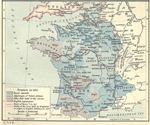
ROUTE OF HENRY V IN 1415
Click map to enlarge
Same on this map, check Henry V's first campaign in France, 1415
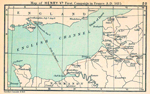
English Channel 1415
Click map to enlarge
See also the chart
Governments in History.
Henry V Timeline -
Major Events
1414 - Henry V of England claims the crown of France, and resolves
to invade and conquer that kingdom. At this time France was in the
most deplorable state of weakness and suffering, from the factions
that raged among her nobility, and from the cruel oppressions which
the rival nobles practiced on the mass of the community.
"The people
were exhausted by taxes, civil wars, and military executions; and
they had fallen into that worst of all states of mind, when the
independence of one's country is thought no longer a paramount and
sacred object. 'What can the English do to us worse than the things
we suffer at the hands of our own princes?' was a common exclamation
among the poor people of France."
Pictorial Hist. of England, vol. i.
p. 28.
1415 - Henry invades France, takes Harfleur, and wins the great
battle of Agincourt.
1417-1419 - Henry conquers Normandy. The French Dauphin assassinates
the Duke of Burgundy, the most powerful of the French nobles, at Montereau. The successor of the murdered duke becomes the active
ally of the English.
1420 -
On May 21, 1420, the
Treaty of Troyes is concluded between Henry V of England
and Charles VI of France, and Philip, duke of Burgundy. By this
treaty it was stipulated that Henry should marry the Princess
Catherine of France; that King Charles, during his lifetime, should
keep the title and dignity of King of France, but that Henry should
succeed him, and should at once be entrusted with the administration
of the government, and that the French crown should descend to
Henry's heirs; that France and England should for ever be united
under one king, but should still retain their several usages,
customs, and privileges; that all the princes, peers, vassals, and
communities of France should swear allegiance to Henry as their
future king, and should pay him present obedience as regent; that
Henry should unite his arms to those of King Charles and the Duke of
Burgundy, in order to subdue the adherents of Charles, the pretended
dauphin; and that
these three princes should make no truce or peace with the
Dauphin, but by the common consent of all three.
1421 - Henry V gains several victories over the French, who refuse
to acknowledge the treaty of Troyes. His son, afterwards Henry VI,
is born.
1422 - Henry V and Charles VI of France die. Henry VI is proclaimed
at Paris, King of England and France. The followers of the French
Dauphin proclaim him Charles VII, King of France. The Duke of
Bedford, the English Regent in France, defeats the army of the
Dauphin at Crevant.
More History
|
|