Home - History Notes - Crazy Horse


Probably Crazy Horse, 1842(?) - 1877
CRAZY HORSE 1840 (?) - 1877

THIS MIGHT OR MIGHT NOT BE A PIC OF CRAZY HORSE.
HERE THE CUSTER BATTLEFIELD MUSEUM EXPLAINS WHY THEY THINK IT PROBABLY IS.
 

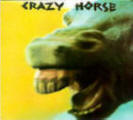
This page is not about Neil Young and his Crazy Horse album. Think Native American instead.

Crazy Horse's Indian name was Ta-sunko-witko. He was born around 1840 or 1842 by the Belle Fourche River, which is near Bear Butte, close to your today's Rapid City in South Dakota. The surrounding Black Hills were Crazy Horse's home.

Crazy Horse Album, 1971

He died September 5, 1877, at Fort Robinson, Nebraska. Apparently, no one knows where he is buried.

George E. Hyde described Crazy Horse as a genius at war and a lover of peace. He was a bit of a loner and not very talk enthused. His folks thought him a little bit unorthodox when it came to following traditions, for which Crazy Horse didn't seem to care too much.

Crazy Horse might or might not have been a chief as such but we know for sure that he was a Sioux of the Oglala branch and that he acted as a leader several times in his life.

Crazy Horse is said to have been loved for his charity and courage. He was a skilled fighter. He became symbol of Sioux freedom, courage, and dignity.

To the timeline:

There was a great Sioux uprising in Minnesota in 1862, which was the time of the American Civil War. The Sioux, led by Little Crow, were defeated by the whites.

Around 1865, the white man decided to build a road through the northern Great Plains up to Montana - the Bozeman Trail. Reason was the gold findings there. On December 21, 1866, frictions between whites and Indians escalated. Near Fort Phil Kearny in Wyoming Territory, the Indians killed 80 whites including their Captain William J. Fetterman, who, some say, had it coming.

There was more trouble on August 2, 1867, in what became known the Wagon Box Fight. Again close to Fort Phil Kearny in Wyoming Territory, Captain Powell and approx. 40 men were attacked by Indians, however, this time the whites were able to defend themselves.

The tension between Indians and whites grew as more and more whites moved in while the game (ergo food) moved out.


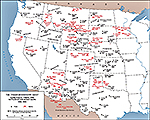
THE SECOND TREATY OF FORT LARAMIE - AUGUST 1868

The treaty guaranteed the Indians possession of the Dakota territory west of the Missouri River. ("Hey, what's a treaty, white man?" "Don't worry about it, son. Just sign the darn paper.") That was until in 1874 gold was discovered in the Black Hills, which was Dakota Territory.

The US government had a problem because their people weren't willing to give up the gold. So it ordered that all Indians had to go back to their reservations by January 31, 1876. Most likely, this decision of the US government did not go out to each and every Indian. At the same time, many of the Indians who knew about it deeply resented it. Not surprisingly hostility increased.

When General George Crook tried to force Crazy Horse to move away from his winter camp on the Tongue and Powder rivers in Montana Territory, Crazy Horse and his people went deeper into the hills instead.

In June 1876, the US government sent Brigadier General Alfred H. Terry to track down the Indians and move them to where the whites thought they should be living. By force, if need be.

Stuff went severely wrong.


BATTLE OF THE ROSEBUD - JUNE 17, 1876

Crazy Horse teamed up with the Cheyenne and launched a surprise attack on Crook in the Rosebud valley, southern Montana, on June 17, 1876. Crook had to retreat.
 

BATTLE OF THE LITTLE BIGHORN - JUNE 25, 1876


Here's a map of the Little Bighorn river. Little Bighorn Battlefield National Monument is located near Crow Agency, Montana on the Crow Indian Reservation.

Crazy Horse went north to join the main Sioux forces, which were led by Chief Sitting Bull and camped on the banks of the Little Bighorn River in Montana Territory. There it came to a clash with the whites on June 25, 1876.

Result: Lieutenant Colonel George A. Custer and all his soldiers (more than 200) were killed within one hour. Hence, the battle was also called Custer's Last Stand. Crazy Horse was one of the Indian leaders in the battle. Today, the Little Bighorn Battle field is a National Monument you're welcome to visit.


Crazy Horse and his folks then went back their own ways into the hills. Little did he know he was followed by Colonel Nelson A. Miles and his soldiers. Miles wanted to register all Indians with the government agencies. Crazy Horse was against this plan, but cold and hunger were nibbling on his people and so they surrendered to General Crook at the Red Cloud Agency in Nebraska. That was on May 6, 1877.


CRAZY HORSE'S DEATH

Crook took Crazy Horse prisoner and brought him to Fort Robinson. In the fort, Crazy Horse was stabbed but nobody really knows what exactly happened.

Larry McMurtry mentions in his book that Crazy Horse got a hair cut the day before he was stabbed. Thus, so McMurtry, he could have easily been mistaken for someone else.

One of several theories.


CRAZY HORSE'S FAMILY AND FRIENDS
Everybody mentioned Crazy Horse's light complexion, something we would have loved for his mom to explain, but apparently nobody asked her, of if they did, they didn't put it on record.

Speaking of Crazy Horse's mom: She was of the Brulé branch of the Sioux and the sister of Spotted Tail.

Crazy Horse's father was the Medicine Man Crazy Horse Senior. In fact, Crazy Horse's name as a kid was Curly (light complexion + the suspicious name Curly as a kid = ... youtellme). Once the boy had his reputation established as a seasoned warrior, Crazy Horse Senior passed on his name to his son.

After this exciting name transfer, the father (formerly Crazy Horse Senior) was henceforward called Worm.

Crazy Horse's brother was Little Hawk. Crazy Horse's daughter was They-Are-Afraid-Of-Her. She died of cholera.

Among others, Crazy Horse's friends were Hump and Lone Bear.

The woman of Crazy Horse's dreams was Black Buffalo Woman, Red Cloud's niece, who was unfortunately married to another guy of the name No Water.

Crazy Horse couldn't give a flying flip because he was in love. He took his dream girl Black Buffalo Woman and ran away with her. No Water was outraged, tracked them down, and shot Crazy Horse in the jaw. The tribe got a little antsy and arranged for Crazy Horse to marry the decent woman Black Shawl instead.

Black Shawl later suffered from tuberculosis. Crazy Horse's second wife was Nellie Larrabee (Laverie), who was half Cheyenne and half French.


MORE ABOUT BLACK BUFFALO WOMAN
The author Larry McMurtry states in his book Crazy Horse (1999, Penguin) page 72, "Black Buffalo Woman's fourth child, a daughter, was notably light-skinned; perhaps the child of Crazy Horse, she lived into the 1940s."

On we read on page 73, "Very probably he [Crazy Horse] never quite got over Black Buffalo Woman, about whose later life nothing is known."


ABOUT CRAZY HORSE'S LOOKS

We are a little short of Crazy Horse photos, but this is how the majority described his looks: not tall, not little, sharp features. The picture above, might or might not be Crazy Horse.


CRAZY HORSE SCULPTURE

A sculpture was built in honor of Crazy Horse in a town called Custer, of all names, in South Dakota.

This is the link to the Custer Chamber of Commerce.

And this is the link to the website of the Crazy Horse Memorial in South Dakota. The site has a live webcam. Sculptor Korczak Ziolkowski started blasting his way into the Thunderhead Mountain in 1948 but died in 1982. His family continues his artwork.

The other Crazy Horse Memorial is in Cleveland and it is a men's club.


BOOKS ON
CRAZY HORSE
There is Larry McMurtry's book Crazy Horse : A Penguin Lives Biography (Penguin Lives). Larry is also the author of Lonesome Dove.

Then we have Ian Frazier's Great Plains; there's Peter Matthiessen: In the Spirit of Crazy Horse; and George E. Hyde's Red Cloud's Folk: A History of the Oglala Sioux Indians (Civilization of the American Indian Series) and Spotted Tail's Folk: A History of the Brule Sioux (Civilization of the American Indian (Paperback))


© Copyright 2005 - 2010 Emerson Kent. All rights reserved.