|
BEHISTUN ROCK
Behistun Rock
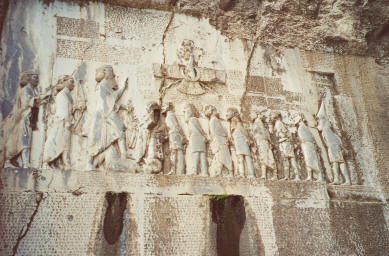
Behistun, Bisitun, or Bisotun is
the word for an ancient village and a steep rock located in
today's Iran.
Bisitun became an official
UNESCO World Heritage Site in 2006.
Back in the days, Persian king
 Darius I
carved an inscription in cuneiform into this rock wall.
Darius I
carved an inscription in cuneiform into this rock wall.
What
in the world is cuneiform?
This wall was situated at the roadside
along the highway
which led from Ecbatana to Babylon. Here is the map, look between
Ecbatana and Babylon, it's labeled "Bisitun"
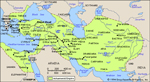
Behistun Map - Click to enlarge
Darius wanted to make sure people would
understand, so he chiseled away in three languages, Babylonian,
Ancient Persian, and Elamite.
Fast forward to the year 1835 and we
have Major
Henry Rawlinson of the East India Company in a
semi-orgasmic state, as he managed to make sense of some alphabet
and grammar. Eventually, Rawlinson deciphered the Persian part of the
inscription. The rest was decoded shortly after.
What did Darius write about?
In a nutshell, Darius wrote about his royal doings from 522 until 520 BC, which included killing
Gaumata
and other rebels, and keeping his
empire organized.
Here is the translation.
More History
|