|
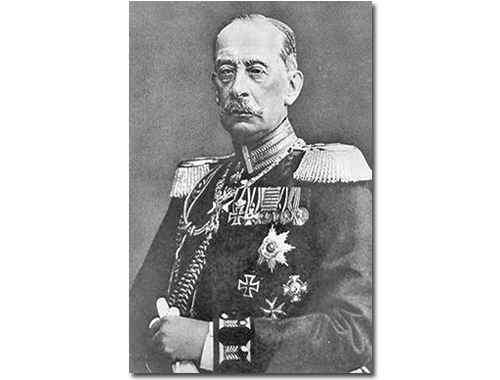
Alfred Graf von Schlieffen 1833 -
1913
|
|
Image above:
Photograph of
Alfred Graf von Schlieffen
Deutsches
Historisches Museum |
Alfred von Schlieffen was a graf, which is German for
count. Von Schlieffen was born, and died, in Berlin.
Alfred Count of
Schlieffen's father was a Prussian general.
Schlieffen also
chose a military career and joined the German
army in 1854. He fought in the
 Seven Weeks' War as well as in the
Franco-Prussian War. Progressing in his career, Alfred
was made officer and, in 1891, the person in charge of the general
staff. His German job title read Generalfeldmarschall. Seven Weeks' War as well as in the
Franco-Prussian War. Progressing in his career, Alfred
was made officer and, in 1891, the person in charge of the general
staff. His German job title read Generalfeldmarschall.
Alfred Graf von
Schlieffen developed a war strategy, the
Schlieffen Plan.
The Original Schlieffen Plan
In the 1800s,
political tension was brewing in Europe. Nations formed
alliances with each other in fear of losing the balance of
power. Soon emerged two sets of military alliances:
Germany,
Austria-Hungary, and Italy (Triple Alliance) on one side and
England, France, and Russia on the other (Triple Entente).
It
became obvious that the one attacking first would have a big
advantage.
Germany, in
particular, was sandwiched by Russia to the east and France to the
west. Alfred von Schlieffen's predecessors always voted for attacking Russia
first, then France.
Von Schlieffen thought that was nonsense
because he figured that the Russians would need at least six weeks to
mobilize
their armies at any given point. This time would be enough for Germany to
crush the west if almost the entire German military strength
could be focused on this attack.
Then came the year 1906 and
Alfred von Schlieffen retired.
Von Schlieffen
The Modified Schlieffen Plan
Helmuth von Moltke,
nephew of famous
Helmuth Graf von Moltke,
became Alfred Schlieffen's successor.
Schlieffen died in
January 1913 and the original Schlieffen Plan
was put on ice.
However, at the
outbreak of
World War I,
Moltke decided to run
with Alfred Schlieffen's basic
idea, which was to attack the West first.
But von Moltke and his
co-strategists did
not put as much oomph into the attack as Schlieffen had pointed out
would be absolutely necessary for this plan's success.
Here are the maps in comparison:
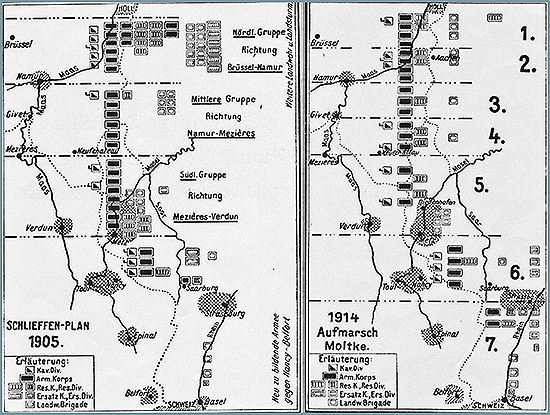
Map of the original Schlieffen
Plan 1905 (left) and Moltke's version 1914 (right)
And Schlieffen was right. In 1914,
Germany failed to have a quick victory in the west and from there it
went downhill for the German score in World War I.
Some think Germany could have won had they applied
the unaltered Schlieffen Plan. Others try to decide whether or not
that would have been a good thing.
And here are two more maps:
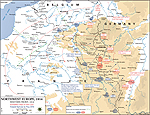
1914 WWI: The Western
Front
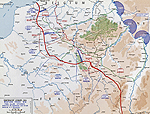
1918, Sept 25-Nov 11 -
WWI: Western Front - Final Allied Offensive
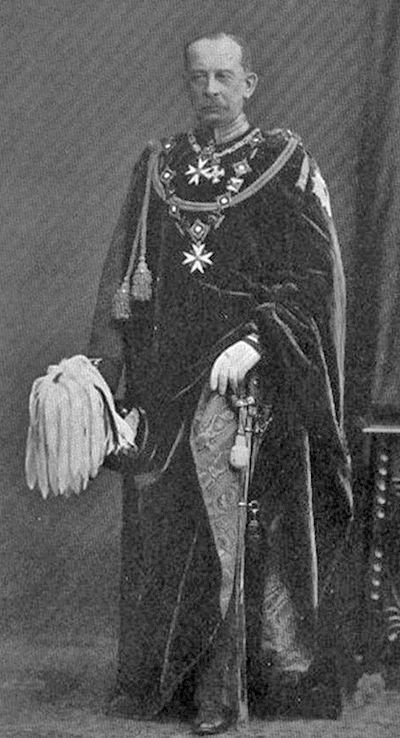
A Knight
of the Order of the Black Eagle -
Alfred Graf von Schlieffen Dressed Up in 1890
More History
|