|
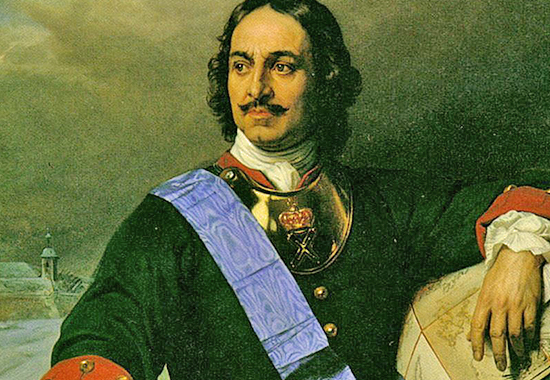
Peter I the Great 1672-1725
Peter the Great was really Peter I, or
Pyotr Alekseyevich, if
you speak Russian.
|
|
Being a very capable Russian emperor, Peter possessed exceptional
abilities as a statesman, organizer, and reformer. He was more than
six and a half feet, or two meters, tall and very strong.
He was a hard worker, expected no less from others, and executed his
well thought-out plans with tremendous energy.
Image above:
Peter the Great, Detail from the painting by
Hippolyte-Paul Delaroche |
Peter understood human nature and was especially able to recognize
talent in a person, whether rich or poor. He also had potential for
cruelty.
Peter was especially interested in military strategies and
navigation. One of his main concerns was to gain Russian access to
the Baltic and the Black Sea.
One of the last projects he
commissioned in his life was
 Bering's Arctic expedition
to determine if Asia and America were connected.
Bering's Arctic expedition
to determine if Asia and America were connected.
Peter the Great, proclaimed
emperor in 1721, was an
enlightened despot.
See also
Forms of Governments.
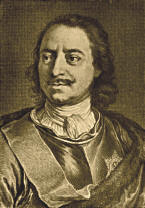
Peter I the
Great
Peter's
Background
Peter's elder half brother Fyodor succeeded to the throne when their
father died. Soon after, Fyodor died without an heir and Peter was
declared czar together with his half brother Ivan V. Their sister
Sophia functioned as regent for the young czars.
Family Feud
Peter's father,
Alexis, married twice: Mariya and Natalya.
Mariya
became the mother of Sophia, Fyodor and Ivan. Natalya was the mother
of Peter. After Alexis's death, these two parties fought and killed
each other over the crown.
While Sophia was regent, she cleverly confined Peter and his mother
to the suburbs of Moscow, trying to cut off their political
influence. Later, Sophia attempted to become czarina. At this point,
Peter exiled her to a convent.
Ivan
Peter's half brother, Ivan, was mentally and physically handicapped.
Interestingly, even though their families were generally hostile
toward each other, Ivan was allowed to co-rule until his death. This
was possible because Ivan was a religious man who did not interfere
with Peter's governing.
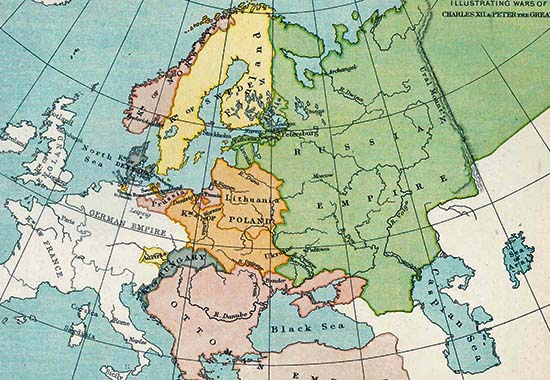
Map
Illustrating the Wars of Charles XII and Peter the Great
Click to enlarge
Peter's
Family
Let's get Peter's family straight: His father was Alexis, his
mother Natalya Kirillovna Naryshkina. His siblings were
Sophia, Fyodor, and Ivan.
The spouses:
Peter's first wife was Eudoxia. They married in
1689. Peter sent her to a convent in 1698 in favor of his second wife
Martha, a
peasant. They married in 1712, and Martha became
crowned empress
Catherine I
in 1724.
The offspring:
There was Alexis (by Eudoxia), who was tried
for treason and died in prison in 1718. Peter also had two more
children by Eudoxia as well as nine more by Catherine.
One of Catherine's and Peter's children was
Elizabeth, who
was born in 1709.
And here is another one of Peter's map
RUSSIA IN EUROPE
Click map to enlarge
Peter's
Military Campaigns
1695 - 1696 Azov campaigns
Peter fought the Tartars successfully for the access to the Black
Sea. The Azov campaigns are one of the
Russo-Turkish Wars.
1700 - 1721 Second Northern War
(
Great Northern War)
Peter fought Sweden successfully for the access to the Baltic.
He founded St. Petersburg in 1703.
1710 - 1713 Turkish War
Turkey declared war on Russia, who was distracted by the Northern
War. With the Peace of the Prut
in 1711, Azov fell to the Turks. The Prut is a river. You can trace
the location of the River Prut, or Pruth, on this map:
Russia in Europe in
the 19th Century, between Moldavia and Bessarabia northwest
of the Black Sea.
This Turkish War from 1710 - 1713 is part of the
Great Northern War, which in turn is one of the
Russo-Turkish Wars.
1722 - 1723 Persian campaign
Peter fought the Persians successfully for the access to the Caspian
Sea.
And here is
Peter the Great's
timeline.
What did Peter the Great and
Leonardo da Vinci have in
common?
The necessity to be active. Neither
could stand just sitting around.
Iron rusts from
disuse; stagnant water loses its purity and in cold weather becomes
frozen; even so does inaction sap the vigor of the mind.
Leonardo da Vinci
More History
|