|
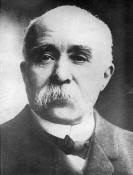
Georges Clemenceau 1841-1929
They called him
The Tiger.
Le Tigre
was French, energetic, and eloquent. Georges Clemenceau was
premier from 1906 - 1909 and again 1917 - 1920, which made solving
 World War I part of his job description.
When Georges Clemenceau was walking
the earth, the French were having their Third Republic. Let's see what that
means in its context:
Second Empire (Emperor Napoleon III)
1852 - 1870
Third Republic
1870 - 1940
Vichy France
1940 - 1944
For the complete list see
Governments of France.
Back to Clemenceau.
When Georges Clemenceau was born, France still had an
emperor.
A student of medicine,
Georges Clemenceau was close to his father, who didn't like the empire and
didn't have a problem voicing his views. Georges felt the same
way and,
in 1848, was arrested for making his opinion known. Clemenceau
Senior was equally
lucky and spent some jail time in 1858.
Georges
Clemenceau went to the States 1865 - 1869 where the
American Civil War was quite the eye opener for him. People
actually had a say in how the country was run.
For a while, Georges Clemenceau worked
as a teacher in Connecticut. Fife days after marrying one of
his pupils in 1869, he packed knapsack and new wife and went back to France to be a doctor.
The lucky student, by
the way, was Miss Mary Plummer, who was to have three little tigers soon after, and a separation from the big tiger seven years
later.
In July 1870,
Emperor
Napoleon III declared war on Germany. This was to become the
Franco-German
War 1870 - 1871. France lost the war and the Third Republic was
declared. The opponents of monarchy
wore party hats. Among them, of course, Georges Clemenceau.
Georges Clemenceau moved on in politics and held a few jobs for the French
government. The German
peace terms at the end of the Franco-German War were frustrating to
him, but there was not much he could do about it there and then. His time would come.
Meanwhile, Georges
Clemenceau was
busy criticizing his country's government. For this, he established his
own newspaper, as he did several times earlier in his life.
Ever the
critic, Clemenceau accumulated a number of enemies himself. This
closed most doors for possibly getting a job in politics, so he decided to become a
journalist on the subject.
Finally, in April 1902,
the great breakthrough. He was back in politics, this time as senator.
After having been
premier twice, Georges had his hands full with the composing of acceptable peace terms
after World War I.
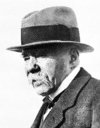
Georges Clemenceau
In 1920, Georges Clemenceau was hoping to become president. After all his hard work
for his country, he certainly deserved consideration. However, the people around him
claimed they didn't like his solo performances in the past and didn't elect him. That was is
for Clemenceau, he quit.
Georges Clemenceau was now 80 years
old and in retirement. But there was no thought of
slowing down. Clemenceau went on a trip to India and Singapore - tiger
hunting among other things - and he visited
Woodrow Wilson in the US.
Georges Clemenceau died in
Paris.
Georges Clemenceau wrote many many
things, even a play. Some of his works are still available.
For example:
In the evening of my thought
Grandeur and misery of victory
The surprises of life
American Reconstruction, 1865-1870
Demosthenes
South America to-day;: A study of conditions, social, political and commercial in Argentina, Uruguay and Brazil
The veil of happiness: A play in one act
Claude Monet
At the foot of Sinai
France facing Germany. Speeches and articles
The strongest: (Les plus fort)
Georges Clemenceau
More History
|