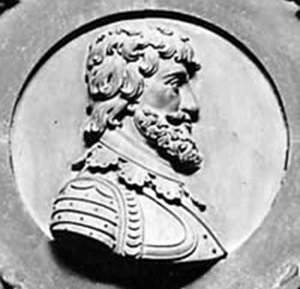
John Cabot was Giovanni Caboto,
because he was from Genoa, Italy. He later received Venetian
citizenship.
Here is a map:
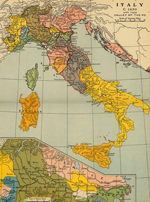
 Map of Italy 1490
John Cabot's Mission
John Cabot was a skilled navigator and
explorer. So much so, that on March 5, 1496, English
King Henry
VII equipped him with all necessary paperwork to discover
unknown lands. King Henry of course expected him also to return to England
with plenty of merchandise and riches.
John knew there was a decent commission
in this and off he went, looking to find a new trade route to Asia,
which would give him the edge in the trading of gold, gems, and spices.
John Cabot's main voyages across the
North Atlantic took place in 1497 and 1498.
1497: John Cabot's
First Voyage
On June 24, 1497, John saw land. It wasn't Asia, but Newfoundland,
today's Canada. John Cabot stuck a British and a Venetian flag into
the soil and traveled back home to announce that there was a
continent missing on the map.
On August 6, 1497, an excited Cabot
was back in Bristol, notifying everyone that he had been to Asia.
1498: John Cabot's Second Voyage
In 1498, John Cabot sailed with five ships, 200 men, and the
goal to reach Japan. Shortly after setting sail, one of the
ships of his fleet turned up in Ireland, the other four, including Cabot, were
gone.
What exactly happened?
Nobody knows. One possible explanation is that the fleet had been
hit by a severe storm.
John Cabot's
Importance in History
John Cabot's mounting of the British flag was one of the main
foundations for the future British claims on the American continent.
And if Cabot's story reminds you of
Christopher Columbus, you
are not far off. Columbus, too, was from Genoa, Italy. He was born a
year later than Cabot, in 1451, and just like Cabot, Columbus distributed
foreign flags on foreign continents.
And here is the map
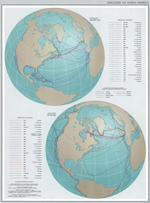
North
America - Discovery