|
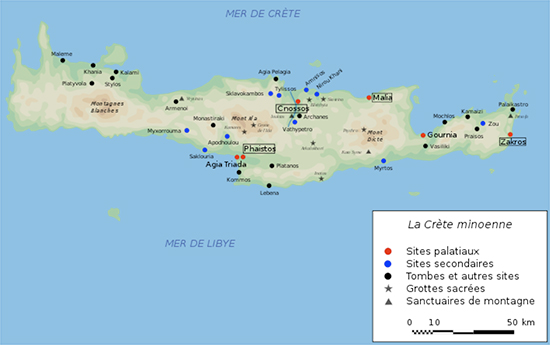
Minoan Crete
Click map to enlarge
The Minoans
The Minoans were islanders, ancient Cretans
to be exact.
|
|
In fact, the Minoans were the first folks to
develop a high civilization in the Aegean area. Historians believe
that the Minoans originally came from Anatolia.
In a nutshell, the Minoans were
Europe's first civilization.
And here is a map of ancient Crete.
Ancient Crete
Click map to enlarge
Why "Minoans?"
Because of archaeologist
Sir Arthur
John Evans, who came up with, and liked, the idea.
Evans lived 1851-1941 and was well
acquainted with Greek mythology.
Minos, King of Knossos
The Minoans were named after
Minos, not only the ancient
ruler of Crete, but also a legend, and a son of
Zeus himself.
And yes, Minotaur is part of the
story.
|
It was Minos' wife
Pasiphae, who had a run-in with
a bull which resulted in her giving birth to a creature that had the
body of a human and the head of a bull.
This nightmare offspring was Minotaur
(Greek tauros means bull = Bull of Minos.) And bull it is. But, let's pretend we buy the story,
it was not all Pasiphae's fault.
First off, the bull she fell in love
with was snow-white. Adorable, right there.
Secondly, Phasiphae was the victim of
a love spell. The bull was sent to Minos
by Poseidon, with the idea that Minos would sacrifice it,
which he didn't. (How could he, it was snow-white!)
So Minos didn't touch
the bull, which outraged Poseidon, who made Pasiphae
fall in love with the bull.
And on a semi-related note: No,
 Catherine the Great did not have sex with a stallion, nor did she die while having sex with one.
Now...
Minotaur had a healthy appetite and
meat was his menu of choice, preferably human. So, annually, the
Greeks sent over six men and six women, young and crispy, to appease
the bull.
The story goes on and involves a
labyrinth, built by Daedalus, and so on and so forth.
Back to the Minoan Civilization.
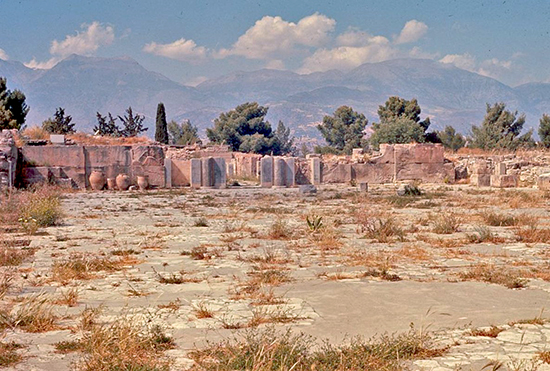
Ruins on Crete,
Knossos. Center of Minoan civilization. Castle with flush toilets,
sewage system, water piped in from 7 miles away
Library of Congress
Archaeology at Knossos
Evans started the dig at Knossos,
Minos' capital, in 1900 and found a fabulous palace, which was built
around 2000 BC and rebuilt after the earthquake of 1720 BC.
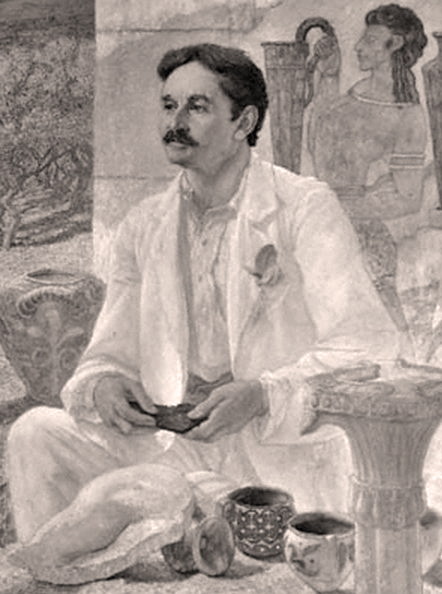
Sir Arthur John Evans
Portrait by Sir William Blake
Richmond, Ashmolean Museum, Oxford
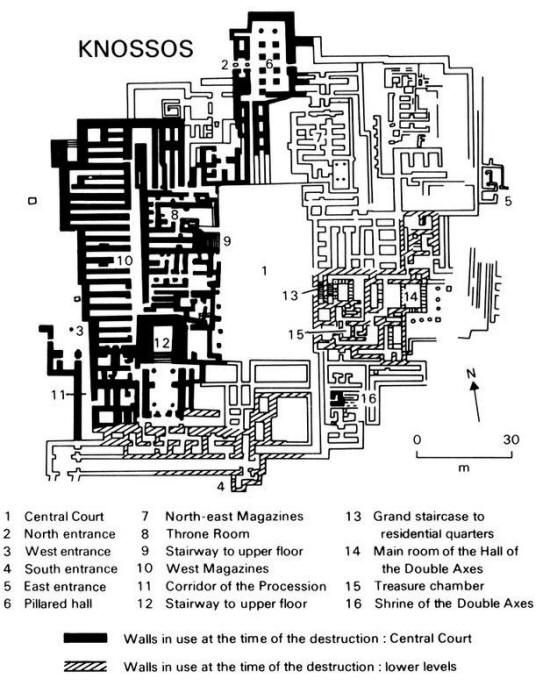
Knossos Palace Floor
Plan
University of Texas at Austin
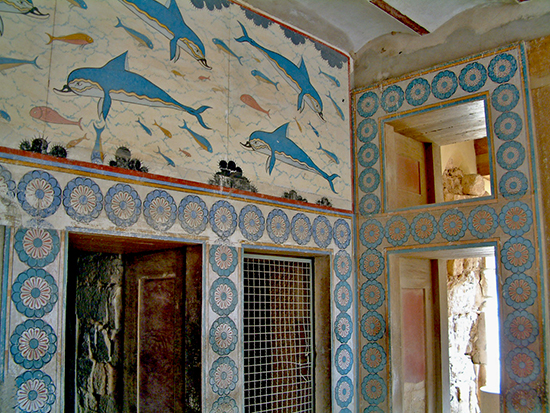
The Queen's Megaron
(Vestibule)
University of Texas at Austin
Minoan influence and dominance spread
onto the Greek mainland, and set the tone for the
Mycenaean civilization, folks
who had shuffled down from the north and settled in Greece.
The Minoan influence eventually faded
proportionally to the advance of the Mycenaean civilization, which
eventually returned the favor and controlled Crete.
Here is the map
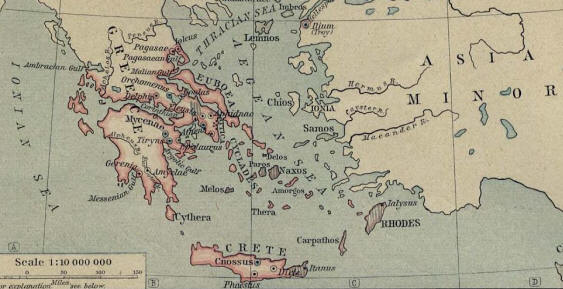
Ancient Crete and the Mycenaean civilization
Click map to enlarge
The Minoans in the
Stream of Time
Minoans seemed to have appeared around
2700 BC. The year 1600 BC roughly marked the pinnacle of the Minoan
civilization.
Around 1400 BC to 1100 BC Knossos',
and the Minoans', heyday was over. Someone or something had caused a serious fire.
The Language of the
Minoans
The Minoans spoke in an ancient Greek
dialect, Minoan. Their writings became known as Linear A and
Linear B forms.
Linear A has similarities with
Sanskrit, Hittite, and Armenian. Thus, it is categorized as one of
the Indo-European languages.
Linear B grew out of Linear A, also
called the Mycenaean dialect, and eventually became the forerunner
of Ancient Greek.
There also exists the Cretan
Hieroglyphic, still a head-scratcher for the pros at the language
desk.
Today's Cretans speak Greek.
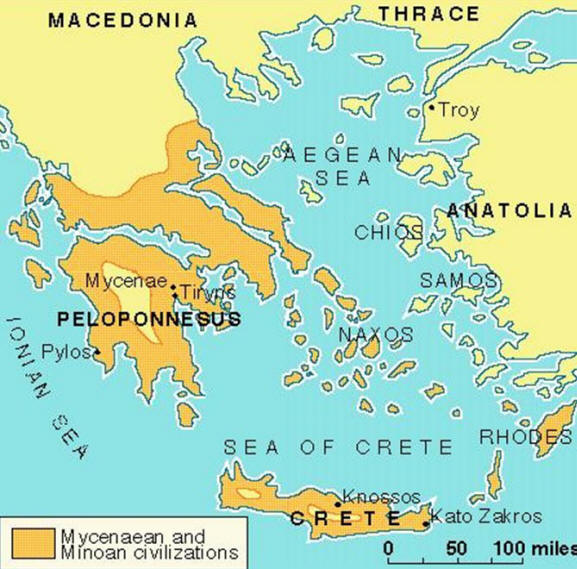
Mycenaean and Minoan
Civilizations
University of North Carolina at
Chapel Hill
And here is more on the
Ancient Greek Civilization.
More History
|