|
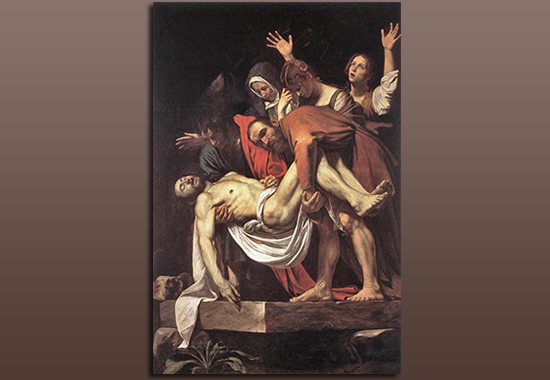
Christ's Deposition From the Cross
Jesus Christ
Not many men had an impact on humankind
like Jesus of Nazareth.
|
|
Image
Above
Christ's
Deposition From the Cross.
Also in the shot
are Nicodemus and John, who carry the body of
Christ, as well as Mary Magdalene, and Mary of
Cleophas with dramatic arms.
Caravaggio's
artwork, created circa 1600-1604, hangs in the Vatican. |
Jesus was born in Bethlehem, Judea (or Judaea,) around 6 to
4 BC. At the time of his birth, the country was officially
part of the
 Roman Empire, but governed
by
Herod
the Great, king of Judea.
Roman Empire, but governed
by
Herod
the Great, king of Judea.
Here is the map
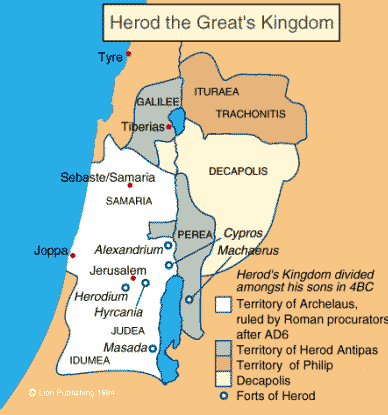
MAP OF HEROD'S KINGDOM
Click to enlarge
Jesus' mother was
Mary, his father
Joseph, a carpenter. The
family later settled in Nazareth.
Jesus grew up and became a carpenter
as well. But more importantly for many, he became Christ and
Messiah.
Terminology
Christ, by the way, stems from
the Greek word khristos, which is the equivalent to the
Aramaic meshiha and the Hebrew mashiah, which became
the English word Messiah. All of which meaning the same thing,
the anointed one.
Jesus' Life
Not completely unlike
Margaret
Thatcher, Jesus has done many things that you haven't.
One of Jesus' most famous speeches was the
Sermon on the Mount.
It is preserved in Matthew 5 to 7. Part of this sermon
is the Lord's Prayer, or Pater Noster.
This only made sense to Margaret, and consequently she followed suit
with her
Sermon on the Mound. The year? 1988.
What Language Did Jesus
Speak?
Encyclopaedia Britannica helps
us out:
Aramaic dialects survived into Roman
times, however, particularly in Palestine and Syria. Aramaic had
replaced Hebrew as the language of the Jews as early as the 6th
century BC.
Certain portions of the Old
Testament—i.e., the books of Daniel and Ezra—are written in
Aramaic, as are the Babylonian and Jerusalem Talmuds.
Among the Jews, Aramaic was used by
the common people, while Hebrew remained the language of
religion and government and of the upper class.
Jesus and the Apostles are
believed to have spoken Aramaic, and Aramaic-language
translations (Targums) of the Old Testament circulated. Aramaic
continued in wide use until about AD 650, when it was supplanted
by Arabic.
Tacitus on Christ
Consequently,
to get rid of the report, Nero fastened the
guilt and inflicted the most exquisite
tortures on a class hated for their
abominations, called Christians by the
populace. Christus, from whom the name had
its origin, suffered the extreme penalty
during the reign of Tiberius at the hands of
one of our procurators, Pontius Pilatus, and
a most mischievous superstition, thus
checked for the moment, again broke out not
only in Judæa, the first source of the evil,
but even in Rome, where all things hideous
and shameful from every part of the world
find their centre and become popular.
Accordingly, an arrest was first made of all
who pleaded guilty; then, upon their
information, an immense multitude was
convicted, not so much of the crime of
firing the city, as of hatred against
mankind. Mockery of every sort was added to
their deaths. Covered with the skins of
beasts, they were torn by dogs and perished,
or were nailed to crosses, or were doomed to
the flames and burnt, to serve as a nightly
illumination, when daylight had expired.
Nero offered his gardens for the spectacle,
and was exhibiting a show in the circus,
while he mingled with the people in the
dress of a charioteer or stood aloft on a
car. Hence, even for criminals who deserved
extreme and exemplary punishment, there
arose a feeling of compassion; for it was
not, as it seemed, for the public good, but
to glut one man's cruelty, that they were
being destroyed.
Cornelius
Tacitus, The Annals, Book XV, Chapter 44
Here is more about
Tacitus.
And here is more on the
Hebrews.
More History
|