|
Frequently Viewed Timelines

Mexican Revolution
Timeline

World War I Timeline

Russian Revolution
Timeline

World War II Timeline
|
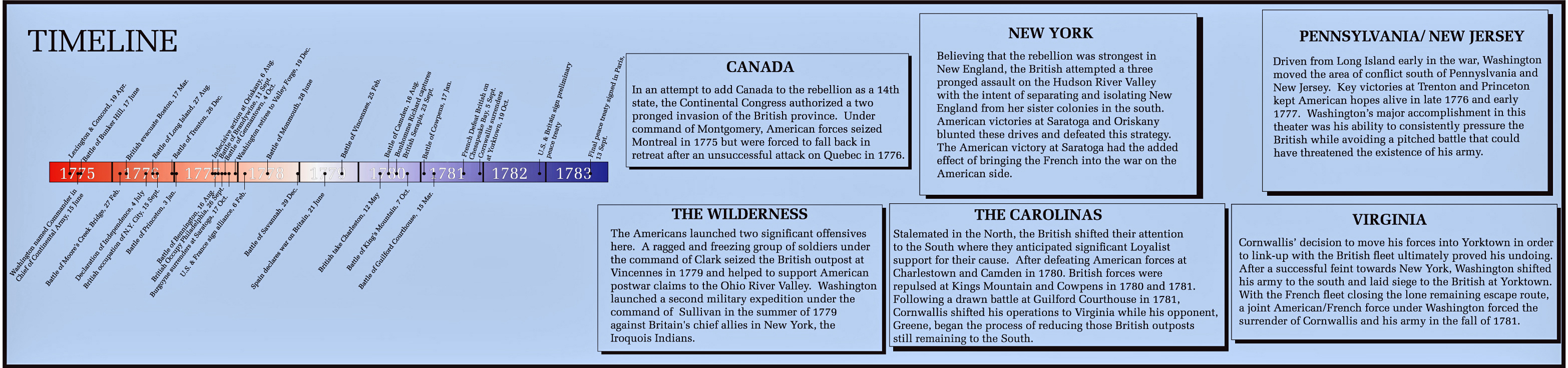
Timeline Description
American Revolution — Major
Events
Illustrating
Main
events from 1775 to 1783:
From the Battle at Lexington and
Concord on April 19, 1775, to the signing of the final peace
treaty at Paris on September 13, 1783.
Lexington & Concord, April 19, 1775
Washington named Commander in Chief of Continental Army,
June 15, 1775
Battle of Bunker Hill, June 17, 1775
Battle of Moore's Creek Bridge, February 27, 1776
British evacuate Boston, March 17, 1776
Declaration of Independence, July 4, 1776
Battle of Long Island, August 27, 1776
British occupation of N.Y. City, September 15, 1776
Battle of Trenton, December 26, 1776
Battle of Princeton, January 3, 1777
Indecisive action at Oriskany, August 6, 1777
Battle of Bennington, August 16, 1777
Battle of Brandywine, September 11, 1777
British occupy Philadelphia, September 26, 1777
Battle of Germantown, October 4, 1777
Burgoyne surrenders at Saratoga, October 17, 1777
Washington retires to Valley Forge, December 19, 1777
U.S. & France sign alliance, February 6, 1778
Battle of Monmouth, June 28, 1778
(First)
Battle of Savannah, December 29, 1778
Spain declares war on Britain, June 21, 1779
Battle of Vincennes, February 25, 1779
Bonhomme Richard captures British Serapis,
September 23, 1779
British take Charleston, May 12, 1780
Battle of Camden, August 16, 1780
Battle of King's Mountain, October 7, 1780
Battle of Cowpens, January 17, 1781
Battle of Guilford Courthouse, March 15, 1781
French Defeat British on Chesapeake Bay, September 5, 1781
Cornwallis surrenders at Yorktown, October 19, 1781
U.S. & Britain sign preliminary peace treaty, November 30,
1782
 Final peace treaty signed in Paris, September 13, 1783
(Part of the
1783 Peace of Paris)
Final peace treaty signed in Paris, September 13, 1783
(Part of the
1783 Peace of Paris)
Canada:
In an attempt to add
Canada to the rebellion as a 14th state, the Continental
Congress authorized a two pronged invasion of the British
province.
Under command of Montgomery, American forces seized Montreal in
1775 but were forced to fall back in retreat after an
unsuccessful attack on Quebec in 1776.
The Wilderness:
The
Americans launched two significant offensives here. A ragged and
freezing group of soldiers under the command of Clark seized the
British outpost
at Vincennes in 1779 and helped to support American postwar
claims to the Ohio River Valley. Washington launched a second
military expedition under the command of
Sullivan in the summer of 1779 against Britain's chief allies in
New York, the Iroquois Indians.
New York:
Believing that the
rebellion was strongest in New England, the British attempted a
three pronged assault on the Hudson River Valley with the intent
of
separating and isolating New England from her sister colonies in
the south. American victories at Saratoga and Oriskany blunted
these drives and defeated this strategy.
The American victory at Saratoga had the added effect of
bringing the French into the war on the American side.
The Carolinas:
Stalemated in the North, the British
shifted their attention to the South where they anticipated
significant Loyalist support for their cause. After defeating
American forces at Charlestown and Camden in 1780. British
forces were repulsed at Kings Mountain and Cowpens in 1780 and
1781. Following a drawn battle at Guilford
Courthouse in 1781, Cornwallis shifted his operations to
Virginia while his opponent, Greene, began the process of
reducing those British outposts still remaining to the South.
Pennsylvania / New Jersey:
Driven from Long Island early in the war, Washington moved the
area of conflict south of Pennsylvania and New Jersey. Key
victories at Trenton
and Princeton kept American hopes alive in late 1776 and early
1777. Washington's major accomplishment in this theater was his
ability to consistently pressure the British
while avoiding a pitched battle that could have threatened the
existence of his army.
Virginia:
Cornwallis'
decision to move his forces into Yorktown in order to link-up
with the British fleet ultimately proved his undoing. After a
successful feint towards New York,
Washington shifted his army to the south and laid siege to the
British at Yorktown. With the French fleet closing the lone
remaining escape route, a joint American/French
force under Washington forced the surrender of Cornwallis and
his army in the fall of 1781.
Credits
Courtesy of the United States
Military Academy Department of History.
Related Timelines
Timeline of the American Revolution (EK)
American Timeline
Related Links
About Abraham Lincoln
About the American Revolution
About the American Civil War
Map of the Campaigns of the American
Revolution 1775-1783
More History
 |

