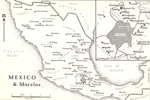
|
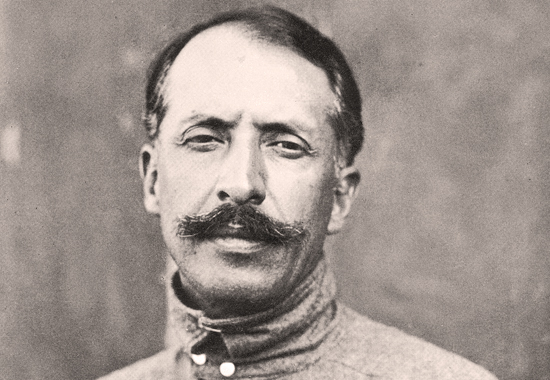
FELIPE ÁNGELES
1869 - 1919
Pancho Villa's
High-IQ General and Possibly the Best Trained
Soldier in the Revolution
Felipe de Jesús Ángeles Ramírez (Felipe Angeles) fought in the
 Mexican Revolution
and was noted for his humanity.
Mexican Revolution
and was noted for his humanity.
|
|
Felipe Ángeles publicly condemned the violence
and brutality committed by
Juvencio Robles
and Adolfo Jiménez
Castro and others.
Besides Spanish,
Felipe Angeles also spoke English, French, and German
fluently.
Felipe Ángeles' Family
Felipe Ángeles' father was
Felipe Ángeles Sr, who died in
1899.
|
Felipe Ángeles' mother was
Juana Ramírez.
Father Felipe was born in Molango,
Hidalgo, in 1824. He was a farmer and a livestock breeder.
He also fought in the
Mexican-American War and in the
French-Mexican
War and became a colonel in the process.
Felipe Ángeles fights for Francisco
Madero
After
Francisco I. Madero
came to power, Felipe Ángeles was
made Brigadier General. Among others, Felipe
fought against revolutionary
Pascual Orozco.
During the
Ten Tragic Days,
President Madero was desperate and turned to Felipe Ángeles
for help. But it was too late.
Victoriano Huerta's forces
arrested President Madero, Vice-President
Pino Suárez,
and Felipe Ángeles on February 18, 1913.
Felipe Ángeles was Huerta's prisoner
until July 29, 1913. He then was exiled to
France.
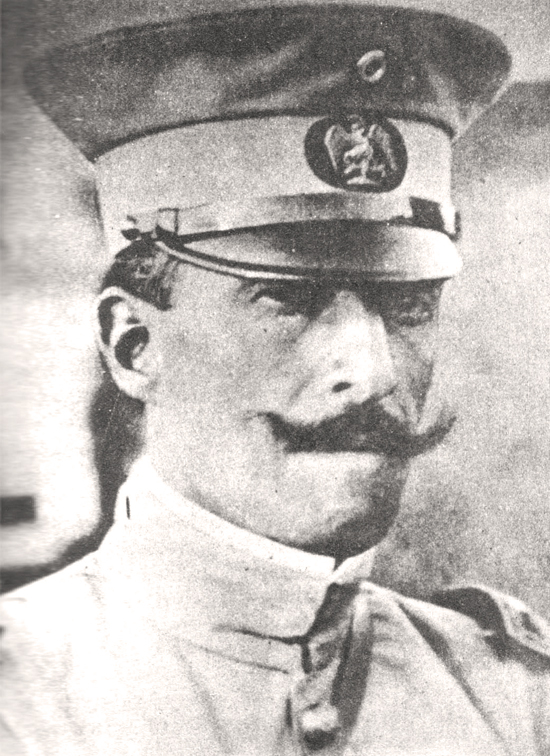
GENERAL FELIPE ÁNGELES
Instituto Nacional de Antropología e Historia
Felipe Ángeles fights for Venustiano
Carranza
In October 1913, Felipe Ángeles
sneaked back into Mexico and met with
Venustiano Carranza
who fought against Huerta. Huerta was overthrown
and Carranza made Felipe Ángeles his
Under-Secretary of War.
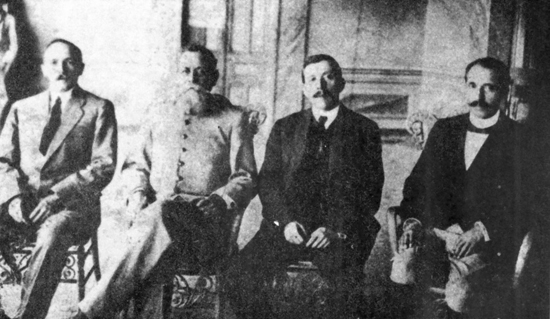
Venustiano Carranza with his
first cabinet, 1913
Left to right: Rafael Zubarán Capmany, Venustiano Carranza,
Francisco Escudero, Felipe Ángeles
Hemeroteca Nacional
Felipe Ángeles fights for Pancho
Villa
The
revolutionaries had a big pow-wow, the
Revolutionary
Convention of
Aguascalientes. The
Convention commenced on October 10, 1914.
During session on October 12, 1914, Ángeles
stated that the northern revolutionaries (the
División del Norte army, also called the
Villistas, led by
Pancho Villa)
were not prepared to come to any agreement
without their brother revolutionaries from the
south (the Ejército Libertador del Sur
army, also called the Zapatistas, led by
Emiliano Zapata) being
represented at this convention.
The convention
agreed and Felipe Ángeles was sent to fetch
them. See photo below.
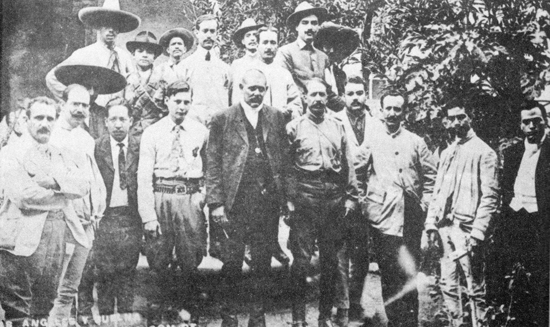
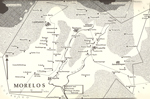
Felipe Ángeles invites Emiliano Zapata to the Aguascalientes Convention
Felipe Ángeles with the commission sent to
Morelos to invite
Emiliano Zapata
to participate in the Aguascalientes Convention.
Front row: Manuel Robles, Dr.
Adolfo Cuarón, Manuel Palafox,
Rafael Buelna,
Juan Banderas, Felipe
Ángeles, Octavio Magaña Cerda,
Antonio Díaz Soto y Gama, Calixto
Contreras.
Standing behind them: Col. Gustavo Baz, Juan Andrew
Almazán,
Dr. Briones and Guillermo Castillo Tapia.
Archivo Histórico, Universidad Nacional Autónoma de México
Felipe Ángeles' Death
Felipe Ángeles was
betrayed by one of his officers and on November
15, 1919, he was arrested by Carranza's feds.
Why was he arrested?
Let David Angeles
Albores, Felipe's great-great-grandson, explain:
After Carranza
took power, Felipe exiled himself to the
USA, where he travelled to New York (as is
my understanding, but this may be wrong) and
met with other Mexican leaders who had been
exiled by the new President.
While in the
USA, they integrated the Alianza Liberal
Mexicana, the Liberal Mexican
Alliance, and concocted the Plan of
Río Florido. Angeles then met with
Villa, and the rest of the story is known
from there.
Ángeles
was brought to Chihuahua City where he was put
on trial for treason.
Ángeles declared
at his trial, "My death will do more good to the
democratic cause than all the actions of my
life. The blood of the martyrs fertilizes the
good."
Felipe Ángeles was
convicted and sentenced to death by firing
squad. He was executed on November 26, 1919, in
Chihuahua City.
Check this event
in the
timeline of the Mexican Revolution.
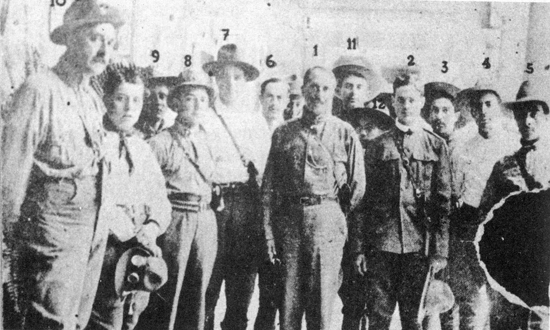
1 Felipe Ángeles, 2 Alfonso
Iturbide, 3 unknown,
4 Fernando Liceaga, 5 Próspero Ángeles. 6 Carlos Arango, 7 Rafael
Iturbide, 8. Eduardo Ángeles, 9 Roberto Morelos Zaragoza,
10. Dr. Wightman, 11. Eduardo Salomón
Hemeroteca Nacional
Felipe Ángeles' Legacy
In 1941 upon the
22nd anniversary of his death, Felipe Ángeles
was declared Hijo del estado de Hidalgo,
or Son of the State of Hildalgo.
They have also
written songs about Felipe. Check the top right
of this page for the video clip.
Historians
describe Felipe Ángeles as a kind, honest,
capable, humble, passionate man, and a top notch
adviser. Critics say he was ambitious.
Quoted
|
 |
Ángeles
taught me there was such a thing as
mercy.
Pancho Villa |

GENERAL FELIPE ÁNGELES
Archivo Cassola
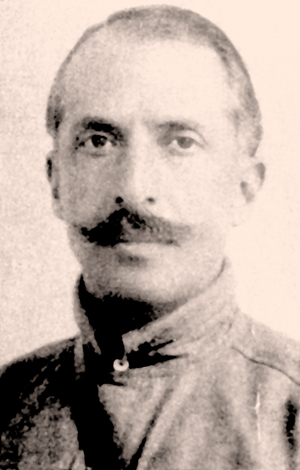
GENERAL ÁNGELES, ONE FOR THE DRIVER'S LICENSE
Archivo Histórico,
Universidad Nacional Autónoma de México
|
Felipe Ángeles' Short Biography |
|
|
|
|
|
June 13, 1868 |
|
Birth
in Zacualtipan (some say Molango), Hidalgo, Mexico |
|
|
|
Primary
education in Huejutla, Molango,
and Pachuca |
|
1883 - 1892 |
|
Military School
made possible thanks to a
scholarship granted by dictator
Porfirio
Diaz, who
gave it as a gift to Felipe's father as a
thank-you for his services |
|
|
|
Military
Studies in the US |
|
1908 |
|
Becomes Colonel |
|
1909
|
|
Military
Studies in France |
|
1911 |
|
Francisco I. Madero makes him
director of the Military College at
Chapultepec, the Colegio Militar
de Chapultepec |
|
|
|
Becomes Brigadier General |
|
July 1913 |
|
Gets exiled to France
after Victoriano Huerta took over |
|
October 1913 |
|
Sneaks back into the country, meets
with Venustiano Carranza, breaks
with Carranza, joins Pancho Villa |
|
January 6 - 12, 1915 |
|
Provisional governor of Coahuila |
|
December 1915 |
|
After
Villa was defeated by Carranza, Ángeles
crosses border and settles down in
El Paso, Texas. If he had only
stayed there... |
|
End of
1918 |
|
Back
to Mexico, meets with Villa and
joins the revolution against
Carranza. |
|
November 15, 1919 |
|
Arrested |
|
November 26, 1919 |
|
Death
in Chihuahua |
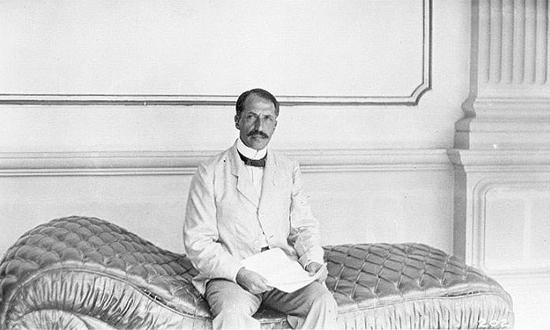
FELIPE ÁNGELES ON CHAISELONGUE
El
Paso Library
Go here for more about the
Mexican Revolution.
More History
|