|
Thirty Years' War 1618 - 1648
The Thirty Years' War is sometimes also called
The European
Civil War. It was a series of battles fought over most of
Europe, although the primary battleground was Germany.
|
|
Here are two maps of Germany at the
beginning of the Thirty Years' War:
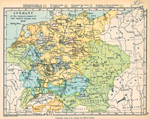
1618 Germany
Click map to enlarge
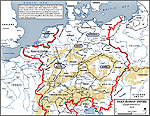
Holy Roman Empire 1618
When Did the Thirty Years' War Begin?
On May 23, 1618, a crowd of Protestants stormed the royal
castle in Prague and threw two members of the Catholic
government and their secretary out the window.
This incident became known as the Defenestration of Prague and
marked the official beginning of the Thirty Years' War.
|
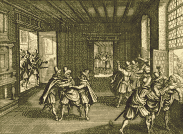
The Defenestration of Prague in
1618
Although none of the three people died, this incident set in
motion a series of events that stirred up almost the whole of
Europe for 30 years.
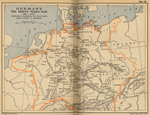
GERMANY 1619
Click to enlarge
When Did the Thirty Years' War End?
The war officially ended on October 24, 1648, with the
 Peace of
Westphalia.
Peace of
Westphalia.
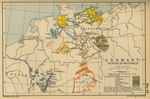
1648 Germany - Peace of Westphalia
What Impact Did the Thirty Years' War Have?
The Thirty Years' War basically shaped the map of modern
Europe as we know it today. It also changed European balance
of power radically.
The member states of the
Holy Roman Empire were granted full
sovereignty. The essential structure of modern Europe as a
community of sovereign states was established.
After the two World Wars, the Thirty Years' War has been the
third most traumatic period in the history of Germany.
THE BATTLES OF
THE THIRTY YEARS' WAR
Approximately 40 battles were fought during the Thirty Years’
War. Some of them were:
The Battle of White Mountain,
also called Battle of White Hill, November 8, 1620. Imperial victory.
Ferdinand II won, Frederick V lost.
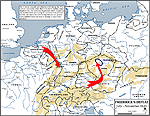
Thirty Years War: Frederick's Defeat 1620
The Battle of Breitenfeld
- September 17, 1631. The first major victory for the
Protestants. Gustav II Adolf of Sweden sent Ferdinand II and
the Catholics packing.
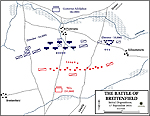
Map of the Battle of Breitenfeld - Initial Disposition
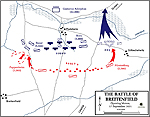
Battle of Breitenfeld - Opening Moves
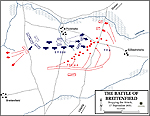
Battle of Breitenfeld - Stopping the Attack
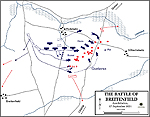
Battle of Breitenfeld - Final Moves
The Battle of Lützen
- November 16, 1632. Imperial defeat. Ferdinand II
lost, the Swedes won but lost their king Gustavus Adolphus.
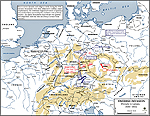
1630-1632 Thirty Years War - Prelude to the
Battle of Lutzen
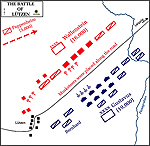
Map of the Battle of Lützen (Lutzen)
The Battle of Nördlingen
- September 5 - 6, 1634. Decisive victory for the
Empire and Spain over the Swedes. This battle ended the
Swedish domination in southern Germany, and forced
Richelieu
to bring France into active participation in the war.
The
Battle of Wittstock - October 4, 1636. Swedish victory, led
by General Johan Banér.
The Battle
of Rocroi - May 19, 1643. The French army of 22,000 men, led
by the Duke D'Enghien,
defeat the Spanish army of 26,000 men, led by Don Francisco de
Melo.
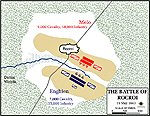
Map of the Battle of Rocroi
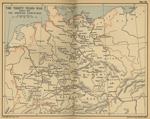
GERMANY 1630 - 1648
Click to enlarge
Who Won the Thirty Years' War? Who Lost?
The winners of the war were Sweden, which gained control over
the Baltic; France, which became the chief Western power; and
the United Netherlands, which became an independent republic.
The losers of the war were Austria and Spain, which lost their
dominant political positions. Spain also lost the Netherlands.
The ultimate loser of the war, however, was Germany. Its
cities, economy and population suffered greatly.
Estimates vary as to the exact number of German lives lost in
the Thirty Years’ War. Some rough estimates are as high as 12
million.
And here is another map of Germany in
1648:
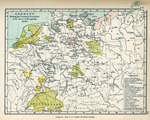
Germany 1648
Click map to enlarge
Why Was the Thirty Years' War Fought?
Originally, the issue was of a religious nature. Protestants,
and later Calvinists, wanted religious freedom from the ruling
Catholics.
The matter soon got out of hand because other
issues were involved, including the struggle for political,
territorial, and commercial control.
Here is a
timeline of the Thirty Years' War.
More History
|