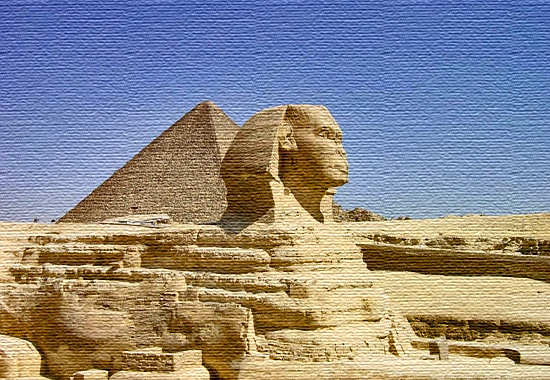
The Great Sphinx and
the Great Pyramid at Giza
The Civilization
of Ancient Egypt
The civilization of the ancient Egyptians
started roughly around the year 3100 BC.*
|
|
Given its old age, a lot of
details still remain guess work. But knowledge
continues to grow as archaeologists keep
digging.
The study of
ancient Egypt is
called Egyptology.
And if you're any good at it, you are probably an
Egyptologist.
 Jean-François Champollion
was a famous Egyptologist. So was
Howard Carter.
Jean-François Champollion
was a famous Egyptologist. So was
Howard Carter.
*=
For exact dates of all dynasties see
Governments of Egypt.
The Pyramids
The ancient
Egyptians built pyramids to store their deceased. However, pyramids
were also built in other parts of the world, for instance in Mexico.
One of the most famous sites of
Egyptian pyramids is Giza, or Gizeh, where you can visit three
pyramids that had been built around the year
2,500 BC.
Considered one of the
Seven Wonders of the World, one
of these pyramids is called the
Great
Pyramid, or the
Khufu or Cheops Pyramid, named after the
pharaoh under which the monument was constructed. While there, you
can also check out the Great Sphinx.
See a picture of the Great Sphinx and
the Great Pyramid at the top of this page.
|
So, Who Built the Pyramids?
Contrary to common believe, the slaves
didn't built the pyramids.
Good Egyptian farmers,
who were sitting at home without TV during the season when the Nile was flooding their
fields, were the construction force behind the famous monuments.
Building pyramids required a load of workers.
Hence, cities were founded wherever workers for respective projects
were housed, e.g. Giza,
Kahun, Amarna, and
Deir el Medina.
The Mummies
Just like the pyramids, mummies can also be found in other parts of
the world because the ancient Egyptians weren't the only ones who
mummified their dead.
Why and how did they mummify? Find out
all about
Mummies.
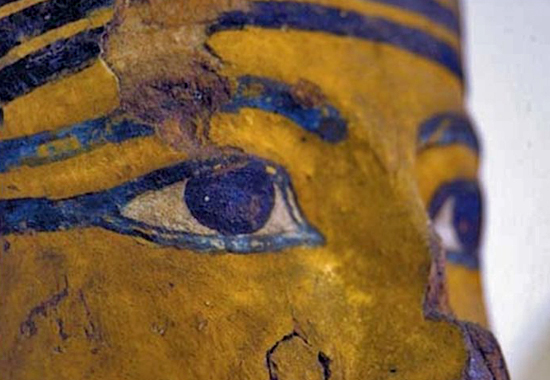
ANCIENT EGYPT -
CUSTOMS AND BELIEFS
PETRIE MUSEUM OF EGYPTIAN ARCHAEOLOGY
The Country
Ancient
Egypt was divided into Upper Egypt and
Lower Egypt, as well as into the
East Bank of the Nile and the
West bank of the Nile.
Here is the map:
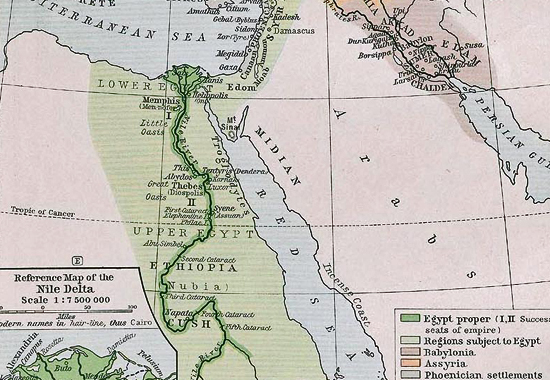
MAP OF ANCIENT EGYPT
Click to enlarge
Entire Egypt was furthermore divided into 42 states or provinces, called nomes.
The Nile River
The Nile
River is the
longest river in the world, running 4,132 miles or 6,650 kilometers long
from Lake Victoria in the south to the Mediterranean Sea in the
north.
The annual flood season of
the Nile in the northern parts lasts from July to October and floods
both sides of the river with up to two feet of water. When the river
recedes, it leaves behind fertile black mud (silt).
The term Nile Valley
is
often used as a synonym for ancient Egypt.
Here is a map of the Nile River:
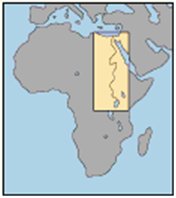
MAP OF THE NILE RIVER
Encyclopædia Britannica
The Paper
Around 3,250 BC, the Egyptians came up
with papyrus reeds. Thus, at that time the first known paper had just been produced in
Egypt.
The Hieroglyphs
Hieroglyphs
are the pictures in the writing on ancient Egyptian monuments.
The Egyptians started developing it around 3,200 BC.
It
took until the early 19th century to decipher these signs.
Jean-François Champollion
provided the brilliant brains that made it happen.
See more under
Rosetta Stone.
The Pharaohs
Around
1,500 BC, the kings (or queens) of ancient Egypt started to be
called pharaohs. The word pharaoh means great house
and was originally the name of the royal palace.
Pharaohs claimed to be divine and were
regarded as the link to the gods.
Some of ancient Egypt's famous queens
were Tiy, who was the wife of
king Amenhotep III (reigned 1390
- 1353 BC) and Nefertiti, who
was Akhenaton's wife (reigned
1353-1336 BC).
Another famous queen of Egypt was
Cleopatra who entered
the stage long after Egypt's glory days.
See the detailed chronology of
dynasties under
Governments of Egypt.
The Dynasties
Ancient
Egypt's history is divided into 30 or 31 dynasties. It was the Egyptian
priest and historian
Manetho,
who came up with this idea.
See the index of all Egyptian
dynasties under
Governments of Egypt.
What Else?
-
Ramses II was pharaoh at
the time when
Moses and
Aaron asked to let the Hebrews
go (see Bible).
-
Wigs were worn in ancient Egypt by
both sexes. The same was true for cosmetics, which was cheerfully
used by both, men and women.
-
The examination of mummies tells us
that the ancient Egyptians suffered from arthritis, tuberculosis,
gout, tooth decay, bladder stones, and gallstones.
-
For an
ancient version of an Egyptian men's
magazine see the
Turin Erotic Papyrus at
the Fondazione Museo Delle Antichita
Egizie (Museo Egizio / Egyptian Museum)
at Turin, Italy.
More History
|